
You showed up. You sat on the couch. You talked. And it still didn’t work.
That kind of disappointment cuts deep—not just because therapy didn’t help, but because it made you wonder if you’re the problem.
You’re not.
This is for the person who’s been told therapy should help, but felt no shift.
For the person who tried to open up but left feeling raw, exposed, and unchanged.
EMDR Therapy isn’t talk therapy. It’s something different. And for a lot of people who feel like they’ve “tried everything,” it’s the first thing that actually helps.
When Therapy Feels Like Another Failure
It’s hard to explain the kind of shame that comes with “doing the work” and still not feeling better.
You don’t just feel discouraged. You feel defective.
You wonder:
- “Am I just too damaged?”
- “Did I not try hard enough?”
- “Is something wrong with me that therapy couldn’t fix?”
Here’s the truth: Talk therapy is a powerful tool—but it isn’t the right tool for everyone, especially when trauma lives deeper than language.
You didn’t fail. Your therapy style just didn’t fit the way your pain works.
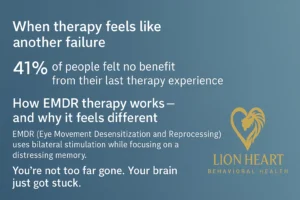
How EMDR Therapy Works—And Why It Feels Different
EMDR stands for Eye Movement Desensitization and Reprocessing. But don’t let the clinical name intimidate you—EMDR is surprisingly simple in practice.
It works by using bilateral stimulation (like side-to-side eye movements, tapping, or sound) while you focus on a memory or feeling that feels “stuck.”
What does that do?
Your brain has a natural healing process—just like your body does. But when trauma hits, that process can freeze. EMDR helps your brain unfreeze those stuck moments, so they can finally move through and out.
And the best part?
You don’t have to relive everything or “talk it out” for it to work.
If You’ve Tried Therapy Before, You’re Not Starting Over
One of the hardest things about trying a new approach is the fear that you’re going back to square one.
You’re not.
In fact, EMDR often works better when people have tried therapy before. You already have some self-awareness. You’ve done the hard work of naming your pain. Now, you get to let your brain finish the healing it was always trying to do.
It’s not a do-over.
It’s the next layer.
EMDR Doesn’t Require You to Perform
There’s an unspoken pressure in talk therapy to “show up” emotionally. To dig deep. To articulate what you’re feeling. To be brave enough to go there—week after week.
For some people, that feels possible. For others, it’s too much, too soon, or just not the way they’re wired.
EMDR doesn’t ask you to explain everything.
It meets you where your nervous system already is—overwhelmed, alert, maybe shut down. And it works with that.
We’ve had clients say EMDR was the first time they felt like they could actually rest in therapy. No pressure to explain. Just the freedom to feel, process, and move through—on their terms.
You’re Not Too Far Gone. Your Brain Just Got Stuck.
Trauma isn’t always dramatic. Sometimes it’s subtle, chronic, or happened so long ago you don’t even know it’s still affecting you.
EMDR helps with:
- Childhood emotional neglect
- Medical trauma
- Grief and loss
- Assault or abuse
- Panic attacks and anxiety
- PTSD symptoms
- Feeling frozen or emotionally flat
What these all have in common: they overwhelm the brain’s ability to process. EMDR helps finish that process.
You’re not too broken. You’re not unfixable. You’re not too late.
You’re just stuck—and EMDR is a tool to help you get unstuck.
What EMDR Therapy Looks Like at Lion Heart
At Lion Heart Behavioral Health in Raynham, Massachusetts, our EMDR-trained clinicians take things at your pace. Always.
You won’t be rushed into trauma work before you’re ready. We start by helping you feel safe in the room—with your therapist, and with yourself.
What you can expect:
- An intake to explore whether EMDR is a good fit
- Preparation sessions to build trust and coping tools
- A gentle explanation of how EMDR works—no jargon, no pressure
- Trauma processing sessions when you are ready
- Follow-up integration to help the healing stick
We see clients who were skeptical, anxious, even cynical. And many say the same thing afterward:
“This felt different.”
EMDR Therapy Is Available in Raynham, Massachusetts
If you live in or near Raynham and you’ve been wondering if something could finally help—this might be it.
You can explore EMDR here without a long-term commitment or pressure to stay if it doesn’t feel right. We offer it as part of a broader range of mental health therapy programs—so you can find what fits. If you’re near New Bedford, or Bristol County, Lion Heart offers programs with that same approach.
FAQ: EMDR Therapy for the Treatment Skeptic
Do I have to believe in EMDR for it to work?
No. This isn’t a placebo-based treatment. EMDR is clinically backed and neurologically based. Many people come in doubtful—and still experience noticeable relief.
How long does EMDR therapy take?
It varies. Some clients see shifts in just a few sessions, while others need more time to build trust or process complex trauma. We’ll go at your pace, not a set timeline.
Will I have to talk about the trauma in detail?
Not in the way you might think. Unlike talk therapy, EMDR allows you to process without giving a full play-by-play. You’ll focus on the memory—but you don’t have to explain everything out loud.
What if I feel nothing or shut down during a session?
That’s okay. EMDR works with whatever state you’re in. Your therapist is trained to guide you gently, even if you’re feeling flat, numb, or overwhelmed. You don’t have to “feel a certain way” for it to work.
Is this offered locally?
Yes—EMDR Therapy is available right here in Raynham, Massachusetts, at Lion Heart Behavioral Health. Our licensed clinicians are trained and experienced in using EMDR with clients who’ve struggled in other therapy settings.
You Tried Before. That Still Counts.
Trying again doesn’t erase how hard it was last time.
But it might change what happens this time.
And if EMDR isn’t the right fit—we’ll tell you that, too. Honestly. Kindly. Without pressure.
📞 Call (774)238-5533 or visit our EMDR Therapy program page to learn more or schedule a conversation. You don’t have to commit. Just reach out.