
When you’re newly stepping into alcohol addiction treatment, everything can feel… raw. You’re navigating loss—of habits, of control, maybe of people you love. The idea of adding medication into the mix? It can feel overwhelming. Foreign. Even threatening.
At Lion Heart Behavioral Health, I’ve had clients look me in the eye, tears welling up, and whisper: “I’m scared it’ll change who I am.”
Let’s talk about that fear. Not to push past it. To honor it. Because being scared doesn’t mean you’re weak—it means you care about staying you. And that’s exactly why it’s worth talking through.
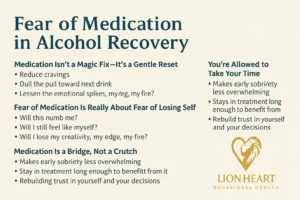
Medication Isn’t a Magic Fix—It’s a Gentle Reset
One of the biggest myths I see around medication in alcohol recovery is that it somehow “fixes” addiction. That’s not how it works—and that’s not what we’re aiming for.
What medication does—when used intentionally, as part of a comprehensive alcohol addiction treatment plan—is help your nervous system come up for air.
It can:
- Reduce cravings
- Dull the pull toward the next drink
- Lessen the emotional spikes that send you searching for relief
And most importantly? It helps create space. Space to heal. Space to decide. Space to reconnect with the part of you that wants something more.
Fear of Medication Is Really About Fear of Losing Self
Most people aren’t scared of the pill. They’re scared of what it means.
- “Will this numb me?”
- “Will I still feel like myself?”
- “Will I lose my creativity, my edge, my fire?”
These are not irrational fears. If you’ve spent years coping with alcohol, it likely became part of how you felt things—how you survived them. So of course the idea of taking a medication that changes your brain feels threatening.
But here’s what I’ve seen in practice:
Medication doesn’t erase the real you. It helps clear the fog so you can find you again.
Think of it less like a mask, and more like a lens wipe. It helps the world (and your choices) come into focus again.
“I Don’t Want to Feel Like a Zombie.” (And You Shouldn’t.)
This is one of the most common fears I hear—especially from people who’ve been on antidepressants or other meds that made them feel flat in the past.
That fear matters.
The good news? Alcohol treatment medications are not designed to sedate you. They don’t “shut you down.” They’re not one-size-fits-all. Options like naltrexone, acamprosate, or disulfiram work in different ways—and we don’t just hand you a bottle and say, “Good luck.”
At Lion Heart, we start slow. We talk about what matters to you. We check in. We adjust. And if something feels off? You get to say so. We’ll work with you—not around you.
You’re Allowed to Take Your Time
There’s no rule that says medication has to be your first step. Some people explore therapy and support groups first. Others want to begin with cravings support.
Alcohol addiction treatment is a relationship, not a prescription pad. We’re here to walk with you, not hand you a to-do list.
We’ve had people in Raynham, New Bedford, and all over Bristol County who spent a month just asking questions. That matters. That counts.
There’s no “right timeline.” There’s only your timeline.
Medication Is a Bridge, Not a Crutch
You may not need medication forever. In fact, many clients use it as a temporary support—a bridge from instability to balance.
Here’s what that bridge can help with:
- Making early sobriety less overwhelming
- Staying in treatment long enough to benefit from it
- Rebuilding trust in yourself and your decisions
It doesn’t mean you’re “weak” or “not doing the work.” It means you’re using the tools available to build something better.
What If It Doesn’t Work for You?
This is the scariest what if for many people:
“What if I try—and it still doesn’t help?”
Here’s my answer: then we try something else.
Your voice is central in this process. You don’t lose autonomy when you choose to try medication—you gain collaboration. If something doesn’t feel right, you say so. If a med has side effects, we hear you. If it helps in some ways but not others, we problem-solve with you.
You’re not stuck. You’re supported.
Real Talk: You’re Not Broken for Being Scared
Let me say this plainly:
Being scared to take medication does not make you difficult. It makes you thoughtful.
You’ve been through things. Your fear likely comes from a place of self-protection, not sabotage. And that instinct—to protect yourself—isn’t wrong.
At Lion Heart, we work with that instinct. We slow things down. We never force or shame. And we never assume that fear means “no.” Sometimes it just means: “Not yet.” And that’s perfectly okay.
FAQ: Medication in Alcohol Addiction Treatment
Is medication required to begin treatment?
No. Medication is always optional. We’ll talk through the options and respect whatever choice you make. Many clients start without medication and add it later—or never.
Can I stop taking it if I don’t like how it makes me feel?
Absolutely. We monitor your experience closely, and if something doesn’t feel right, we adjust. You have full say in your treatment plan.
What if I don’t believe in medication at all?
That’s okay too. Alcohol addiction treatment includes multiple pathways. Therapy, peer support, trauma work, and life skill building are just as core to the recovery process.
How long would I need to be on medication?
That depends on your unique needs and goals. Some use it short-term to get through early sobriety; others benefit from longer use. There’s no one-size-fits-all timeline.
What if I’ve had bad experiences with psych meds before?
Your past experiences matter, and we want to hear about them. Medications for alcohol recovery often work differently than psychiatric meds—and you’re always in control of what you try.
📞 Still unsure? We’re ready when you are.
Call (774) 341-4502 or visit our Alcohol Addiction Treatment program in Raynham, Massachusetts to explore your options. Whether you choose medication, therapy, or just want a conversation—we’re here to support your next right step.