
You made it 90 days—and then everything got harder.
If that sentence hits a nerve, you’re not alone. For many alumni of alcohol addiction treatment programs, the 90-day mark brings not relief, but reckoning. The pink cloud fades, the applause dies down, and you’re left staring at the life you’re supposed to be excited about—but don’t recognize yet.
At Lion Heart Behavioral Health, we know this part of recovery hits differently. If you’re in Raynham or anywhere in Massachusetts, and you’ve relapsed—or are afraid you might—you still belong here.
90 Days Isn’t a Finish Line—It’s a Reveal
In the first few weeks of sobriety, everything is urgent: detox symptoms, managing triggers, showing up to treatment or meetings. You’re fighting for your life—and you can feel it.
But once you clear that initial chaos, something quieter sets in. Around 90 days, the dust settles. And for the first time, you’re sober and stable enough to feel.
Memories come back sharper. Regrets get louder. You realize alcohol wasn’t just something you quit—it was a relationship, a routine, and a way to survive. Now that it’s gone, what’s left?
That question can unearth pain you never had to sit with before. And if you weren’t expecting it, it can knock the wind out of you.
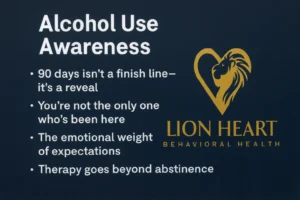
The Emotional Weight of Expectations
People start looking at you differently after 90 days. They smile more. They tell you how proud they are. Some may even say you “beat it.”
But what if you don’t feel proud? What if you’re exhausted, raw, and secretly terrified you can’t keep this up?
There’s an unspoken expectation that by 90 days, you should be fine. But for many, it’s when the real work begins. The external chaos has quieted—but inside, the noise gets louder.
If you slipped—or if you’re close to slipping—it doesn’t mean you weren’t strong enough. It means this part is hard. Because it is.
“I Thought I’d Feel Better By Now”
We hear it from alumni all the time:
“I did everything right. I went to group. I journaled. I even started working again. But I still felt hollow.”
This is where relapse often happens—not out of rebellion, but desperation. When the progress feels invisible and the emotions feel unbearable, old habits start whispering comfort.
If that’s you, we want you to know: you’re not starting over. You’re continuing. Just with more honesty than before.
Your Pain Doesn’t Mean You’re Failing
Shame tells you that relapse means you ruined it. That all your progress is gone. That you can’t go back to treatment because “you should’ve known better.”
Shame lies.
You didn’t lose your insight. You didn’t unlearn your tools. You’re not back at Day 1—you’re just at a different part of the path. And you’re not the only one who’s been here.
At Lion Heart Behavioral Health in Raynham, MA, we build space into our programs for exactly this: the real, messy, human part of recovery that comes after the big milestones.
Why 90 Days Is a Dangerous Myth
We’ve glorified 90 days like it’s a finish line. But in reality, it’s a doorway. And not everyone is ready to walk through it alone.
By this point, external support often starts to drop off. Your team might step back. Friends and family may assume you’re “good now.” But inside, the battle is still raging.
At this stage, what many people need isn’t less care—it’s deeper care. More emotional support. Space to process identity shifts, grief, and the terrifying question: Who am I without alcohol?
This is where ongoing support—like recovery coaching—can make a meaningful difference, helping you stay connected and supported as your life continues to evolve.
What Our Alcohol Addiction Treatment Program Offers After 90 Days
At Lion Heart, our Alcohol Addiction Treatment in Raynham doesn’t end when the pink cloud fades. We offer:
- Alumni Re-engagement Support for those who relapsed or stepped away
- Therapy that goes beyond abstinence—including trauma work, grief support, and identity reconstruction
- Group programming that normalizes the 90-day wall instead of shaming it
- Family and relationship support to help rebuild trust without pressure
- Recovery coaching to provide ongoing accountability, structure, and support in daily life beyond formal treatment
This isn’t just about staying sober. It’s about helping you feel human again.
If You Relapsed After 90 Days, You’re Still Welcome
You don’t need to rehearse your apology. You don’t need a dramatic comeback story. You just need to walk through the door—again.
And if you’re in Bristol County or looking for Alcohol Addiction Treatment in New Bedford, MA, we’re here, too. Every community deserves compassionate support, especially when the milestones get messy.
Peer Quote: What It’s Like to Come Back
“Coming back after relapse was harder than starting the first time. I thought I’d walk in and be met with silence or judgment. But instead, someone hugged me. No words. Just held me for a second longer than I expected. That hug saved my life.”
– Alumni Client, 2023
FAQ: Alcohol Addiction Treatment & Relapse After 90 Days
What should I do if I relapsed after 90 days sober?
You don’t have to figure it all out today. Reach out for support—whether it’s a friend, a therapist, or a treatment center like Lion Heart. The most important thing is reconnecting before shame builds too high.
Does relapse mean my treatment didn’t work?
No. Relapse can happen even with excellent treatment—it often signals that something deeper still needs healing. It doesn’t mean your recovery was fake or wasted.
Can I go back to treatment even if I left before?
Absolutely. We welcome returning clients with open arms. Our approach recognizes that recovery is not linear—and sometimes, it takes a few tries to find what truly sticks.
Is 90 days really the hardest part for everyone?
Not for everyone—but it’s common. At 90 days, emotional clarity returns, but coping skills may still be underdeveloped. That combo can feel overwhelming. Support during this stage is crucial.
Do you offer services for alumni who relapsed?
Yes. Lion Heart offers alumni re-engagement, therapy, and intensive outpatient options tailored for people returning after a relapse.
For many people, coming back doesn’t always mean starting over in a full program. Sometimes, it means adding the right layer of support to what you’ve already built.
Recovery coaching can help you stay on track, rebuild confidence, and navigate the day-to-day challenges that come after early milestones.
You Don’t Have to Be “Okay” to Come Back
Relapse doesn’t erase your story. It deepens it. And you don’t have to earn your place in recovery again—you already have it.
Call (774) 341-4502 or explore our recovery coaching program to get support that meets you where you are—not where you think you should be.