
I remember the exact moment I realized I couldn’t do it alone.
Not because I hit some dramatic rock bottom.
Not because my life completely fell apart.
Because I was tired.
The kind of tired that settles deep into your bones.
The kind that makes simple decisions feel heavy.
The kind that comes from spending months trying to convince yourself you’re okay when you’re not.
Ninety days earlier, I thought I had finally figured things out.
Ninety days without falling back into old patterns.
Ninety days of rebuilding trust.
Ninety days of feeling like maybe, just maybe, I was becoming the person I wanted to be.
Then life happened.
Stress piled up.
Anxiety got louder.
Sleep became harder.
The thoughts I thought I’d left behind started creeping back in.
And eventually, I found myself staring at a setback I never thought I’d face again.
What surprised me wasn’t the disappointment.
It was the shame.
Not just because I had struggled.
Because I needed help again.
For many alumni, that’s the part nobody prepares you for.
The fear isn’t always about what happened.
It’s about what it means.
When I began looking at anxiety-focused treatment options, I wasn’t asking whether support could help.
I was asking whether I had enough energy left to try.
I Thought Needing Help Again Meant I Had Failed
That’s where my mind went immediately.
I told myself I should know better by now.
I should have stronger coping skills.
I should have been able to handle things differently.
I should not be back here.
Maybe you’ve had those thoughts too.
They’re common after a setback.
Especially for people who have already worked hard on their mental health.
The problem is that shame is a terrible teacher.
It doesn’t help you heal.
It doesn’t help you move forward.
It simply convinces you that asking for support is proof you’ve done something wrong.
For weeks, I treated myself like someone who had failed a test.
Looking back, I wasn’t failing.
I was struggling.
There’s a difference.
And that difference matters.
The Hardest Part Wasn’t Admitting I Needed Support
The hardest part was admitting I couldn’t handle another full-day schedule.
That felt embarrassing.
Part of me believed that if I was serious about recovery, I should be willing to do whatever was necessary.
Even if it overwhelmed me.
Even if it wasn’t realistic.
Even if I knew I probably couldn’t sustain it.
Many people carry this belief.
They assume the best support is always the most intensive support.
But recovery doesn’t work that way.
The best support is the support you can actually engage with.
The support you can show up for consistently.
The support that fits your life instead of requiring you to disappear from it completely.
At the time, I didn’t understand that.
I thought asking for something different meant asking for less.
What I eventually learned is that asking for the right fit isn’t weakness.
It’s wisdom.
Anxiety Had Quietly Taken Over My Life
The strange thing about anxiety is that it rarely announces itself dramatically.
It sneaks in.
A little more worry.
A little more overthinking.
A little more self-doubt.
At first, it feels manageable.
Then one day you realize you’re spending more time inside your head than inside your life.
That was me.
I analyzed every conversation.
Replayed every mistake.
Prepared for problems that never happened.
Questioned every decision.
By the end of each day, I felt emotionally exhausted.
People often assumed I was functioning because I was still going to work and meeting responsibilities.
What they couldn’t see was how much energy it required.
I wasn’t living.
I was managing.
There’s a difference.
And eventually, managing becomes exhausting.
The Relief Came From An Unexpected Place
When I first considered evening support, I worried it wouldn’t be enough.
That concern kept me stuck.
I thought I needed something bigger.
More dramatic.
More intense.
What I discovered instead was that consistency mattered more than intensity.
I could attend after work.
I could maintain responsibilities.
I could continue participating in my life while still receiving meaningful support.
That mattered more than I expected.
Because recovery isn’t just about what happens in treatment.
It’s about what happens between sessions.
It’s about practicing new skills in real situations.
It’s about learning how to handle difficult moments while still living your life.
For me, that made all the difference.
Hearing Other People’s Stories Changed Mine
One thing nobody prepared me for was how powerful it would feel to hear other people describe experiences that sounded like my own.
Someone talked about panic attacks.
Someone talked about shame.
Someone talked about feeling like they had disappointed everyone.
Someone talked about being afraid to ask for help again.
And suddenly I didn’t feel so alone.
For months I had treated my struggles like evidence that I was uniquely flawed.
Listening to others helped me realize something important.
I wasn’t uniquely broken.
I was experiencing something many people experience.
That realization didn’t solve my problems.
But it reduced the isolation.
And isolation is often where anxiety grows strongest.
Progress Looked Different Than I Expected
The first time I sought help, I expected recovery to feel dramatic.
This time I paid closer attention.
I noticed smaller things.
I reached out sooner when I was struggling.
I recovered more quickly from stressful days.
I stopped assuming every setback would become a disaster.
I became more honest about what I was feeling.
At first these changes seemed insignificant.
Then I realized something.
The goal wasn’t perfection.
The goal was resilience.
Life was still difficult sometimes.
But difficult moments stopped turning into full-scale crises.
That’s progress.
Even when it doesn’t feel exciting.
I Stopped Trying To Earn Recovery
This was one of the biggest lessons I learned.
For a long time, I treated recovery like something I had to deserve.
I thought I needed to suffer enough.
Work hard enough.
Prove myself enough.
Eventually I realized recovery isn’t a reward.
It’s a process.
You don’t earn support.
You use support.
You don’t prove you’re worthy of help.
You accept help because you’re human.
That shift changed how I viewed treatment.
It also changed how I viewed myself.
Why Evening Support Worked When Nothing Else Felt Possible
The honest answer is simple.
I could say yes to it.
That’s not a small thing.
When you’re exhausted, overwhelmed, or discouraged, saying yes matters.
I didn’t need another impossible expectation.
I needed something realistic.
Something sustainable.
Something that met me where I was instead of where I thought I should be.
That support gave me room to rebuild confidence.
It helped me reconnect with people.
It helped me stop viewing every setback as proof that recovery wasn’t working.
Most importantly, it reminded me that healing doesn’t require starting over.
The Search Many People Make In Silence
At one point, I spent hours searching online trying to figure out what kind of help made sense.
I wasn’t looking for a program.
I was looking for hope.
People searching for anxiety group therapy Worcester MA options are often doing the same thing.
They’re trying to figure out whether support exists that fits their life.
They’re trying to determine whether recovery is still possible after a setback.
They’re trying to understand whether they can move forward without putting everything on hold.
I understand those questions because I asked them myself.
What I’d Tell Another Alumni Today
If you’re reading this after a relapse, setback, or difficult season, here’s what I want you to know.
You don’t have to prove how much you’re hurting before you deserve support.
You don’t have to choose the hardest possible path.
And you don’t have to start from zero.
The progress you made still matters.
The lessons you learned still matter.
The strength you built still matters.
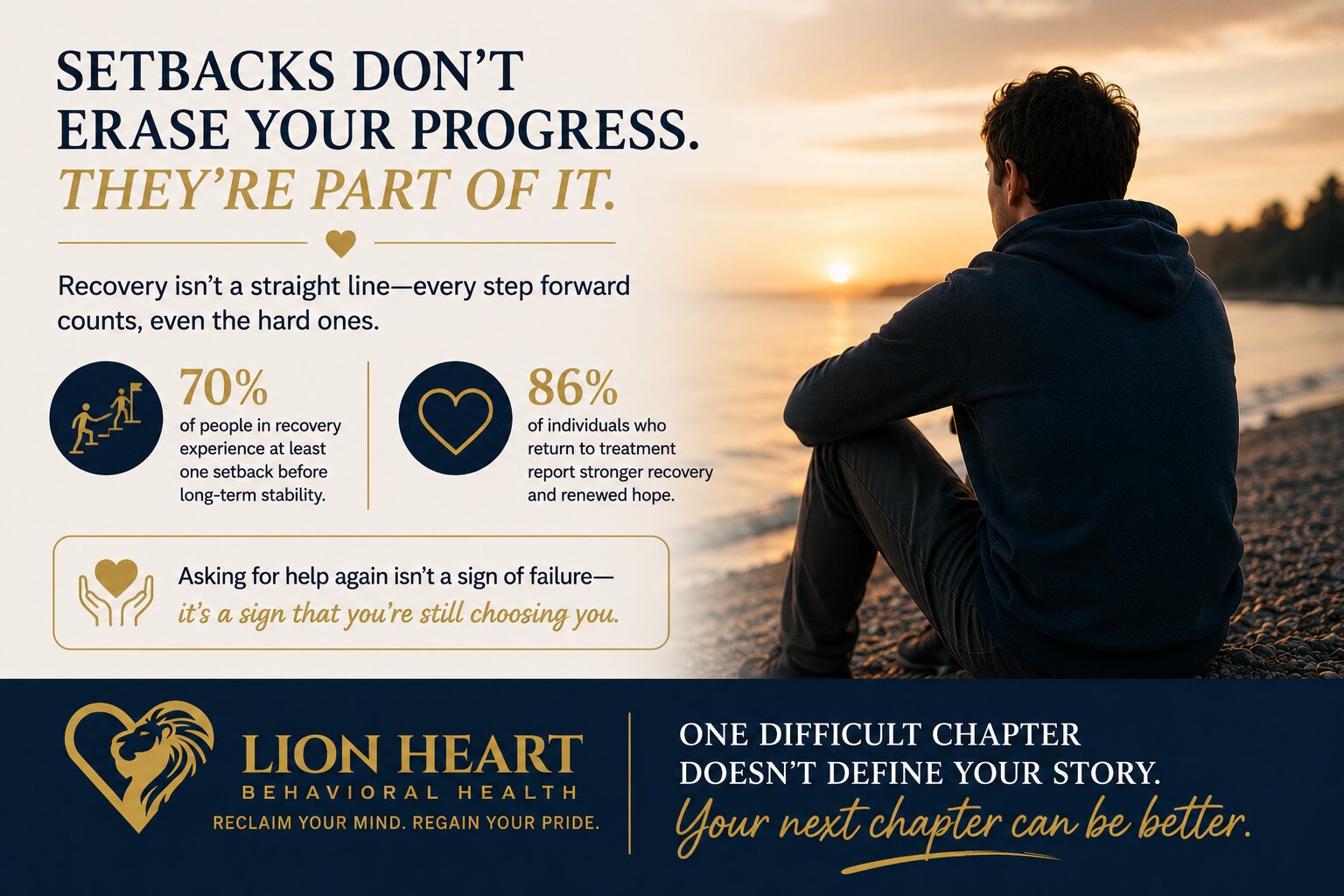
Recovery isn’t erased by a difficult chapter.
Sometimes it simply requires a new approach.
For individuals exploring treatment options in Bristol County MA or seeking care in Raynham MA, support is available.
And if you’re exhausted from trying to be the person who “should be fine,” maybe it’s time to stop carrying that burden alone.
Because asking for help again isn’t evidence that you’ve failed.
It may be evidence that you’re still fighting for your future.
Frequently Asked Questions
Is it normal to feel ashamed after a setback?
Yes. Many alumni experience shame, disappointment, and self-criticism after a relapse or difficult period. These feelings are common, but they do not define your progress or your future.
Does a setback erase previous recovery progress?
No. The coping skills, insights, and growth developed during recovery do not disappear because of one difficult period.
Why can returning to treatment feel overwhelming?
Many people feel emotionally exhausted after struggling. The idea of beginning treatment again can feel intimidating, even when they know support could help.
Can group therapy help with anxiety?
Many people find that group therapy reduces isolation, provides perspective, and creates opportunities to learn from others facing similar challenges.
What if I can’t commit to a full-day treatment schedule?
There are often different levels of support available. Finding an option that fits your responsibilities and lifestyle can make it easier to remain engaged in treatment.
How do I know if I need additional support?
If anxiety is affecting relationships, work, daily functioning, or overall quality of life, speaking with a professional can help determine what level of support may be beneficial.
Why is hearing other people’s experiences helpful?
Many individuals discover that shared experiences reduce shame and help them realize they are not alone in what they’re facing.
Is it possible to recover after a relapse or setback?
Absolutely. Many people continue building meaningful recovery after setbacks. A difficult chapter does not determine the rest of your story.
Call (774) 341-4502 or visit our Anxiety Therapy Program to learn more about our Anxiety Therapy Program services Raynham, MA.