

I remember the exact moment I realized I had crossed the line.
Ninety days sober had turned into ninety-three. I felt steady. Clear. Proud, even. Then one hard night turned into one drink, and one drink turned into the familiar blur I swore I was done with.
The next morning wasn’t dramatic. It was quiet. And heavy.
If you’ve relapsed after 90 days, you probably know that feeling. The shame. The self-talk. The question that won’t stop looping: Did I just fail?
Let’s talk honestly about the difference between failing… and returning.
The Story Shame Tells You
Shame is loud after relapse.
It says:
- “You should’ve known better.”
- “You already proved you can’t do this.”
- “Everyone is going to see you differently now.”
It tries to rewrite your 90 days as if they never happened.
But here’s what shame leaves out: those days were real. The growth was real. The effort was real. The healing was real.
You did not hallucinate your progress.
Relapse does not delete what you built. It interrupts it.
There’s a difference.
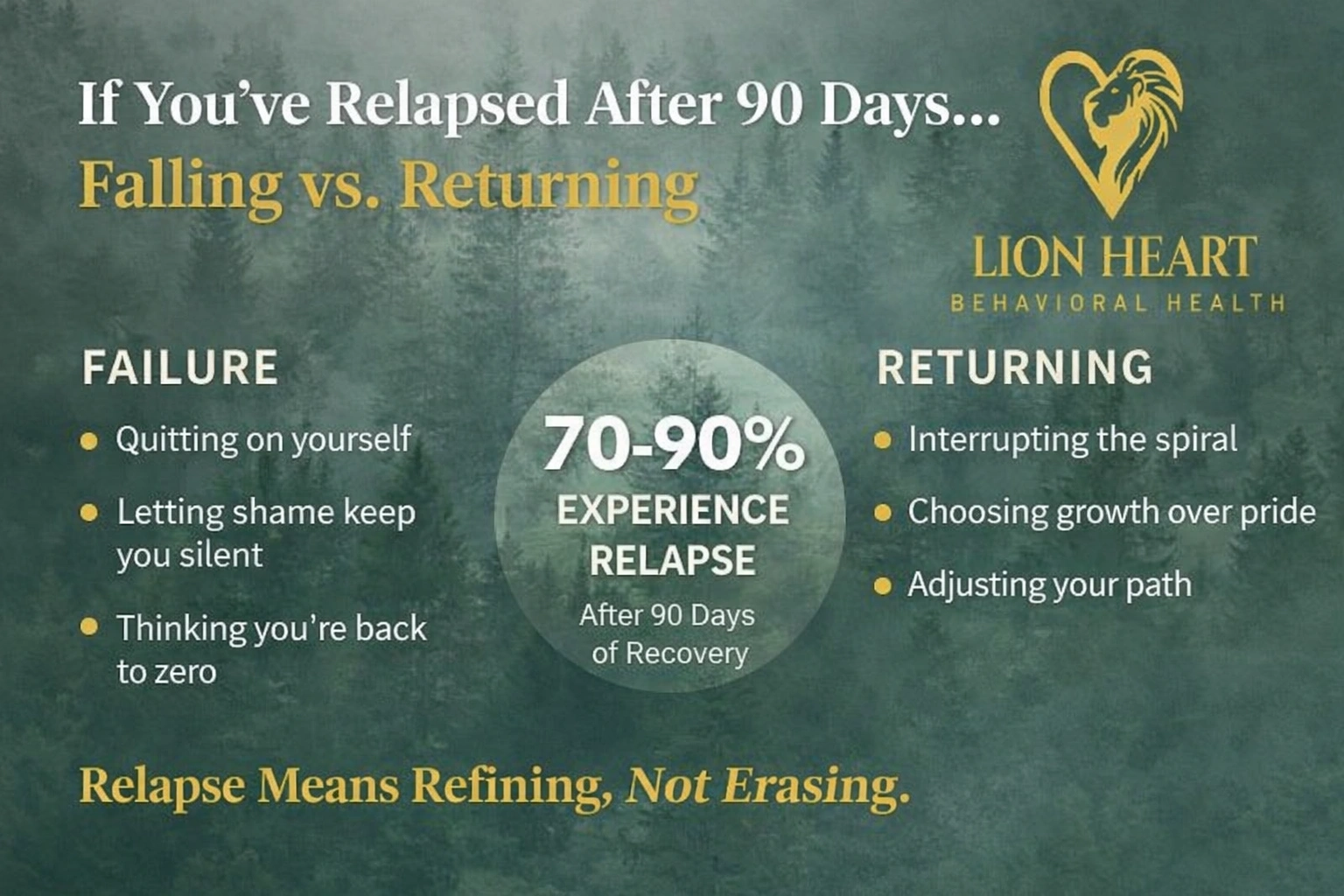
Failing Is Quitting on Yourself
Let’s get clear about something uncomfortable.
Relapse is painful. It matters. It’s not something to brush off or romanticize. But relapse is not the same as failure.
Failure isn’t the drink.
Failure is deciding you’re not worth trying again.
Failure is letting embarrassment keep you silent.
Failure is isolating because you think you “should know better.”
Failure is convincing yourself you have to spiral before you’re allowed to ask for help.
Returning, on the other hand, is an act of humility.
And humility is strength in recovery.
Why Coming Back Feels Worse Than Starting
The first time you sought help, you were likely desperate. Raw. Maybe even scared enough to push past pride.
The second time? Pride is the obstacle.
You think:
- “They’ll be disappointed.”
- “They gave me tools and I still drank.”
- “I don’t want to walk in and explain myself.”
I’ve had those thoughts too.
What I learned is this: people who work in recovery do not expect perfection. They expect humanity.
Many alumni who reconnect with care say the second time feels different. There’s less denial. More honesty. Fewer masks.
Sometimes the second round in an alcohol treatment program goes deeper because you’re not pretending anymore.
You’re not there to prove something.
You’re there to protect your life.
You Are Not Back at Zero
This is the lie relapse loves to tell: You’re starting over.
You’re not.
You still know your triggers.
You still know what clarity feels like.
You still have insight into your patterns.
You still remember how good it felt to wake up without regret.
You are not a blank slate.
You are someone who hit turbulence and is adjusting the flight path.
Think of it this way: if someone trains for a marathon for 90 days and misses one week of running, they don’t lose all muscle memory. They don’t forget how to run.
They re-engage.
Recovery works similarly.
Relapse Is Information, Not Identity
One of the hardest truths I had to accept was this: my relapse didn’t mean I was incapable. It meant something in my life needed more attention.
Stress I ignored.
Loneliness I minimized.
Overconfidence I didn’t question.
Relapse often highlights the cracks.
It’s data.
If you’re honest enough to look at it, relapse can refine your recovery rather than erase it.
That shift—from “I failed” to “I learned something important”—is powerful.
The Alumni Trap: “I Should Be Beyond This”
There’s a specific kind of shame that comes with relapsing after 90 days.
You think you’re supposed to be past this stage.
You think, I had momentum. I had clarity. I had support.
You might even be living in or near New Bedford, Massachusetts, passing familiar streets and wondering how you ended up back in this headspace.
But recovery isn’t linear. It’s layered.
Ninety days is incredible. It’s meaningful. But it’s also early. Neural pathways are still healing. Emotional regulation is still stabilizing. Identity is still shifting.
You were building something new. Sometimes new structures need reinforcement.
That doesn’t make you weak. It makes you human.
What Returning Actually Says About You
Returning says:
- “I care about my future.”
- “I’m not pretending this didn’t happen.”
- “I’m willing to interrupt this before it grows.”
It takes courage to admit you need support again.
Especially when you feel like you “shouldn’t.”
Especially if you’re in a smaller community like Raynham, Massachusetts, where it can feel like everyone knows everyone.
But here’s the truth: most people are too busy fighting their own battles to sit in judgment of yours.
And the ones who understand recovery? They respect the return.
Sometimes the Second Round Is the Turning Point
This might surprise you.
For some of us, the relapse becomes the moment we finally get honest.
The first time through care, we might still be protecting certain behaviors. Still holding onto certain relationships. Still telling partial truths.
After a relapse, the denial is thinner.
You’ve felt the sting. You’ve tasted the disappointment. You don’t want to repeat it.
That clarity can make the next phase of structured support more intentional.
Not desperate.
Intentional.
When you re-engage with an alcohol treatment program, you’re not the same person who walked in the first time.
You have experience now. You know what early sobriety feels like. You know where your blind spots are.
That changes everything.
If You’re Afraid to Make the Call
Let’s sit with this for a moment.
You might be hovering over your phone right now.
You might be thinking:
- “What if they think I wasted their time?”
- “What if I disappoint my family again?”
- “What if I can’t do this long-term?”
Those thoughts are normal.
But here’s something important: the people who helped you before want you stable. They don’t want you spiraling alone because you’re embarrassed.
Returning early is powerful.
Waiting until things implode is harder.
You don’t need to crash to justify support.
The Difference Between Guilt and Shame
Guilt says, “I made a mistake.”
Shame says, “I am the mistake.”
One invites correction.
The other invites hiding.
If you feel guilt after drinking, that’s actually a healthy sign. It means your values are intact. It means you care.
Shame, on the other hand, tries to push you away from the very support that would help you.
When you’re deciding whether to return, ask yourself:
Am I responding to guilt—or hiding because of shame?
There’s wisdom in that question.
You’re Allowed to Protect Your Progress
Even if it feels fragile.
Even if it feels embarrassing.
Even if you think you “should’ve known better.”
Recovery is not about proving you can be perfect. It’s about building a life you don’t want to escape from.
Sometimes that means re-engaging with structure.
Sometimes that means admitting you need accountability again.
That’s not regression.
That’s maintenance.
And maintenance is how long-term stability is built.
FAQ: Relapsing After 90 Days
Does relapse mean treatment didn’t work?
No. It means recovery is ongoing. Treatment gives you tools, awareness, and support—but long-term sobriety is built over time. A relapse doesn’t erase what you learned. It shows where reinforcement may be needed.
Should I wait before going back?
If you’re already questioning whether you need support, that’s worth listening to. Waiting often increases shame and risk. Reaching out early can prevent a short slip from becoming a longer spiral.
Will I have to start completely over?
Not necessarily. Many programs adjust care based on your current needs. You’re not walking in as someone with zero insight—you’re walking in with experience.
What if people judge me?
Some might. Most won’t. The people who understand recovery know relapse can be part of the process. Their focus is stability, not judgment.
How do I tell my family?
Honesty is usually the strongest starting point. You can keep it simple: “I had a setback, and I’m taking steps to address it.” Action builds trust faster than explanations.
A Final Word From Someone Who’s Been There
I once believed that relapse meant I wasn’t cut out for sobriety.
I was wrong.
Relapse meant I still had work to do.
There is a huge difference between failing and returning.
Failing is turning away from help because your ego is bruised.
Returning is choosing your life over your pride.
If you slipped, you are not broken.
If you’re ashamed, you’re not hopeless.
If you’re considering coming back, you’re not weak.
You’re someone who still cares.
And that matters more than one night ever could.
If you’re ready to steady yourself again, call 774-341-4502 to learn more about our alcohol treatment program in Massachusetts.