

If you’re starting to explore treatment options, it probably means you’ve already had some honest moments with yourself.
Maybe the thoughts have been circling for weeks:
“I’m not doing great.”
“I can’t keep pretending.”
“I’m functioning, but barely.”
And in between Google searches, Reddit scrolls, and late-night questions you haven’t said out loud yet, maybe you came across the term PHP.
And maybe it made you pause.
Because let’s be honest—Partial Hospitalization Program doesn’t exactly sound approachable. Most people hear it and immediately think:
“That’s too much.”
“That’s not for me.”
“Isn’t that for people who are totally falling apart?”
We hear those same questions every single day.
And here’s the truth: PHP is one of the most misunderstood levels of care in the behavioral health world—but also one of the most useful for people who feel stuck, overwhelmed, or scared that they’re running out of options.
So let’s clear the air. Here are the most common PHP myths we hear at Lion Heart—and the truths that might help you breathe a little easier.
Myth #1: “PHP is only for people in full-blown crisis.”
Truth: PHP is actually preventative care.
This is by far the biggest myth—and the one that keeps so many people from getting support before they hit rock bottom.
People often think they have to be completely falling apart to “deserve” help. But the whole point of a Partial Hospitalization Program is to stabilize before things get worse.
You might be:
- Struggling to manage your emotions
- Using more than you want to admit
- Burned out and emotionally exhausted
- Tired of white-knuckling your way through every week
You don’t need to have lost your job, your relationships, or your health to qualify for PHP.
You just need to be honest that what you’re doing now isn’t working anymore.
At Lion Heart’s PHP program in Raynham, Massachusetts, we welcome people who are in that in-between space—people who aren’t in acute crisis but know they’re running out of emotional bandwidth.
Myth #2: “PHP is inpatient care under a different name.”
Truth: PHP is outpatient, not inpatient.
We get it. The term “partial hospitalization” sounds intense. But here’s what it really means:
- You attend a structured program during the day (usually 5 days/week, around 6 hours/day).
- You go home at night and sleep in your own bed.
- You receive medical and clinical support—without being admitted to a hospital.
At Lion Heart Behavioral Health, PHP includes individual therapy, group therapy, psychiatric care if needed, and support with real-life things like emotional regulation, relapse prevention, and self-awareness.
It’s immersive, yes—but it’s also designed to fit into a life you still want to live.
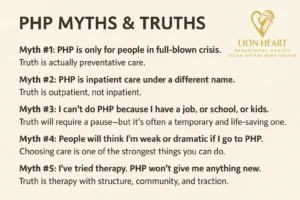
Myth #3: “I can’t do PHP because I have a job, or school, or kids.”
Truth: PHP will require a pause—but it’s often a temporary and life-saving one.
We’re not going to sugarcoat it. PHP is a time commitment. Most people need to step away from full-time obligations for a few weeks while they’re in the program.
But here’s what we see happen over and over again:
The short-term pause leads to long-term clarity.
Trying to “push through” while your mental health or substance use is worsening usually just leads to more breakdowns, not breakthroughs.
We’ll help you navigate the logistics—whether that’s FMLA paperwork, talking to HR, or figuring out childcare options. You won’t have to do that part alone.
Myth #4: “People will think I’m weak or dramatic if I go to PHP.”
Truth: Choosing care is one of the strongest things you can do.
So many clients tell us they put off asking for help because they were afraid of judgment—from their families, their friends, their coworkers.
Here’s the reframe:
If you broke your leg, would you hesitate to go to the doctor?
Mental health deserves that same urgency. That same care. That same respect.
You don’t have to explain to anyone why you want to get better.
You only have to decide that you’re worth the effort it takes.
And if you’re scared of what people might think? That’s human. We’ll help you work through that too.
Myth #5: “I’ve tried therapy. PHP won’t give me anything new.”
Truth: PHP is therapy with structure, community, and traction.
Weekly therapy is great—but sometimes, it’s not enough.
You leave session, go back to the chaos, and nothing really changes.
In PHP, you get:
- Daily support and accountability
- Group sessions that normalize what you’re going through
- Tools you can practice in real-time
- A team of clinicians who actually talk to each other about how you’re doing
It’s not just a deeper dive—it’s a safer container.
A place where change can actually stick.
Myth #6: “I should be able to figure this out on my own.”
Truth: You’ve probably already tried.
Most of the people we work with in PHP have already:
- Read the books
- Downloaded the apps
- Tried to “cut back” or “calm down” or “just focus”
They’re exhausted from trying to manage it all silently.
Asking for structured care isn’t giving up. It’s saying, “I’m done guessing.”
At Lion Heart, we don’t shame you for struggling. We honor the fact that you’ve fought this long. Now let us help you carry it.
Still Not Sure If PHP Is Right for You?
Here’s what we tell people who are on the fence:
PHP doesn’t have to be forever. But it might be exactly what you need right now.
You might be a good candidate for PHP if:
- You’re not in immediate danger, but you’re emotionally worn down
- Your anxiety, depression, or substance use is interfering with daily life
- You’ve tried therapy but need more structure and support
- You’re scared of where things are heading if nothing changes
- You’re ready to feel better—but you don’t want to do it alone
Frequently Asked Questions
How long does PHP usually last?
Most programs run for 2 to 6 weeks, depending on your needs. At Lion Heart, we’ll assess what’s best for you and adjust as needed. Some clients step down into IOP (Intensive Outpatient Program) afterward.
Is PHP covered by insurance?
Often, yes. PHP is considered a clinical level of care and is typically covered by most private insurance plans. Our team can help verify your benefits and explain your options clearly.
Will I be with people going through addiction or mental health or both?
Lion Heart’s PHP program serves clients facing a range of challenges. That may include substance use, anxiety, trauma, depression, or dual diagnosis. Groups are designed to be inclusive, respectful, and trauma-informed.
Do I lose access to my phone or contact with people while in PHP?
No. PHP is outpatient care. You go home at night and maintain your personal life while receiving intensive daytime support.
What happens after PHP ends?
Before you graduate, we’ll build a personalized aftercare plan with you. This may include individual therapy, support groups, medication management, or step-down levels of care like IOP.
The Bottom Line?
PHP isn’t a punishment. It’s a reset.
It’s not where people go because they’ve failed. It’s where people go when they’re ready to stop floundering and start healing—with structure, support, and a team that listens.
If you’re tired of guessing…
If you’re scared but also a little bit hopeful…
If you’re reading this thinking, “Maybe this could help…”
That’s enough.
You don’t have to wait for things to get worse.
You just have to want something better.
Let’s Take the Pressure Off
Call (774) 341-4502 or visit our PHP program in Massachusetts to talk with someone who will actually listen. No judgment. Just clarity and care—right when you need it most. If you’re in New Bedford or anywhere in Bristol County, Lion Heart provides programs built on that same compassionate approach.”