

There’s a very specific kind of silence that enters a home when something is truly wrong.
It’s not the silence of a moody teen or a long day. It’s the silence of fear.
When your son locks the door more than usual. When your daughter stops answering texts.
When something in your gut says: This isn’t just a phase. This isn’t attitude. This is different.
Maybe your child has started self-isolating. Maybe they’ve become explosive, reckless, withdrawn, or completely unreachable. Maybe they’re using substances to cope. Or maybe they’ve said something that sent chills down your spine:
“I don’t want to do this anymore.”
If you’re here, you’re probably scared.
And you’re probably asking the question no parent ever imagines having to Google:
“Is PHP enough for my child?”
Let’s talk about that question—honestly, gently, and without pressure. Because the answer isn’t always simple, but it’s never hopeless.
What Is PHP—and Why Is It So Misunderstood?
PHP stands for Partial Hospitalization Program. At first glance, it can sound like something extreme or overly clinical. But in reality, it’s a structured, intensive form of outpatient treatment designed for people who are struggling—but not necessarily in need of 24/7 inpatient care.
Here’s what PHP actually means at Lion Heart Behavioral Health in Raynham, Massachusetts:
- Full-day treatment, 5 days a week
- Group therapy, individual therapy, and psychiatric support
- Emotional regulation and skill-building
- Structured routine and daily accountability
- The ability to return home each evening
Think of PHP as the “middle ground” between inpatient care and traditional therapy. It’s immersive enough to help your child stabilize—but flexible enough to allow for family involvement, home transitions, and real-world integration.
“Is It Enough?” Depends on What Your Child Needs Right Now
As a parent, it’s normal to feel torn.
You want to intervene—but not overreact.
You want to support—but not smother.
You want to trust them—but your gut is screaming that something is off.
Here’s what PHP can do:
- Support a young adult who is spiraling but not fully in crisis
- Help stabilize after a recent hospitalization or mental health episode
- Catch someone who’s been hiding the severity of their pain
- Provide intensive care when weekly therapy isn’t enough
- Rebuild momentum in school, work, and relationships
But here’s what PHP is not:
- It’s not a lockdown unit.
- It’s not residential or overnight.
- It’s not a last resort.
If your child is deeply unstable, refusing care entirely, or has active safety risks that cannot be managed at home, a higher level of care (like inpatient or residential) may be a safer first step.
But if your child is struggling, exhausted, emotionally shut down, or cycling through behaviors that scare you—PHP might be exactly the right level of care to intervene before things collapse.
When Parents Say “I Don’t Want to Push Too Hard”
This is one of the most common emotional blocks we hear from parents:
“I don’t want to push them away.”
“They’ll just shut down if I bring this up.”
“They won’t go if they don’t want to.”
And yes—autonomy matters. Especially if your child is over 18.
But here’s something else we’ve seen again and again: Avoiding the conversation doesn’t build trust. It builds silence.
And silence is where crisis grows.
You can bring up PHP without threatening or demanding. You can say:
- “We’ve been watching you struggle, and we’re worried.”
- “There’s a program that doesn’t require hospitalization, but it’s serious enough to actually help.”
- “We want to help you find support, even if you don’t know how to ask for it.”
This doesn’t have to be “tough love” in the harsh, cold way people sometimes frame it.
This can be brave love—where you hold boundaries with compassion and create space for real support.
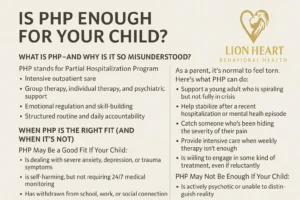
When PHP Is the Right Fit (And When It’s Not)
To help you clarify, here’s a quick breakdown of situations where PHP tends to be appropriate—and when it might not be enough.
PHP May Be a Good Fit If Your Child:
- Is dealing with severe anxiety, depression, or trauma symptoms
- Is self-harming, but not requiring 24/7 medical monitoring
- Has withdrawn from school, work, or social connection
- Has recently been discharged from inpatient care and needs structure
- Is using substances, but doesn’t need full medical detox
- Is willing to engage in some kind of treatment, even if reluctantly
PHP May Not Be Enough If Your Child:
- Is actively psychotic or unable to distinguish reality
- Has suicidal intent with a clear plan and no protective factors
- Is completely refusing care and cannot be physically brought to sessions
- Needs detoxification for heavy alcohol or drug dependence
- Poses a danger to themselves or others that cannot be managed at home
Still not sure? Call us. We’ll listen to your story, not just check boxes.
What Parents Often Discover (But Don’t Expect)
There’s a strange guilt that comes with finally asking for help.
Like you should have known sooner. Like you missed something. Like you waited too long.
We want to be very clear: You’re not late. You’re just ready now.
And here’s what so many parents find once PHP starts:
- Their child often feels relieved, not punished.
- The home environment becomes less tense because care isn’t all on you.
- Family sessions help unpack long-held resentments and miscommunications.
- Their child begins to show up again—maybe slowly, maybe awkwardly—but present.
Recovery isn’t linear. And progress isn’t always dramatic.
But when your child starts making eye contact again? Eating dinner again? Sleeping through the night again?
It’ll feel like breathing for the first time in months.
What Happens After PHP?
Another smart question.
At Lion Heart Behavioral Health, PHP is just the beginning. Before discharge, we work with you and your child to create a personalized aftercare plan that may include:
- Stepping down to Intensive Outpatient (IOP)
- Ongoing individual therapy or psychiatry
- Referrals for family counseling
- Educational or vocational support
You won’t be left hanging. We walk with you through the transitions. If you’re near New Bedford, or Bristol County, Lion Heart offers programs with that same approach.
Frequently Asked Questions (FAQs)
How long does PHP typically last?
Most PHP programs last 3–6 weeks. Some clients may stay longer depending on their progress and needs. Your child’s care plan will be personalized.
Will my child be around others who are in active crisis?
Clients in PHP are usually stable enough to participate safely in group therapy. They may be struggling, but they’re not in immediate danger—just like your child.
Can we be involved as parents?
Yes. Family involvement is encouraged and often built into the program. We offer parent education, family therapy, and regular updates—always with your child’s consent.
Is PHP covered by insurance?
Often, yes. PHP is typically covered by most major insurance providers. Our team at Lion Heart can help verify your benefits and explain what’s included.
What if my child refuses to go?
That’s common, especially early on. We can help coach you through that conversation and may be able to speak with your child directly. Sometimes, hearing from a clinician makes all the difference.
You’re Not a Bad Parent. You’re a Brave One.
If you’re reading this, you’re already doing something extraordinary:
You’re refusing to look away.
You’re refusing to minimize the ache in your gut.
You’re choosing action over silence.
And whether your child ends up in PHP, residential, or something else entirely—what matters most is that you’re here now. That you’re asking the hard questions.
At Lion Heart, we don’t judge families. We support them. With clear guidance. With compassion. And with respect for the quiet, everyday courage it takes to say:
“My child needs help. And I’m ready to find it.”
We’ll Help You Figure This Out
Call (774) 341-4502 or learn more about our PHP programs in Massachusetts to talk with someone who understands what your family is going through. No pressure. Just clarity, care, and real next steps.