
You’re not crashing. You’re functioning. You’re doing the job, managing the schedule, checking the boxes. From the outside, things look fine.
But you’re tired. Really tired.
As a clinician, I work with high-functioning clients every day—people who manage families, careers, relationships, and routines while quietly using alcohol or substances to hold it all together. They don’t think they need treatment. They think treatment would blow up the life they’ve built. They think stepping away would mean failing.
And yet, I still recommend our intensive outpatient program in Massachusetts.
Not because they’re broken. But because IOP offers something they rarely let themselves have: relief.
“I Can’t Take Time Off”—The Most Common Obstacle
High-functioning clients say the same thing, almost word for word:
“I can’t stop working.”
“My family depends on me.”
“This isn’t that bad.”
And they believe it—because their lives are still standing. But just because something looks stable doesn’t mean it’s sustainable.
Here’s what they rarely say out loud:
“I’m scared of what would happen if I stopped.”
“I don’t know who I’d be without this.”
“I feel like a fraud.”
IOP in Raynham, MA is designed exactly for this. You don’t have to walk away from your responsibilities to walk toward your recovery. You don’t have to check into a facility or explain an absence to your employer. Most clients continue working, parenting, and living at home.
What changes isn’t your entire life—it’s how much of that life you spend hiding.
IOP Offers a Structured Way to Step Back—Without Stepping Away
Our intensive outpatient program is a few hours per day, several days a week. That’s it.
It’s structured enough to give you meaningful support and accountability—but flexible enough to fit around your job or parenting schedule. And unlike inpatient care, you go home at the end of the day. You sleep in your own bed. You stay connected to your life—while starting to imagine a version of it that doesn’t run on anxiety and alcohol.
In areas like New Bedford and Bristol County, where many of our clients live and work, this format is often the first and only type of treatment they’re willing to try.
And for many, it’s enough.
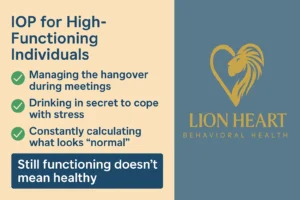
“Still Functioning” Doesn’t Mean Healthy
There’s a dangerous myth that as long as you’re not spiraling, you’re fine. That myth keeps people stuck for years.
You might be holding everything together—but just barely. You might be:
- Managing the hangover during morning meetings
- Drinking in secret to “take the edge off”
- Planning your week around how much you can use without anyone noticing
- Constantly calculating what looks “normal” enough to avoid suspicion
- Feeling numb in places where you used to feel joy
This is what high-functioning addiction often looks like. Not chaos. Just constant management.
And it’s exhausting.
IOP offers a way out—not just from the substance, but from the pressure to keep pretending you don’t need help.
You Don’t Need to “Crash” First
Many of the clients I refer to IOP haven’t lost jobs, wrecked relationships, or hit a dramatic “bottom.” They’re not in crisis. They’re just quietly worn down by the mental load of keeping up appearances while self-medicating their way through the week.
One client told me:
“I didn’t realize how bad it felt until I finally felt something better.”
That’s the turning point. IOP isn’t about waiting until things collapse. It’s about building support before they do.
What Actually Happens in an IOP?
Each IOP looks a little different, but at Lion Heart Behavioral Health, a typical week includes:
- Group therapy for connection, insight, and peer accountability
- Individual therapy for private, personalized work
- Psychoeducation on addiction, trauma, emotional regulation, and mental health
- Life skill building to support long-term recovery and stability
You’ll have a consistent schedule and a dedicated care team. You’ll talk to people who get it. And you’ll stop feeling like you’re the only one faking your way through.
We make it easy to join—especially if you’re seeking support discreetly in Raynham, New Bedford, or the surrounding South Shore area.
FAQs
1. Is IOP Confidential?
Absolutely. Your participation is fully protected under HIPAA. We understand the fear of being found out, especially if you’re a parent, professional, or someone with a high-profile job. Everything you share is private. Even our scheduling and communication methods respect your discretion.
2. Can I Keep Working During IOP?
Yes. That’s the whole point. Intensive outpatient programs are designed around your real-life commitments. Sessions are usually held in the morning or evening so you can still work, care for family, or manage your daily responsibilities while getting consistent support.
3. What If I Don’t Feel “Sick Enough” for Treatment?
This is incredibly common—especially for high-functioning adults. But needing help doesn’t require total collapse. If you’re using substances to cope, hiding your use, or living in quiet distress, that’s enough. You don’t need to be worse off to deserve better.
4. How Long Does IOP Last?
Most programs run 6 to 12 weeks, depending on your needs. You and your treatment team will work together to decide what makes sense. Some people transition into individual therapy or support groups after IOP. Others may continue with extended outpatient care.
5. Will I Be Grouped with People Like Me?
You’ll be surprised who you relate to. Our IOP groups include professionals, parents, young adults, and retirees. Addiction and emotional struggle don’t discriminate. You may come in thinking you won’t belong—and leave feeling understood in a way you haven’t felt in years.
Recovery Is a Return—Not a Disruption
One of the biggest lies high-functioning clients believe is that recovery will ruin their life.
But the truth? Recovery often gives them their life back.
It returns the energy, clarity, and peace they forgot was even possible. It allows them to be present—not just productive. To feel rested—not just responsible. To experience connection—not just compliance.
You don’t have to walk away from everything you’ve built. But you do deserve to build it from a place of wellness—not survival.
Let’s Talk—Quietly, Honestly, On Your Terms
Call (774)238-5533 or visit our intensive outpatient program in Raynham, Massachusetts to learn more about how we support high-functioning adults who are ready for something better.