
I remember sitting in my car during lunch break Googling treatment options with one hand while answering Slack messages with the other.
That’s where a lot of high-functioning people end up eventually.
Not passed out in an alley.
Not after some dramatic collapse.
Usually still employed. Still functional enough to look “fine” from the outside. Still convincing themselves they just need more sleep, better routines, less stress, fewer drinks, more discipline.
Meanwhile their nervous system is screaming.
If you’re researching structured recovery support in Massachusetts while trying to figure out how much help you actually need without blowing up your entire life, you are not overreacting.
You are probably exhausted from carrying everything alone.
And honestly, most high-functioning adults wait too long before admitting that what used to work is no longer working.
High-Functioning People Become Experts at Looking Fine
That’s part of the problem.
People think addiction, burnout, anxiety, or depression always look dramatic. But some of the most overwhelmed people you’ll ever meet still show up to work every day.
They answer emails while panicking internally.
Drink at night to quiet their thoughts.
Sleep poorly.
Stay emotionally disconnected.
Snap at people they love.
Zone out during conversations.
Promise themselves every Monday will somehow be different.
And because they’re still technically functioning, nobody intervenes.
Including them.
One of the strangest parts of high-functioning struggle is how invisible it becomes. People congratulate you for “holding it together” while you privately feel like a rubber band stretched to the point of snapping.
You stop asking:
“Am I okay?”
And start asking:
“How long can I keep this going before something breaks?”
I Thought More Structure Meant I Had Failed
This belief kept me stuck longer than almost anything else.
I assumed needing treatment automatically meant:
- Things were “serious”
- I had failed at managing my own life
- I couldn’t handle adulthood
- I’d lose independence
- Work would disappear
- Everyone would know something was wrong
So instead of asking for help, I optimized my suffering.
I bought planners.
Listened to productivity podcasts.
Tried “moderation.”
Worked longer hours.
Promised myself I’d slow down next month.
Drank more than I admitted.
Repeated the cycle.
Nothing changed because burnout and addiction do not respond well to negotiation.
Eventually I realized I wasn’t asking:
“Do I need support?”
I was asking:
“How much pain do I need to be in before I allow myself support?”
That’s a dangerous question for high-functioning people because we tend to move the goalposts endlessly.
The Confusion Usually Starts With One Thought
Most people comparing levels of care are not casually researching.
They’re already struggling.
Maybe not publicly. Maybe not dramatically. But internally, life has started feeling harder to manage than it used to.
You notice:
- Therapy stops carrying you through the week
- Anxiety rebounds faster
- Drinking becomes less optional
- Emotional numbness gets stronger
- Burnout turns physical
- Rest no longer restores you
- Small tasks feel emotionally expensive
That’s usually when people start trying to understand the PHP vs IOP difference.
Not because they want treatment.
Because they’re trying to figure out how much support they can accept while still keeping their life intact.
And honestly? That’s a very human thing to wrestle with.
Some People Need More Structure Than They Want to Admit
This was the hardest truth for me personally.
I wanted just enough support to stop feeling awful—but not enough to disrupt my routines, identity, or work life.
But recovery and mental health don’t really work like that.
If your nervous system is overloaded, your coping skills are collapsing, and your life increasingly revolves around surviving stress, there comes a point where more structure becomes relief instead of restriction.
That realization surprised me.
I thought structure would feel suffocating.
Instead, it felt like someone finally helping me carry groceries I’d been pretending weren’t heavy.
That’s often the emotional reality for high-functioning adults. They adapt to exhaustion so gradually that they stop noticing how much effort basic life requires.
Emails become draining.
Phone calls feel overwhelming.
Simple decisions become exhausting.
Socializing starts feeling performative.
At some point, functioning itself becomes a full-time job.
Work Makes This Decision Emotionally Complicated
This part matters more than people admit.
For high-functioning adults, work is often tied directly to identity.
Being productive means:
- Being valuable
- Being safe
- Avoiding questions
- Maintaining control
- Preserving normalcy
So when treatment enters the conversation, panic usually follows close behind.
People think:
“If I slow down, everything will collapse.”
“If I need more support, maybe I’m weaker than everyone else.”
“If work notices something is wrong, I’ll lose respect.”
Meanwhile they’re already emotionally drowning in private.
One client once told me:
“I built my whole identity around being dependable while secretly becoming completely unavailable to myself.”
That sentence hits hard because many high-functioning adults quietly abandon themselves for years while remaining extremely responsible externally.
More Intensive Support Is Not a Moral Judgment
This is important.
A lot of people unconsciously view different levels of care like report cards.
More support = worse person.
More structure = bigger failure.
Less independence = weakness.
But emotional overwhelm does not care how intelligent, successful, responsible, or capable someone is.
Sometimes people simply need more consistency than weekly therapy alone can provide.
Structured daytime care often includes more hours of therapeutic support during the week. Multi-day weekly treatment may offer more flexibility for people balancing work or family obligations while still needing consistent accountability and connection.
The real question is not:
“What sounds less serious?”
The real question is:
“What honestly matches the level of support I need right now?”
That answer requires brutal honesty sometimes.
Especially for people used to minimizing their own suffering.
High-Functioning Adults Often Normalize Dangerous Levels of Stress
This happens constantly.
People say things like:
- “I’m just burned out.”
- “Everyone drinks after work.”
- “I’ve always had anxiety.”
- “I’m functioning.”
- “This is just adulthood.”
Meanwhile:
- Their sleep is collapsing
- Their relationships are strained
- Their substance use is escalating
- Their nervous system never fully relaxes
- They feel emotionally detached most of the time
- They fantasize constantly about escape, isolation, or disappearing
And because they are still showing up externally, they convince themselves they do not deserve support yet.
That’s one of the cruelest parts of high-functioning struggle:
you can deteriorate quietly for years before anyone realizes how bad things have become.
Including yourself.
The Right Program Should Feel Like Support — Not Punishment
This matters deeply.
A lot of people avoid treatment because they imagine it as harsh, restrictive, or humiliating.
Especially adults already overwhelmed by work, burnout, anxiety, or addiction.
But good treatment should create stability, not shame.
Whether someone benefits more from structured daytime care or flexible multi-day weekly treatment, the purpose is not to take their life away.
It’s to help them stop disappearing inside it.
That may look like:
- Consistent therapy
- Accountability
- Group support
- Emotional regulation work
- Structure around difficult days
- Reduced isolation
- Help rebuilding routines
- Learning healthier coping strategies
And honestly, one of the biggest reliefs for many high-functioning adults is simply being around other people who understand what it feels like to privately struggle while publicly performing.
That level of understanding matters.
Because exhaustion becomes much heavier when you think you’re the only person experiencing it.
You Do Not Need to Completely Fall Apart Before You Deserve Help
This misconception keeps people suffering far longer than necessary.
People wait for:
- Severe relapse
- Job loss
- Relationship collapse
- Public breakdowns
- Panic attacks
- Medical emergencies
before they “allow” themselves additional support.
But many high-functioning adults are deeply overwhelmed long before their lives visibly unravel.
That’s why understanding the PHP vs IOP difference matters less than honestly assessing your current reality.
Ask yourself:
- Are you coping or barely surviving?
- How much energy does it take to appear okay lately?
- Is your current support actually enough?
- Are substances becoming more central to emotional regulation?
- Are you emotionally present in your life anymore?
- Have you normalized feeling miserable?
Those questions often reveal more truth than denial does.
Sometimes the Better Choice Is the One That Helps You Breathe Again
Most people researching treatment are not looking for perfection.
They’re looking for relief.
Relief from constant anxiety.
Relief from emotional exhaustion.
Relief from carrying every week like a backpack full of bricks.
For some people, more structured daytime support creates the stability they need.
For others, flexible multi-day weekly treatment allows enough support while still balancing work and outside responsibilities.
The “better” option is usually not the one that sounds easier emotionally.
It’s the one that honestly reflects how overwhelmed your nervous system has become.
FAQ About Choosing Between Different Levels of Structured Support
Can I still work while attending treatment?
Sometimes, yes. Many people continue working part-time, remotely, or with adjusted schedules while receiving multi-day weekly treatment. Structured daytime care may require more daytime availability depending on individual needs.
How do I know if I need more structure?
If you are struggling between therapy sessions, increasingly relying on substances, emotionally overwhelmed most days, or having difficulty functioning consistently, more support may help create stability.
Is needing more treatment a sign I failed?
No. Needing additional support often means your current stress level, symptoms, or coping strategies are no longer sustainable—not that you failed personally.
What if I’m still functioning at work?
Many high-functioning adults continue working while privately struggling with severe burnout, anxiety, depression, or addiction. External performance does not always reflect emotional health.
Is structured daytime care always more effective?
Not necessarily. Different levels of care fit different needs. The best fit depends on symptom severity, emotional stability, work responsibilities, support systems, and overall functioning.
What if I’m afraid treatment will disrupt my life?
Untreated mental health struggles and substance use are already disruptive. Good treatment aims to help people reconnect with life—not abandon it.
Can treatment help before things become a crisis?
Absolutely. Many people seek support before reaching a severe crisis point because they recognize they are becoming emotionally exhausted, disconnected, or increasingly dependent on unhealthy coping mechanisms.
You Are Allowed to Need More Support Than You Planned For
There’s no award for surviving the longest without help.
And honestly, many high-functioning adults spend years trying to “earn” support by becoming worse first.
You do not need to completely collapse before care becomes valid.
For people exploring structured recovery support in Massachusetts, the goal is not to remove your life from you.
It’s to help you feel present inside it again.
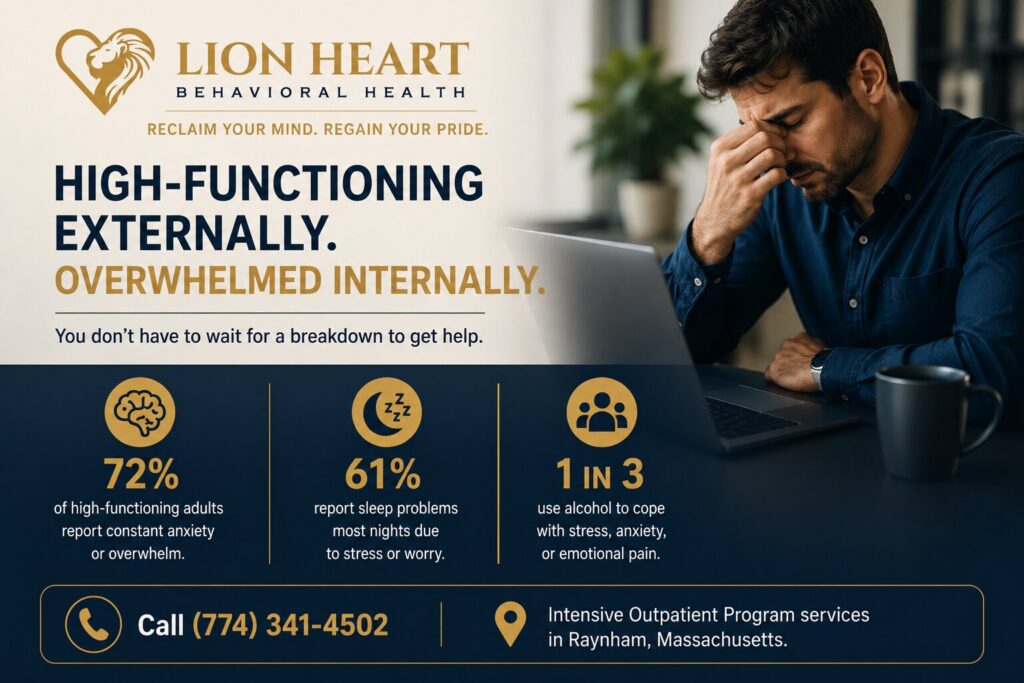
Call (774) 341-4502 or explore our Intensive Outpatient Program services in Raynham, Massachusetts to learn more about our programs.