
Some moments don’t shout. They whisper.
He didn’t make eye contact. Didn’t raise his voice. But when he said the words—“I still want to live”—the room stilled. In alcohol addiction treatment, those five words changed everything.
Learn more about our alcohol addiction treatment programs in Raynham, Massachusetts
The Room Where No One Is Ready
Treatment isn’t always about dramatic rock bottoms. More often, it begins with quiet exhaustion. People come in not because they’re hopeful—but because they’re out of options.
He was one of those. A man in his early 50s, dressed plainly, posture slumped, eyes somewhere else. The intake said “depressed, drinking daily, suicidal thoughts.” But there was more between the lines—something harder to name.
In his first group, he didn’t participate much. He listened. Or at least stared in the direction of the speaker. Someone finally asked, “Do you want to get better?”
He gave a half-shrug.
“I don’t know.”
Then, just as the silence was starting to settle again, he added:
“I don’t want to die. I just don’t know how to live like this anymore.”
What Happens When Someone Still Wants to Live—But Can’t See How
There’s a common misconception that people struggling with suicidal thoughts want to die. That may be true for some. But often, the truth is more complex.
Many of the people we meet in alcohol addiction treatment aren’t trying to die. They’re trying to make the pain stop. They’re trying to escape the weight of shame, the cycle of withdrawal and regret, the sense that they’ve failed everyone—especially themselves.
When someone says “I still want to live,” even through clenched teeth or with a tired stare, it’s not a small thing. It’s not just a phrase. It’s a flicker of will. A reason to keep going, however faint.
In the world of recovery, it’s a foothold.
Alcohol Addiction Doesn’t Always Look Like Despair—But It Often Feels Like It
We often talk about alcohol addiction in terms of external signs: missed work, legal trouble, family issues, DUIs. But the deeper damage is internal.
What it does to your identity. Your confidence. Your ability to feel joy or connection.
That client hadn’t lost everything. He still had a job. Still paid his bills. But inside, he was slipping.
He told us later: “I was just drinking to make the day tolerable. To get to sleep. To not think too much.”
That’s where alcohol addiction becomes its own kind of trap. It doesn’t always look dangerous from the outside. But inside, it’s eroding everything that makes life feel worth living.
What Recovery Looked Like—One Quiet Day at a Time
He didn’t change overnight.
There were hard mornings. Missed groups. Sessions where he said little. But slowly, that quiet thread—“I still want to live”—pulled him forward.
Here’s what changed:
- He began eating full meals again. For someone whose appetite was mostly liquid, this was a milestone.
- He reached out to his daughter. Not to make amends, not yet. Just a text: “Thinking about you.”
- He asked for more help. Requested extra time with his clinician. Showed up early to group one day.
- He laughed. Just once, at a joke another client made about “rehab coffee.” But it was real.
Recovery didn’t make everything easy. But it gave him space to breathe—and enough clarity to see that life could be different.
When Clients Aren’t Sure They Want Help—But Still Show Up
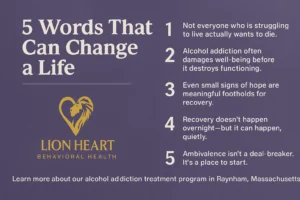
Not everyone arrives in treatment ready to heal. That’s okay.
At Lion Heart Behavioral Health, we don’t expect people to be all-in on Day One. We know how heavy ambivalence can feel. We’ve worked with clients who say:
- “I don’t know if I can do this.”
- “I’ve tried before and failed.”
- “What if this doesn’t work either?”
And maybe the most honest:
“I’m not sure I even care anymore.”
But if there’s even the smallest part of you that still wants to live—or isn’t ready to give up—we can work with that. We’ll hold that part gently, and help you protect it.
The Power of Slowing Down Suicidal Thinking
One of the most important things we do in alcohol addiction treatment—especially when suicidal ideation is present—is help clients slow down.
When the brain is overwhelmed with pain, decision-making collapses. The future disappears. Everything feels like too much. And alcohol, in those moments, becomes both a numbing agent and a gasoline can.
But when someone speaks the truth out loud—“I’m tired” or “I can’t do this anymore” or “I don’t want to die, but…”—that’s the beginning of change. Not because we fix it in one session. But because we’ve opened a space where no one has to be alone with those thoughts.
Looking for Alcohol Addiction Treatment in Raynham, MA?
Whether you live nearby or are looking for support in the region, Lion Heart Behavioral Health provides alcohol addiction treatment in Raynham, MA that honors your whole story—not just your symptoms.
We also serve the surrounding area. If you’re looking for alcohol addiction treatment in New Bedford, MA or alcohol addiction treatment in Bristol County, MA, our team is here to support you—whether you feel ready or just barely willing.
FAQ: Alcohol Addiction Treatment and Mental Health
What if I’m not sure I want to stop drinking?
That’s okay. Ambivalence is common. You don’t need to be fully ready to stop drinking in order to begin treatment. You just need to be open to exploring what alcohol is doing in your life—and whether it’s working for you anymore.
Can I get help even if I’m feeling suicidal?
Yes. In fact, treatment is one of the safest and most supportive places to be when you’re having thoughts of suicide. We take those feelings seriously and respond with compassion, not punishment. You’ll never be shamed for struggling.
What’s different about your alcohol addiction treatment in Raynham, MA?
We integrate mental health and addiction support because we know they’re often intertwined. Our programs are personalized to your emotional, psychological, and medical needs. And we believe that healing requires dignity, not discipline.
Is it normal to feel numb in early recovery?
Completely. Many people describe early recovery as emotionally flat or even painful. That’s because alcohol numbs the nervous system—and when it’s gone, emotions start to reawaken. We’ll help you move through that discomfort at your own pace.
What if I’ve tried treatment before and it didn’t help?
That doesn’t mean you failed—or that you can’t heal. Not all treatment programs are the same. Sometimes, it takes the right place, the right timing, and the right kind of support. We’ll meet you where you are, without judgment.
Ready to Talk?
You don’t have to be sure. You just have to be here.
Call (774) 238-5533 to learn more about our alcohol addiction treatment services in Raynham, Massachusetts.
We’ll walk with you—even if all you can say right now is, “I still want to live.”