

You know that moment when someone says, *“You should try this—it really helped me” and all you can think is: “Yeah, well… I already did all that.”
That was me.
Therapy dropout. Medication survivor. Still stuck.
This is the story of the one weird therapy I almost didn’t try—EMDR Therapy—and why, somehow, it actually helped. If you’re near Raynham, Massachusetts and you’re curious (or just quietly desperate), Lion Heart Behavioral Health offers EMDR therapy right here in town. But let me back up.
I didn’t “hate therapy.” I just didn’t think it worked.
I showed up. I journaled. I tried to be open.
I tried different therapists—some kind, some distant, some brilliant, some baffling. But no matter who I saw, or what approach they used, I kept leaving sessions with the same weight in my chest and the same questions rattling in my head.
Why am I not getting better? Why does it still feel like I’m drowning inside a house with all the windows painted shut?
Eventually, I just stopped going. Not because I didn’t care about healing—but because I didn’t believe healing was available to me. Not through therapy, anyway.
That’s the part people don’t always get. Giving up on therapy doesn’t mean you gave up on yourself. Sometimes, it means you just got tired of hoping and being let down.
When someone said “EMDR Therapy,” I rolled my eyes
It was a friend.
She’d been through her own mess—grief, trauma, anxiety. She mentioned this therapy that helped her finally sleep again.
“EMDR,” she said.
Eye Movement Desensitization and Reprocessing.
It sounded… clinical. Woo-woo. Hypnosis-adjacent.
I imagined a pendulum swinging back and forth and someone snapping their fingers.
But she wasn’t trying to sell it to me. She just said, “It’s different. You don’t have to talk everything to death. Just try it.”
And something in her tone made me pause. She wasn’t excited. She was steady. Like someone who’d finally found a door where before there’d only been walls.
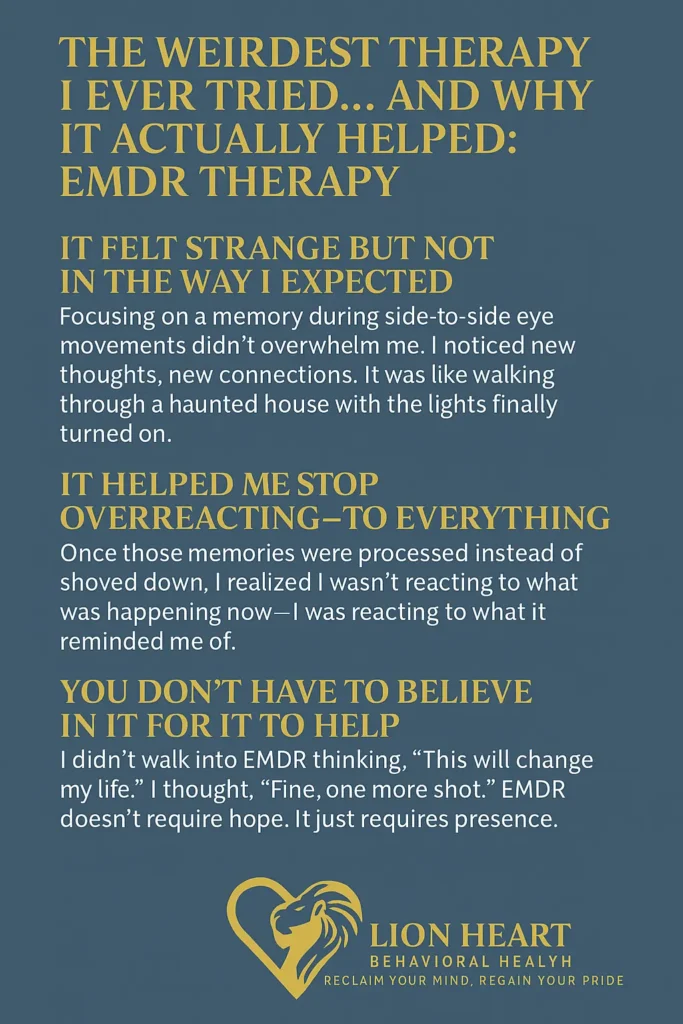
EMDR felt strange—but not in the way I expected
I sat across from the therapist, arms folded, pretty sure I was about to waste another hour.
She asked about what brought me in. I kept it vague. I didn’t want to relive anything.
She didn’t push.
Instead, she explained how EMDR worked. That it wasn’t about reliving trauma in detail—it was about reprocessing it. Taking memories that were stuck in panic or shame and helping the brain finally file them as past—not present.
Then she asked me to think of a memory.
Just one.
And we began. Left-right-left-right. Sometimes with my eyes, sometimes with tapping, sometimes with buzzers in each hand. And as I focused on that memory, something unexpected happened:
I didn’t spiral.
I didn’t shut down.
I didn’t cry uncontrollably or run out of the room.
Instead, I noticed thoughts surfacing I’d never voiced. Connections I’d never made.
It was like walking through a haunted house with the lights finally turned on.
It helped me stop overreacting—to everything
For so long, I thought I was just “too sensitive.”
Things would trigger me and I’d feel like I was overreacting. But I couldn’t stop.
EMDR helped me understand something I’d never been able to name:
I wasn’t reacting to what was happening now—I was reacting to what it reminded me of.
And once those memories were actually processed instead of shoved down, my reactions started to shift. I had more pause between the stimulus and the explosion. I had choice.
Progress wasn’t instant—but it was real
I didn’t wake up one morning completely healed.
It was more like… I started noticing room to breathe.
I started speaking up in conversations where I used to shrink.
I started sleeping without that low-grade dread at bedtime.
I noticed I didn’t avoid certain songs, smells, or places anymore.
It was small at first.
But it was real.
And it didn’t come from overanalyzing my childhood or rehashing the worst moments of my life. It came from letting my brain finish what trauma had interrupted.
Who is EMDR Therapy actually good for?
EMDR is often used for:
- People who’ve experienced trauma—whether “big T” (like assault, violence, or combat) or “little t” (emotional neglect, chronic stress, subtle abuse)
- Anxiety and panic symptoms that don’t respond well to talk therapy alone
- Memories that feel stuck in your body—even if they’re hard to explain out loud
- Situations where logic doesn’t help and self-awareness hasn’t moved the needle
At Lion Heart Behavioral Health in Raynham, MA, EMDR is part of a wider set of mental health services—and they’re used to working with people who are skeptical, scared, or burned out. If you’re near New Bedford, or Bristol County, Lion Heart offers programs with that same approach.
You don’t have to believe in it for it to help
This might sound odd, but it’s true.
I didn’t walk into EMDR thinking, “This will change my life.”
I walked in thinking, “Fine. One more shot.”
And that was enough.
EMDR doesn’t require hope.
It just requires presence.
What I’d tell someone who thinks therapy “didn’t work”
You didn’t fail therapy.
And therapy didn’t fail you.
You were probably just trying the wrong tool for the problem.
And that’s not your fault.
If something in you is still aching for relief… if you feel stuck but still want to feel something better… EMDR might be worth exploring.
No shiny promises. No hype.
Just a different door.
FAQ: EMDR Therapy
What does EMDR Therapy actually look like during a session?
In an EMDR session, you’ll be guided to focus on a distressing memory while engaging in bilateral stimulation (usually through eye movements, tapping, or sounds). This helps your brain reprocess the memory so it’s no longer emotionally disruptive.
Do I have to talk about everything that happened to me?
No. One of the strengths of EMDR is that you don’t have to talk in detail about your trauma. You only need to recall it internally, and the therapist guides you through the process without forcing disclosure.
Is EMDR safe if I’ve never done trauma work before?
Yes—when facilitated by a trained professional, EMDR is considered safe and can even be less overwhelming than traditional talk therapy because it doesn’t rely on verbal processing alone.
How many sessions does EMDR usually take?
It depends. Some people feel relief in just a few sessions, while others may work through multiple memories over time. The therapist will work with you to create a plan that feels manageable and respectful of your pace.
Is EMDR therapy covered by insurance?
At Lion Heart Behavioral Health, many insurance plans are accepted for EMDR therapy. It’s best to call directly to verify your coverage.
📞 Thinking about giving therapy one more try?
Call (774) 341-4502 or visit our EMDR Therapy page in Raynham, Massachusetts to learn more about how EMDR works and whether it could be a better fit for what you need right now.