

When your child is struggling with addiction, the silence can be deafening.
You might find yourself trying to shield younger siblings, maintain routines, and carry a smile you don’t feel—all while wondering if anyone else in your family truly sees what this is doing to you.
At some point, you realize: We need help too. Not just for them. For all of us.
Family addiction support programs exist for this exact reason—to help parents, siblings, spouses, and loved ones find their footing in the chaos addiction can bring. But bringing the idea up with your family? That can feel vulnerable, even risky.
Here’s a step-by-step guide to help you approach the conversation with care, courage, and practical direction.
1. Get Clear on Why This Matters to You
Before you say a word to anyone else, take a moment to sit with your own heart.
What are you hoping will change if your family joins a support program?
Maybe you’re tired of walking on eggshells. Maybe you’re scared to name what’s happening out loud. Maybe you’re just trying to figure out how to love your child without losing yourself.
These aren’t small things. And you don’t have to justify them.
When you get clear on your own “why,” it helps you speak from a grounded, honest place—not from fear or blame. You’re not bringing this up to control anyone. You’re doing it to create room for care.
You don’t need anyone’s permission to want more peace in your home.
2. Choose a Time That Makes Space for Listening
When emotions are high, timing is everything.
Don’t try to start this conversation in the middle of a crisis, during a sibling conflict, or while someone’s distracted. Look for a quiet, neutral moment—an after-dinner walk, a Sunday afternoon, a day when things feel relatively calm.
You can start simply:
“There’s something I’d like us to talk about—not right now, but soon. It matters to me, and I think it could help us all.”
This signals care without urgency. It opens a door instead of pushing someone through it.
3. Speak From Experience, Not Accusation
One of the biggest fears families have is being blamed. Everyone is raw, and it’s easy to get defensive—even when no one means to.
That’s why language matters.
When you speak from your experience, people listen differently. Use “I” and “we” instead of “you.”
Try:
- “I’ve been feeling overwhelmed, and I think we all deserve some support.”
- “I found a family addiction support program in Raynham, and I think it could help us understand what’s going on together.”
Avoid:
- “You need to learn how to handle this better.”
- “You never do anything to help.”
The goal isn’t to assign blame. It’s to invite healing.
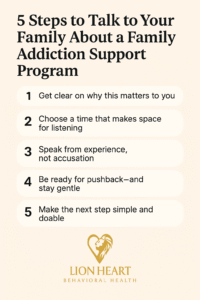
4. Be Ready for Pushback—And Stay Gentle
Some family members may jump at the idea. Others may hesitate or resist.
That’s normal.
They might say things like:
- “We don’t need that.”
- “It won’t change anything.”
- “I’m too busy.”
These aren’t rejections of you. They’re defense mechanisms. They’re fear showing up as skepticism.
Stay calm. Reaffirm your own path.
You can say:
“I understand. I’m going either way, because I know I need it. You’re welcome to come with me—or just think about it.”
Your willingness to go first can be the very thing that makes space for others to follow.
5. Make the Next Step Simple and Doable
Don’t overload them with pamphlets, stats, or long-winded explanations. Instead, offer a clear, calm next step.
You might say:
- “I looked into a program at Lion Heart Behavioral Health in Raynham. They have weekly support groups for families like ours.”
- “It’s not a huge commitment—we can just call to ask questions first.”
If they need time, give it. If they’re open, take the step together. Either way, you’re modeling what strength and care can look like.
This isn’t about fixing your child. It’s about helping your family stop falling apart in silence.
Frequently Asked Questions (FAQs)
What is a family addiction support program?
It’s a dedicated space where loved ones of someone struggling with addiction can learn, process, and heal together. At Lion Heart Behavioral Health, our family program includes education on addiction, support groups, boundary-setting tools, and space for grief, questions, and hope.
Do we have to attend as a whole family?
No. One person can begin. In fact, many parents start alone—and over time, other family members become curious or feel ready. There’s no requirement for full-family attendance.
Will this focus on blaming the person using?
Absolutely not. Family addiction support is blame-free. It’s about understanding addiction as a family illness—and learning how to support your loved one without sacrificing your own mental health.
What if I feel ashamed to talk about our situation?
That’s a deeply human feeling. Many families carry shame about addiction. But support programs are confidential, compassionate, and full of people who’ve been exactly where you are. You won’t be judged—you’ll be understood.
Can support programs help even if my child isn’t in treatment?
Yes. Family healing doesn’t have to wait for your child to get sober. In fact, many parents find that when they get support, it shifts the dynamic enough to help their child reconsider treatment.
You’re Not Alone—And You Don’t Have to Stay Silent
Call (774)238-5533 to talk with someone at Lion Heart Behavioral Health who understands what families face when addiction is in the picture.
We offer family addiction support programs in Raynham, MA, built to help you feel seen, supported, and informed. Even if your child isn’t ready for change, you can be. You matter too.