

You’ve hoped. You’ve held on. Maybe you’ve even convinced yourself that the last relapse was the last relapse. But now you’re back to watching for the signs—again.
Your 20-year-old swears they’re okay, but they’re avoiding appointments. Sleeping all day. You’ve found the missing cash. The phone calls at strange hours. The late nights. You know the signs better than you ever wanted to.
You’ve been through outpatient care before. It helped a little—until it didn’t.
You’re not wrong to worry. And you’re not wrong for needing something more.
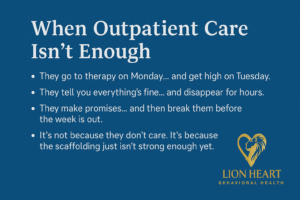
When Outpatient Care Isn’t Enough
Outpatient programs are built around the idea that the individual can keep one foot in their daily life—work, school, or home—and one foot in treatment. But what if that daily life is the very thing pulling them back into the addiction?
That’s where outpatient treatment can fall apart for young adults.
Here’s what we see all the time:
- They go to therapy on Monday… and get high on Tuesday.
- They tell you everything’s fine… and disappear for hours.
- They make promises… and then break them before the week is out.
It’s not because they don’t care. It’s because the scaffolding just isn’t strong enough yet. And expecting them to build a new life while still standing on shaky ground isn’t fair—to them or to you.
What Makes a Partial Hospitalization Program Different?
A partial hospitalization program (PHP) offers a higher level of care—without full-time residential treatment. It gives your child access to clinical intensity five to six days a week, with the opportunity to return home in the evenings.
That means:
- Daily therapy and structured support
- Multiple sessions each day—group therapy, individual counseling, psychiatric support
- Integrated skill-building and relapse prevention
- Real-time support for mental health challenges that often accompany addiction
PHP creates the kind of rhythm and accountability most young adults can’t maintain on their own. It reduces exposure to high-risk situations, provides a protective structure during the most vulnerable part of recovery, and helps them build real change from the inside out.
Why PHP Helps Break the Relapse Cycle
Relapse is often not a sudden event—it’s a slow unraveling.
Without daily support, your child might not recognize the shift until they’re already deep in it:
- Skipping one meeting
- Answering one text from an old using friend
- Taking one drink or pill, convinced it’s “just this once”
By the time you see the warning signs, the spiral may already be in motion.
In PHP, your child doesn’t just “check in” once a week. They live in recovery—learning how to:
- Identify their triggers
- Respond to cravings
- Practice emotional regulation
- Build sober support systems
- Reconnect to goals, purpose, and accountability
It’s not just about stopping the behavior. It’s about rewiring the choices that lead there.
You’re Not Overreacting—You’re Responding to Reality
We know how exhausting it is to always be the one worrying. The one googling symptoms. The one hiding your wallet, texting reminders, or double-checking the locks.
You didn’t cause this. But you’re the one trying to hold the line.
When outpatient treatment isn’t working, stepping up to PHP isn’t “escalating”—it’s responding appropriately to the pattern.
It’s not about being dramatic. It’s about being done with the chaos.
Stat Block: Studies show that intensive outpatient and partial hospitalization programs significantly reduce relapse risk when compared to low-frequency therapy alone—especially in young adults whose addiction is still deeply rooted in social routines and environments.
Why Families in Raynham Trust Lion Heart Behavioral Health
At Lion Heart Behavioral Health in Raynham, MA, we meet families where they are—usually heartbroken, tired, and terrified of another letdown. Our partial hospitalization program is built with this in mind.
We offer:
- Evidence-based clinical care
- A warm, nonjudgmental environment
- Deep understanding of co-occurring disorders and family strain
- Real, actionable recovery plans
Our team doesn’t just support your child—we support you. We’ll help you know when to let go, when to hold the boundary, and when to just breathe and know you’re doing enough.
FAQs About Partial Hospitalization Programs
What’s the difference between PHP and outpatient care?
PHP provides care five or more days a week, for several hours each day. Outpatient treatment usually involves 1–3 sessions per week. PHP is a step up in intensity and is ideal for those at risk of relapse.
Will my child be living at your facility?
No. PHP is daytime treatment only. Clients attend full-day programming and return home in the evening. It’s a structured bridge between inpatient and outpatient care.
What kind of therapy is included?
Our PHP includes individual therapy, group therapy, family counseling, and psychiatric support when needed. The treatment plan is customized to each client.
Can my child go to school or work during PHP?
Most clients pause work or school while in PHP due to the full-day schedule. However, we work with families to create transition plans that include education or career goals.
How do I know if PHP is the right fit?
If outpatient hasn’t helped—or if your child keeps relapsing despite being in therapy—PHP may be a strong next step. We’re happy to talk it through with you at no obligation.
You Don’t Have to Wait for a Crisis
Every time you’ve stepped in, you’ve helped protect your child from something worse. But now it’s time to bring in more support.
Call at (774) 341-4502. We’ll help you determine if our partial hospitalization program in Raynham is the right fit—and walk beside you either way.