

Sometimes, the hardest part isn’t starting treatment. It’s coming back after you’ve stopped.
Maybe you dropped out of IOP a few weeks ago. Maybe it’s been longer. Maybe you’re not even sure why you left—you just did. The program felt like too much. Or not enough. Or life got complicated. Or you couldn’t stay sober and didn’t want to face anyone.
Whatever the reason, here you are now: wondering if it’s time to try again. Wondering if you’d even be allowed back. Wondering if it’s worth it.
If that sounds like you, you’re not alone. And you haven’t blown your shot.
1. Ask Yourself: “What’s Really Making Me Hesitate?”
This question matters—because your answer might not be what you think.
Sometimes, the block isn’t whether you want help. It’s fear of being judged for leaving. It’s the awkwardness of reaching back out. It’s the shame spiral that says: “They probably gave up on me. I don’t deserve another chance.”
But here’s the truth: treatment programs see people pause and restart all the time. It’s part of the process. You’re not disqualified. You’re not “too much.” You’re a person doing their best—and ready for more support now.
You don’t have to be at rock bottom to return. You just have to be willing to say: “I’m ready to try again.”
2. You’re Not Starting Over—You’re Picking Up the Thread
It can feel like going back to treatment means wiping the slate clean. But what if it doesn’t?
What if everything you learned during your IOP—every honest moment in group, every tool that clicked, every insight that stirred something in you—is still there? Still part of you?
Recovery isn’t a linear path. It loops. It stretches. It pauses. Coming back doesn’t erase progress—it builds on it.
So instead of “starting over,” what if you thought of it as starting from here?
3. Look at What Life’s Been Like Since You Left
This isn’t about punishing yourself or picking apart mistakes. It’s about checking in with what’s real.
What’s been easier since you left treatment? What’s been harder?
Are you coping the way you hoped you would? Have your relationships improved—or gotten more strained? Do you feel more in control, or more overwhelmed?
Even if things look “fine” on the outside, how are you feeling on the inside?
Sometimes, the signal that it’s time to try again isn’t a huge crisis. It’s a quiet tug: I think I need more than this.
Listen to that voice. It knows something.
4. Let the Guilt Be There—But Don’t Let It Drive
It’s normal to feel awkward or guilty about ghosting a program.
You might feel like you let people down. Like you wasted a spot. Like you’re not “the kind of person” who gets to go back.
But none of that is true. No one gets it perfect. And no one’s keeping score.
The best drug treatment programs in Massachusetts—like the one at Lion Heart Behavioral Health in Raynham—are built around the understanding that recovery happens in layers. And sometimes, stepping away gives you the clarity you didn’t have before.
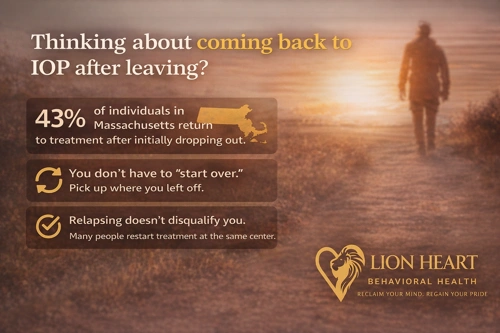
5. Re-Treatment Is More Common Than You Think
It might feel like you’re the only one who didn’t “stick it out.” You’re not.
Plenty of people leave IOP early. Some return to the same program. Some switch to something different. What they share is this: they didn’t give up altogether.
“I bailed halfway through IOP and went right back to using. I felt embarrassed to call again. But when I finally did, the intake person just said, ‘We’re glad you reached out.’ That one sentence changed everything.”
— Alumni, 2023
The truth is, your treatment team wants to hear from you. Even if it’s been months. Even if you think they forgot about you. They haven’t.
6. You Can Try a Different Approach This Time
Maybe your IOP didn’t quite fit your needs. That doesn’t mean all treatment is a mismatch.
Some people need more structure—like a Partial Hospitalization Program (PHP). Some need trauma-focused care. Others benefit from medication support or dual-diagnosis programs.
The point is: if you’ve tried one version of treatment and it didn’t land, that’s not the end of the story. It’s just one chapter.
At Lion Heart Behavioral Health, our drug treatment programs in Raynham are flexible, individualized, and designed to meet you where you are—not where you think you “should” be.
7. It’s Okay to Feel Both Ready and Scared
You can want to come back—and still feel terrified. That’s not a contradiction. That’s being human.
You might worry about failing again. About what people will think. About whether you have the energy to do it.
But fear doesn’t mean stop. It means something matters.
Take the fear with you. And keep moving.
8. Give Yourself Permission to Come Back—Messy, Honest, Whole
You don’t have to show up perfect. Or certain. Or sober.
You can come back messy. Unsure. Mid-relapse. Emotionally raw.
You are still worthy of care.
Whether you’re looking for drug treatment programs in New Bedford, MA or closer to home in Raynham, the door is still open.
What People Say After Returning to Treatment
“I thought I had to explain everything. They just said, ‘Let’s start from today.’”
“I was afraid they’d judge me. They didn’t. They helped me figure out what I needed this time around.”
“Going back was the hardest thing I’ve done. It was also the thing that saved me.”
You don’t have to believe these fully. Just let them be possible.
Frequently Asked Questions About Coming Back to Treatment
Is it common to drop out of IOP?
Yes. Many people leave IOP before completing it—sometimes because life gets in the way, sometimes because the fit isn’t right, and sometimes because it just feels overwhelming. It doesn’t mean treatment failed. It means you’re human.
Will I be judged if I return?
A good treatment center won’t shame you for leaving. Lion Heart Behavioral Health knows that recovery takes time—and that re-entry is often when things really start to click.
Do I have to go back to the exact same program?
Not at all. You might return to the same center but start in a different program level. Or you might try a new approach based on what you learned the first time.
What if I’ve been using again?
You can still come back. You don’t have to be sober to start treatment again. In fact, that’s what treatment is for. Don’t wait to feel “ready enough.”
How do I start the process of re-enrolling?
Just call. You don’t need a speech. You don’t have to explain everything. You can say, “I was in treatment before. I want to come back.” That’s enough.
We’re Still Here. And You’re Still Welcome.
It’s okay that you left. It’s okay if you’re unsure. It’s okay if this feels like a weird or hard step.
But it is a step. And it’s one you can take right now.
Call (774) 341-4502 or visit our Drug Treatment Program page to explore what re-entry could look like for you.
No judgment. No lectures. Just support—from people who understand how hard this part can be.