

You may not have expected this part.
At first, the idea of drinking less — or stopping entirely — might have felt empowering. Healthier mornings. Clearer thinking. More intentional choices.
But then something surprising happens.
A party invitation arrives. A networking event appears on your calendar. A friend suggests meeting at a bar.
And suddenly, something feels different.
Without alcohol in the picture, social spaces can feel louder, more intense, even intimidating. Conversations may feel harder to start. The familiar “social buffer” is gone.
If this sounds familiar, you are far from alone. Many people exploring sobriety notice social anxiety rising to the surface once alcohol is removed from the equation.
That’s why some individuals begin exploring structured mental health support, such as an anxiety treatment program in Massachusetts, to better understand and manage these feelings while building confidence in social environments.
The encouraging news is this: social confidence is absolutely something you can rebuild — often stronger and more authentic than before.
Understand Why Social Anxiety Can Increase When You Stop Drinking
The first step is recognizing that this experience is extremely common.
Alcohol often plays a quiet role in social life. It lowers inhibition, dulls self-conscious thoughts, and temporarily calms the nervous system.
For many people, it becomes an unspoken coping tool.
So when someone begins drinking less, their brain suddenly has to navigate social situations without that familiar shortcut.
The nervous system may respond with heightened awareness:
You may notice your thoughts more clearly.
You may feel more aware of how others perceive you.
You may become sensitive to awkward pauses or uncertain conversations.
This doesn’t mean sobriety created the anxiety.
More often, it simply revealed feelings that alcohol had been masking.
Think of it as turning up the lights in a room. At first, the brightness feels uncomfortable. But eventually your eyes adjust — and you see the room more clearly than before.
Identify the Thoughts That Fuel Social Anxiety
One of the most powerful ways to manage social anxiety is learning how to recognize the thoughts behind it.
Many sober curious individuals experience internal questions like:
“What if people think I’m boring now?”
“What if someone asks why I’m not drinking?”
“What if I say something awkward?”
These thoughts feel convincing because anxiety presents them as warnings.
But they are often exaggerated predictions, not facts.
Learning to pause and examine these thoughts can change their influence.
Instead of accepting them as truth, you begin asking:
Is this assumption realistic?
What evidence supports it?
What would I tell a friend having the same thought?
This shift doesn’t eliminate anxiety instantly, but it reduces its power.
Many people practicing these skills within an Anxiety Therapy Program discover that simply understanding their mental patterns can make social situations far less intimidating.
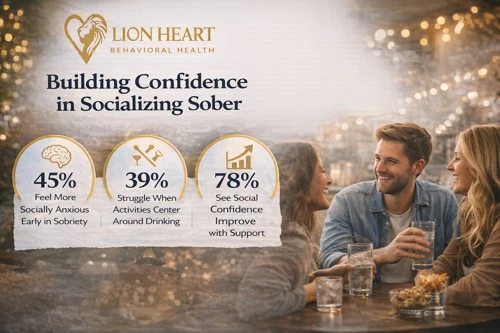
Start With Social Environments That Feel Manageable
Another helpful strategy is choosing environments that support your comfort level while your confidence grows.
You do not have to jump directly into crowded parties or loud nightlife settings.
Instead, begin with lower-pressure social situations.
Coffee meetups.
Walks with friends.
Small dinner gatherings.
Outdoor activities.
These environments create opportunities for connection without overwhelming stimulation.
Confidence builds through repetition.
Every time you successfully navigate a social moment without relying on alcohol, your brain learns something new:
“I can handle this.”
That learning gradually reduces anxiety over time.
Train Your Nervous System Before Entering Social Spaces
Anxiety does not live only in the mind.
It also lives in the body.
Rapid heartbeat.
Tight shoulders.
Restless energy.
Shallow breathing.
When your nervous system is activated, your brain interprets the situation as threatening — even if nothing dangerous is happening.
That’s why calming the body before entering social environments can make such a difference.
Simple techniques can help:
Deep breathing exercises for a few minutes before arriving.
Taking a brief walk to release tension.
Listening to calming music during the drive to the event.
Pausing for a moment of quiet reflection before entering the room.
These small actions signal safety to the brain.
And when the body feels calmer, social interactions often feel easier.
Shift the Goal From Impressing People to Connecting With Them
One of the hidden drivers of social anxiety is the belief that we must perform.
Be interesting.
Say the right thing.
Avoid awkwardness at all costs.
But meaningful connection rarely depends on perfect conversation.
In fact, some of the most genuine interactions include moments of hesitation, laughter, and vulnerability.
Instead of focusing on impressing everyone around you, try reframing the goal.
Your job isn’t to perform.
Your job is to be present.
Ask a question. Listen. Share something real.
Connection happens naturally when people feel seen and heard.
And those interactions often feel more authentic without alcohol in the mix.
Replace the Emotional Role Alcohol Used to Play
For many sober curious individuals, alcohol served more than a social function.
It softened nerves.
It lowered self-consciousness.
It helped quiet racing thoughts.
Once alcohol is removed, those emotional needs don’t disappear.
They simply need new support systems.
This may include:
Mindfulness practices.
Exercise or movement.
Supportive friendships.
Professional mental health guidance.
Many individuals seeking support in Bristol County, Massachusetts discover that structured anxiety care helps them build sustainable coping skills that replace the temporary relief alcohol once provided.
These tools strengthen confidence rather than masking discomfort.
Allow Yourself to Develop a New Social Rhythm
One of the most liberating discoveries sober curious individuals make is that social life does not have to look the same as it once did.
Your preferences may change.
You may enjoy smaller gatherings more than crowded parties.
You may leave events earlier to protect your energy.
You may value deeper conversations over loud environments.
This isn’t losing something.
It’s gaining clarity.
People exploring support options in Raynham, Massachusetts often discover that once anxiety becomes manageable, their social lives become more intentional and fulfilling.
They spend time in environments that actually support their wellbeing.
And that shift can transform the entire social experience.
Confidence Returns — Often in a More Authentic Way
At first, navigating social spaces without alcohol can feel unfamiliar.
You may feel exposed, uncertain, or awkward.
But something powerful happens with time and practice.
You learn you can handle the conversation.
You learn awkward moments aren’t catastrophic.
You learn connection does not require a drink in your hand.
Confidence grows quietly — not from artificial courage, but from genuine self-trust.
And that kind of confidence tends to last.
FAQs
Why does social anxiety appear when someone becomes sober curious?
Alcohol often reduces self-conscious thoughts and lowers inhibition. When people reduce drinking, they may temporarily feel more aware of social pressure or awkwardness.
Is it normal to feel uncomfortable in social situations without alcohol?
Yes. Many people experience this adjustment period. As confidence builds and new coping strategies develop, social situations typically become easier.
Can social anxiety improve over time?
Absolutely. With practice, supportive environments, and healthy coping tools, many people find that social confidence returns stronger than before.
What are helpful coping strategies for sober curious individuals?
Breathing exercises, choosing smaller gatherings, focusing on connection rather than performance, and building supportive friendships can all help reduce social anxiety.
How can professional support help with social anxiety?
Guided support can help individuals identify anxious thought patterns, calm their nervous system, and practice social skills in a supportive environment.
Will social events ever feel enjoyable again without alcohol?
Yes. Many sober curious individuals report deeper conversations, stronger relationships, and greater emotional clarity once they adapt to socializing without alcohol.
Call (774) 341-4502 to learn more about our anxiety therapy program in Bristol County, Massachusetts.