

I didn’t relapse. I just stopped feeling anything.
That was the strange part. I was still sober. Still going through the motions. Still technically “doing well.”
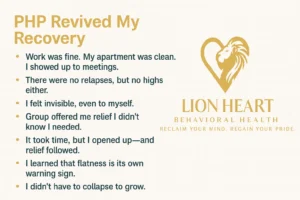
Work was fine. My apartment was clean. I showed up to meetings. I nodded in the right places. Said the right things.
But something inside had gone dark. Not chaotic—just quiet.
Too quiet.
I wasn’t in crisis. I wasn’t about to use. But I also wasn’t living.
It felt like my recovery had run out of color. Everything became muted. I couldn’t tell if I was numb or just…done.
So I did something I didn’t expect: I checked myself into PHP at Lion Heart in Raynham, Massachusetts.
Not because I was falling apart.
But because I didn’t want to.
PHP Wasn’t a Step Back. It Was a Step Toward Myself.
I used to think PHP was just for people in crisis.
For those just out of detox. Or in relapse. Or hanging on by a thread.
But that wasn’t my story.
I wasn’t trying to save my life—I was trying to feel it again.
PHP didn’t strip my independence. It didn’t press reset on my whole recovery. It created space. Space to breathe. Space to ask different questions. Space to say, “I think I’m drifting,” and not be met with pity or pressure.
Lion Heart’s PHP met me where I was: functioning on the outside, but fading on the inside.
I Didn’t Know I Was Disconnected Until I Felt Seen Again
The thing about long-term recovery is that people stop checking in on you.
They assume you’ve got it handled. You’ve been sober for a few years—shouldn’t you be thriving by now?
But here’s the truth no one talks about: thriving isn’t guaranteed.
Not even with a chip. Not even with routines and therapy and all the “right” tools.
I was surrounded by people who loved me. And I still felt completely alone.
In PHP, I said that out loud for the first time:
“I feel invisible, even to myself.”
No one told me to be grateful. No one gave me a worksheet and moved on.
They listened. Really listened. And then they asked better questions. The kind that crack you open just enough to let light in.
The Schedule Helped, But the People Made the Difference
I won’t lie: part of me didn’t want to go back to a structured day.
I had a life. A job. Responsibilities. I wasn’t 23 and falling apart anymore.
But the truth? I needed the structure.
PHP gave my day bones again—healthy routines, steady rhythms, time to process instead of react.
But the bigger shift came from group.
I wasn’t the only long-term alumni there.
There were others who had hit that same flatness. That same “is this it?” moment. Some had relapsed. Some hadn’t. But we all shared the same ache:
We’d stayed sober… but somewhere along the way, we lost touch with why.
Being in a group where I didn’t have to be the “example” was a relief.
I could be raw. Real. Confused. Not just “sober and grateful.”
I Found My Voice Again—And It Was Messy
Long-term recovery gave me a lot. But it also made me quiet in a weird way.
I got good at saying the “right” things in meetings.
I stopped talking about stuff that didn’t fit the narrative.
I didn’t want to “bring down the room,” so I just stopped sharing.
In PHP, I finally said things I hadn’t said in years:
- “I don’t feel connected to anyone.”
- “I’m scared I’m doing everything right and still missing the point.”
- “I feel like a ghost in my own life.”
And no one looked away.
They leaned in.
There’s something holy about that—being heard without being fixed.
That’s where I found my voice again. Not the polished one. The real one. The one that shakes and stutters and still deserves a mic.
I Didn’t Need to Be in Crisis to Need More
I used to wait until I was breaking down before I asked for help.
This time, I didn’t.
That’s something I’m proud of.
Because I’ve learned that you don’t have to fall apart to want more.
You don’t have to hit bottom to ask for support.
Flatness is its own kind of warning sign.
So is over-functioning.
So is smiling while secretly wondering what the point is.
PHP taught me that prevention is valid. That support isn’t just for emergency use. It’s for recalibration. Reconnection. Reflection.
I didn’t check in because I was failing.
I checked in because I was still worth showing up for.
I Left With More Than Insight— I Left With Direction
By the time I finished the program, I didn’t just feel better.
I felt oriented.
I had:
- A list of things I wanted to try again (even if I wasn’t good at them)
- A therapist I actually connected with
- A plan for what to do when the numbness creeps back
- A few people who got it—and still text me now and then, just to check in
But mostly?
I had a deeper knowing: that sobriety is not the same as aliveness.
And I want both.
PHP didn’t give me all the answers. But it made me brave enough to ask better ones.
FAQs for Alumni Considering PHP
Is PHP only for people who are actively using?
No. In fact, many PHP clients are sober but struggling. PHP is for anyone who needs structure, support, and therapeutic space—whether you’re newly in recovery or years into it.
Will people think I’m relapsing if I go to PHP again?
Maybe. But their assumptions don’t matter. What matters is what you need. Going back to PHP doesn’t mean you’re failing—it means you’re paying attention.
How long does PHP last?
Programs vary, but most PHP tracks run for several weeks. Lion Heart Behavioral Health will work with you to customize the timeline based on your needs, goals, and schedule.
Can I work or go to school while doing PHP?
Most PHPs are daytime programs and require a temporary pause from full-time commitments. But Lion Heart can help you figure out logistics—and there are often step-down options like IOP once you’re ready.
I’ve done treatment before. Is this just more of the same?
Not at Lion Heart. PHP here is designed for people who’ve done the work and still want more. It’s layered, intentional, and geared toward people with depth—not just people in crisis.
If You’ve Been Quiet Too Long, This Might Be Your Moment
You don’t have to make a dramatic exit from your life to step into something deeper.
You just have to be willing to say,
“Something feels off. And I don’t want to ignore it anymore.”
Lion Heart’s PHP program in New Bedford, Massachusetts isn’t just a place to stabilize—it’s a place to realign.
If you’ve been going through the motions…
If you miss your own voice…
If you’ve stayed sober but lost your spark…
Maybe it’s time.
Feel Like You’ve Been Quiet Too Long?
Call (774) 341-4502 or visit our Partial Hospitalization Program in Raynham, Massachusetts to reconnect with the version of yourself who still wants more. You’re not too late. You’re just ready.