

When your child ends up in the hospital for a mental health crisis, it can feel like the ground has given out from under you.
The fear, the confusion, the silence from doctors who can’t give you clear answers—it’s overwhelming. And even when the immediate danger passes, it’s hard to know what comes next.
But crisis isn’t the end of the road. With the right care, it can be the first step toward healing.
At Lion Heart Behavioral Health, our mental health treatment programs in Massachusetts help families move from panic to progress—one small, steady step at a time.
After the Hospital: Now What?
Discharge day often feels like a moment you should be celebrating. Your child is stable enough to come home. They’re not in immediate danger. The worst, you hope, is over.
But then reality sets in.
They’re still withdrawn. They might be irritable, shut down, or scared to talk.
And you’re suddenly the one managing medications, follow-ups, school or work re-entry—and the emotional chaos that often follows a behavioral health crisis.
This is where structured outpatient mental health treatment makes the difference. It offers more than a plan. It offers partnership.
Why Ongoing Mental Health Treatment Matters
Hospitalization is designed to stabilize—not to heal.
It stops the crisis.
It doesn’t unravel what led to it, or give your child the tools they need to avoid future spirals.
That’s where outpatient treatment comes in.
Mental health treatment helps your child:
- Learn to identify early warning signs
- Understand their diagnosis (if one applies)
- Build emotional regulation skills
- Reconnect with a sense of identity that’s not defined by crisis
It also helps you—as a parent—understand how to support without controlling, how to set boundaries without rejection, and how to move forward without walking on eggshells.
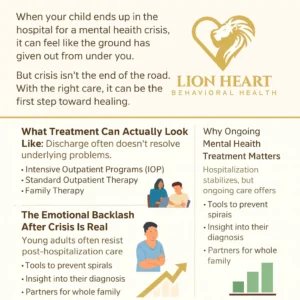
What Treatment Can Actually Look Like
Many families picture therapy as one hour a week in a quiet office. And for some, that’s enough.
But for young adults recovering from a behavioral health crisis, more support is usually needed—at least in the beginning.
At Lion Heart, we offer programs tailored to each client’s needs. Depending on severity, history, and life circumstances, we may recommend:
- Intensive Outpatient Programs (IOP): Multiple sessions per week, including group and individual therapy.
- Standard Outpatient Therapy: Weekly one-on-one sessions, focused on building insight and coping skills.
- Family Therapy: A space for honest conversation, healing, and learning new ways to relate.
- Psychiatric Support: Medication evaluation and management, if clinically appropriate.
These services are coordinated with care—so your loved one isn’t just “going to therapy,” but moving through a clear plan toward stability and resilience.
The Emotional Backlash After Crisis Is Real
One of the hardest parts of post-crisis recovery is that things can actually feel worse before they get better.
We see this often. A young adult gets discharged from inpatient care. Parents are hopeful. But within days, there’s friction.
They don’t want to talk.
They’re tired of being monitored.
You feel shut out and terrified all over again.
This is a common and deeply human reaction.
Hospitalization is often disorienting. It strips away routine, privacy, autonomy. Even if it saved their life, your child may carry shame or resentment about the experience. That’s normal.
A strong mental health treatment plan allows space to process all of this—so that emotions don’t get buried, and families don’t get stuck.
What Healing Might Look Like (Hint: It’s Not Linear)
There’s no universal roadmap for recovery. But we can tell you what it often includes:
- A return to routine, one piece at a time
- A therapist your child actually connects with
- Setbacks that don’t turn into spirals
- Rebuilding trust—slowly, painfully, but authentically
- A moment, six months from now, where your child laughs in a way you haven’t heard in ages
Healing doesn’t erase what happened. It integrates it.
Mental health treatment isn’t about “fixing” your child—it’s about helping them live with more agency, clarity, and self-compassion.
You’re Allowed to Be Scared and Still Be a Good Parent
There’s a particular kind of grief that comes with watching your child struggle with their mental health.
It’s invisible. It’s heavy. And it doesn’t get talked about enough.
You might feel:
- Guilty for not noticing sooner
- Powerless to protect them
- Angry at the system—or even at your child
- Completely alone
Here’s what we want you to know: none of those feelings make you a bad parent.
They make you a human one.
At Lion Heart, we hold space for that, too.
We work with families who are learning how to show up differently. Not as saviors. Not as problem-solvers. But as steady, loving people navigating something impossibly hard.
Why Family Involvement Helps Recovery Stick
Many parents ask if they’ll be included in treatment—and if that means their child won’t get to speak freely.
The truth is, both things can be true. Your child needs privacy in therapy.
But they also need safe, functional relationships outside of it.
Family therapy helps create that. And it’s not about pointing fingers.
It’s about building new ways of listening, validating, setting boundaries, and repairing breaks in connection.
Even if your child resists it at first, we’ve seen time and time again how family involvement—at the right pace—can soften resistance, reduce isolation, and strengthen recovery. If you’re in New Bedford or anywhere in Bristol County, Lion Heart provides programs built on that same compassionate approach.”
FAQ: Mental Health Treatment After Hospitalization
How soon after discharge should treatment begin?
Ideally, treatment should begin within a week of discharge. That continuity helps prevent relapse and keeps your loved one supported during a vulnerable time.
What’s the difference between outpatient and IOP?
Outpatient care is typically 1–2 sessions per week. IOP includes several sessions across the week and is ideal for people who need more structure and support, but don’t require hospitalization.
Will my child have to take medication?
Not necessarily. We assess each client individually. Medication is recommended only when clinically appropriate and is always discussed transparently with families.
Can I be involved in treatment?
Yes. We often include family therapy or parent sessions, especially during the early stages of recovery. We balance this with your loved one’s need for autonomy.
Is it too late if my child has already relapsed?
Not at all. Recovery is rarely a straight line. Every moment of re-engagement is an opportunity. We meet clients where they are.
Do you work with clients who don’t have a formal diagnosis?
Yes. Many clients come to us with symptoms or struggles that haven’t been labeled. A diagnosis isn’t required to begin care.
Is this covered by insurance?
We accept many major insurance plans. Our team will verify benefits and explain all options before starting treatment.
Hope Isn’t a Guarantee—But It’s a Starting Point
If your child is still struggling after a crisis, and you don’t know what to do next, take a breath.
It’s okay not to have all the answers.
It’s okay to feel heartbroken and unsure.
It’s okay to want help—not just for them, but for yourself, too.
What we know is this: healing is possible. Not always fast. Not always smooth. But real.
And mental health treatment gives you a place to start.
When You’re Ready, We’re Here
Call (774)238-5533 or visit our mental health treatment services in Raynham, Massachusetts to learn how we help families move forward after crisis.
We’ll meet you where you are—with steadiness, care, and a plan you don’t have to carry alone.