

I wasn’t in crisis. I wasn’t relapsing.
But I wasn’t okay either.
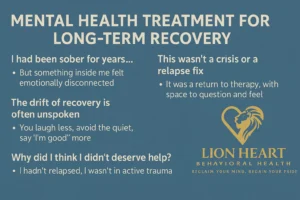
I’d been sober for a while—years, actually.
I had a steady job, a couple of people who loved me, a decent handle on life.
And still, something inside me felt… quiet. Not in a peaceful way. In a distant, emotionally sleepwalking kind of way.
That’s the version of me that walked back into treatment.
Not the panicked version, not the one clawing their way out of chaos—but the one who looked fine, functioned fine, and didn’t feel much of anything at all.
The Drift I Couldn’t Name
No one talks enough about the drift that can happen in long-term recovery.
You’re doing the work. You’re not using. You’re keeping it all together.
But emotionally, things start to blur.
You laugh less. You say “I’m good” more—because you don’t really know what you are.
You start to avoid the quiet, because when you finally stop moving, the emptiness gets loud.
It’s not the high-alert survival mode of early recovery.
It’s something more invisible. More hollow.
A slow leak that doesn’t scream—but quietly deflates.
That’s what I was living with. And the longer it went unnamed, the heavier it got.
Why I Thought I Didn’t Deserve Help
I didn’t feel “bad enough.”
I hadn’t relapsed. I wasn’t in active trauma. I wasn’t withdrawing from anything except—maybe—my own life.
I told myself this was just the natural flattening of recovery.
That maybe this was the trade-off for stability: you give up the chaos, and the color goes with it.
But underneath that logic was fear.
Fear that if I reached out for help, I’d be seen as back at square one.
Fear that maybe I’d already gotten all the healing I was going to get.
Fear that saying “I need something more” would make me sound ungrateful.
It took me months to realize that those thoughts were symptoms too—not facts.
The Moment I Knew I Needed Something More
It was a Tuesday morning. I was making coffee and scrolling through a playlist that used to make me feel something—nostalgia, sadness, joy, anything.
And I felt nothing.
That absence, more than any big breakdown, is what moved me to act.
Because I knew what it had felt like when I first got sober—raw and messy and deeply alive.
And I knew this wasn’t that.
So I reached out. Quietly.
No announcement, no breakdown post, no sponsor call.
Just a form on the Lion Heart website. A one-line message:
“I’m in long-term recovery but feel emotionally disconnected. Do you work with that?”
The answer was yes.
Starting Again Without Starting Over
That first session back felt weird.
I wasn’t sure where to begin.
Do I explain my whole history? Do I talk about my timeline, the milestones, the relapse-free years?
But my therapist didn’t ask for a rundown.
She asked, “What feels like it’s missing?”
That question opened something in me.
We didn’t start from the beginning. We started from now.
We started with the questions that had been humming beneath the surface of my days:
- Why does everything feel muted?
- Why do I keep moving even when I’m tired?
- Why do I feel like a visitor in my own life?
That became the work. And it was sacred.
What Mental Health Treatment Gave Me This Time
This wasn’t a “crisis fix.” This wasn’t relapse prevention.
This was a return. A reawakening.
Here’s what I learned:
- You can be sober and still emotionally starving. Sobriety is a foundation, not a finish line.
- Grief doesn’t follow a timeline. Some of my flatness was unprocessed grief—layers I didn’t have capacity to face in early recovery.
- Stability without connection isn’t peace—it’s paralysis. I’d built a good life, but I’d stopped inhabiting it.
- Growth can be gentle. This wasn’t a hurricane. It was more like opening a window I hadn’t touched in years.
Therapy helped me see that my disconnection wasn’t regression.
It was a call to deepen—not start over.
Why This Time Felt More Real
In early recovery, I chased healing with urgency. It was survival.
But this time, there was space.
To question. To reflect. To feel without scrambling to fix.
I got curious about things I used to bulldoze:
- What makes me feel safe now?
- What am I avoiding with busyness or “helpfulness”?
- Who am I outside of the identity of “person in recovery”?
The answers didn’t come all at once. But they came.
And slowly, the color came back too.
What I’d Say to Anyone Feeling Quietly Lost
If your recovery feels… faded.
If your life is good enough but feels far away.
If you’re showing up but not really there.
It’s not just you.
And it’s not forever.
You don’t have to be falling apart to deserve more connection.
You don’t need a relapse to justify re-engaging with care.
You don’t have to be in crisis to feel spiritually hungry.
Saying yes to mental health treatment again isn’t failure. It’s faith—that there’s still more to become.
FAQ: Mental Health Treatment for Long-Term Recovery
Is it normal to feel emotionally flat after years of sobriety?
Yes. It’s more common than people admit. Therapy can help you reconnect with meaning, emotional depth, and a sense of aliveness beyond just stability.
Do I have to go over my whole history again?
Not unless you want to. At Lion Heart Behavioral Health, we focus on where you are now. Your past matters—but your present leads the way.
What if I’ve “already done therapy”?
Healing is layered. The tools you used before may no longer fit your current life. New seasons call for new kinds of support.
Will I be treated like a newcomer?
No. Your experience in recovery is respected. The work we do together builds on what you already know—with space to explore what you’ve outgrown.
Is it okay to come back to treatment without a crisis?
Absolutely. In fact, some of the most transformative therapy happens when you’re stable enough to go deeper.
If You’re Craving More Than Just “Fine,” We’re Here
Call (774)238-5533 or visit our mental health treatment page in Raynham, Massachusetts to learn how we support long-term alumni who want more than maintenance. You’re not starting over. You’re expanding what recovery can mean now. If you’re in New Bedford or anywhere in Bristol County, Lion Heart provides programs built on that same approach.”