

Even when your calendar is full and your to-do list is checked off, something underneath might not be okay.
Holding down a job, caring for your kids, being the reliable one—it’s exhausting when you’re also trying to hide a problem you don’t know how to name. At Lion Heart Behavioral Health, our Intensive Outpatient Program in Massachusetts is built with this reality in mind.
We don’t assume your life is falling apart. We know the pressure it takes to keep it looking like it’s not.
You Don’t Have to “Fall Apart” to Qualify for Help
One of the most common things we hear from high-functioning clients is this:
“I didn’t think I was bad enough to need help.”
You don’t need a crisis to qualify for care. You don’t need a DUI, an intervention, or a rock bottom. What you need is a moment of honesty—one where you admit that something doesn’t feel sustainable.
Some of our IOP clients are managing teams at work. Others are running households, parenting toddlers, or caring for aging parents. They still show up. But inside, they’re unraveling.
That unraveling doesn’t always look like chaos. Sometimes, it just feels like disconnection, exhaustion, or dread that you’ve learned to silence.
IOP isn’t a punishment for falling apart. It’s a chance to reimagine what your life could feel like if you weren’t keeping so many secrets.
What High-Functioning Struggle Often Looks Like
We see clients who:
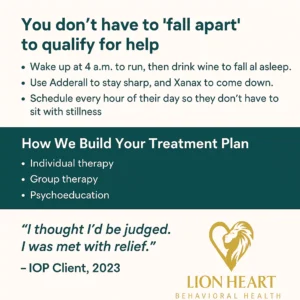
- Wake up at 4 a.m. to run, then drink wine to fall asleep.
- Use Adderall to stay sharp, and Xanax to come down.
- Schedule every hour of their day so they don’t have to sit with stillness.
From the outside, it looks like discipline. Inside, it’s often avoidance, anxiety, or pain. Sometimes, it’s trauma that was never addressed. Sometimes, it’s a slow bleed of self-betrayal—saying yes when you mean no, smiling when you’re breaking.
What’s hardest for these clients isn’t function—it’s rest. It’s honesty. It’s the fear of being seen without the armor.
IOP makes space for that without blowing up the rest of your life.
How We Build Your Treatment Plan (Without Disrupting Your Life)
Our IOP isn’t pre-packaged. We start by asking:
- What’s working for you?
- What’s not?
- Where do you feel like you’re pretending the most?
From there, we build a care plan that meets you where you are. Most IOP schedules involve 9–12 hours of therapy per week. For high-functioning clients, we often begin with:
- Individual therapy: To unpack the patterns you’ve kept hidden.
- Group therapy: To learn you’re not the only one keeping up appearances.
- Psychoeducation: To understand what’s happening under the surface—why control feels like safety, why substances became tools, why exhaustion feels earned.
We don’t ask you to quit your job. We don’t ask you to walk away from your life. We ask you to let us walk with you—so you don’t have to carry it all alone.
“I Thought I’d Be Judged. I Was Met With Relief.”
One of our clients—a professional in his 40s—told us he’d rehearsed what to say for weeks before coming to group. He was afraid of being the “least qualified” person there.
Instead, this is what he said after the first session:
“I thought I’d be judged. I was met with relief. Everyone else was just as good at hiding it.”
– IOP Client, 2023
That’s the reality many high-functioning people discover: the hiding is what’s keeping you sick. Not the drinking. Not the perfectionism. Not the overcommitment. It’s the silence around it all.
IOP helps you build new language, not just new habits.
Why IOP Is a Strategic Fit for High-Functioning Clients
We’ve designed our IOP to offer structure without suffocation. It’s intensive—but it doesn’t require you to disconnect from your real life. That balance is crucial for high-functioning people, especially those who’ve spent years using substances to maintain control, not escape it.
What makes IOP effective for this population:
- Time-bound commitment: You engage meaningfully without stepping away from work or parenting.
- Accountability without surveillance: You’ll be seen, but not micromanaged.
- Clinical expertise with flexibility: We’re trained to recognize hidden patterns and adjust care accordingly.
- Therapy that honors your intelligence: You won’t be talked down to. We meet you as the capable, struggling human you are.
What If You’re Still Not Sure This Is “Serious Enough”?
You’re not alone in that doubt. Here’s a short list of common signs that often get dismissed—but can indicate the need for IOP-level care:
Signs You Might Be Holding It Together on the Outside but Struggling Internally:
- You only feel calm after drinking, using, or numbing.
- You dread weekends or downtime because they feel empty.
- You lie about small things—how much you drank, how tired you are, why you missed that call.
- You’re excelling publicly, but privately you feel robotic or disconnected.
- You’ve tried to cut back “on your own” more than once, without success.
If these sound familiar, it’s not about being broken. It’s about being tired—and needing a different kind of support.
IOP in Raynham, Massachusetts: Local Care with Real Roots
At Lion Heart Behavioral Health, we’re not a chain. We’re a local clinic with real people who know what it’s like to carry hard things in private. We work with clients all across Bristol County—including Raynham, Taunton, Easton, and the surrounding area.
Our clinicians specialize in building care around your actual life—not some idealized version of it. Whether you’re a teacher, a parent, a business owner, or just someone who’s gotten good at pretending—you’ll be treated with respect, clarity, and confidentiality.
FAQ: IOP for High-Functioning Clients
Do I have to stop working to attend IOP?
No. Our IOP schedule is designed to support working professionals, parents, and caregivers. Evening and daytime tracks are available to accommodate your life.
What if I’m not ready to talk about my substance use?
That’s okay. Many clients start with stress, anxiety, or burnout as the focus. We follow your lead—and build trust before pushing deep.
Will I be in a group with people in very different situations?
Possibly—but that’s not a bad thing. IOP groups are often diverse in age, background, and experience. What matters is that everyone is working toward honesty, change, and support.
Can I still attend events, travel, or handle responsibilities during IOP?
Yes, within reason. IOP is flexible but requires commitment. We’ll work with you to plan around important obligations.
Is IOP covered by insurance?
In many cases, yes. We accept a range of insurance plans and will verify benefits for you before you begin.
What if I want to keep this private from my job or family?
Confidentiality is central to our program. We’ll talk with you about how to maintain privacy while still getting the care you need.
The Quiet Crisis Doesn’t Need to Get Louder
Some people crash before they seek help. Others coast—high-functioning, high-performing, and slowly breaking on the inside.
If that’s you, know this: You don’t have to wait until it gets worse.
You don’t need to prove how bad it is to deserve help.
You’re allowed to want more than survival.
At Lion Heart, our IOP in Raynham, Massachusetts is designed for people like you—people who look fine but don’t feel fine. People who are exhausted from managing the image, and ready for something real.
Call (774)238-5533 or visit our IOP page to learn more. You don’t need a perfect explanation to reach out. You just need to be tired enough to want something different. If you’re near New Bedford, or Bristol County, Lion Heart offers programs with that same approach.