

I didn’t have a dramatic bottom.
No car crash. No intervention. No jail time.
Just a quiet unraveling. The kind that looks like high performance from the outside—until you zoom in.
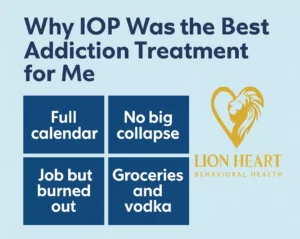
I had a good job. A full calendar. Groceries in the fridge. And vodka in the laundry basket. I didn’t think I was “addicted.” I thought I was just coping—wrong, maybe. But not “bad enough” to need help.
When I finally started googling treatment options, I did it with one hand while answering work emails with the other. I didn’t want a residential facility. I didn’t want to disappear for 30 days. I didn’t even want anyone to know.
What I found instead was an intensive outpatient program (IOP) in Massachusetts. And for me? It was the only kind of treatment that ever made sense.
I Was Functioning—But Barely
You know that meme about being “one inconvenience away from a full breakdown”? That was me.
My life looked intact—but I was managing it like a one-person circus act. My mornings started with shame, my evenings ended with wine, and the middle was a blur of high-functioning burnout.
I didn’t feel “out of control.” I just didn’t feel anything—except exhausted.
I wasn’t drinking at work. I wasn’t missing deadlines. But I was disappearing from my own life. And eventually, even I couldn’t pretend I wasn’t scared.
So I looked for help that wouldn’t blow up my world. Help that could fit into the life I had—because for better or worse, I still had one.
That’s when I found IOP.
IOP Let Me Keep My Life—While Rebuilding It
Here’s what most people don’t understand:
When you’re high-functioning, it’s not that you don’t want help. It’s that you feel like you can’t afford to stop.
IOP gave me a way to get real support without walking away from everything else. I didn’t have to disappear. I didn’t have to quit my job. I didn’t have to explain my absence to clients or coworkers or my own mother.
Three evenings a week. Structured groups. One-on-one sessions. Enough to keep me honest, but not so much that it felt impossible.
And in between sessions? I went home. I made dinner. I cried in the shower. And I showed up again.
It wasn’t dramatic. It wasn’t glamorous. But it worked.
I Finally Had a Place Where I Didn’t Have to Pretend
Group therapy terrified me. I pictured cold chairs and forced sharing and strangers judging my “not bad enough” story.
But when I walked into my first IOP group at Lion Heart in Raynham, MA, something cracked open.
People didn’t talk about “hitting bottom.” They talked about hiding. About functioning. About fear. About drinking alone after tucking their kids into bed. About feeling like frauds.
I sat there thinking, Wait… this is allowed?
It wasn’t about confessing. It was about finally exhaling.
IOP gave me space to talk honestly about the alcohol, yes—but also the anxiety. The panic. The pressure. The “Why am I like this?” that haunted me even on my best days.
It Wasn’t Just About Quitting—It Was About Understanding
I’d tried to quit on my own before.
I white-knuckled it. I deleted apps. I promised myself, “Just weekends.”
But every time I got quiet, the panic started. The loneliness kicked in. The self-doubt screamed louder than the hangover.
What I didn’t realize was that my drinking was a symptom—not the whole story.
IOP didn’t just help me stop. It helped me understand.
I learned how my brain works when it’s overwhelmed. How trauma can wear business-casual. How avoidance becomes a lifestyle.
I didn’t need more discipline. I needed more compassion—and better tools.
Looking for an intensive outpatient program in Bristol County, MA? This kind of care exists. Quiet. Respectful. Deep. And built for real life.
IOP Wasn’t a Detour—It Was the On-Ramp
At first, I worried that treatment would derail everything I’d worked so hard to hold together.
What I didn’t expect was that it would help me re-enter my life.
More present. More honest. Less frantic.
I still had to work. I still had stress. But the spiral loosened.
And here’s the truth no one told me: Recovery doesn’t have to be a wrecking ball.
Sometimes it’s a scaffolding. Quiet. Supportive. Holding you up while you rebuild.
What I Wish I Could Tell Anyone Who Feels Like I Did
You don’t have to wait for things to explode.
You don’t have to be sure it’s “bad enough.”
You don’t have to wear yourself down to the bone before asking for help.
If you’re searching for an intensive outpatient program in New Bedford, MA or nearby, start with this:
It’s okay to need support before everything falls apart.
It’s okay to be high-functioning and not okay.
It’s okay to want more from life than just getting through it.
Frequently Asked Questions (FAQs)
What exactly is an intensive outpatient program (IOP)?
An IOP is a structured treatment program that usually meets several times a week (often 3–4 days for a few hours each session). It includes therapy groups, individual counseling, and support for both substance use and mental health—without requiring you to live onsite.
How is IOP different from inpatient or residential treatment?
Inpatient or residential treatment is 24/7 and often involves stepping away from daily life completely. IOP lets you live at home, work, care for family, and maintain your responsibilities while still receiving structured support.
Can I go to work or school while in IOP?
Yes. That’s actually one of the biggest benefits of IOP. Many programs, including ours in Raynham, offer evening or flexible scheduling to accommodate work or school.
Is IOP just for people who already went to detox or inpatient?
Not necessarily. IOP can be a first step for people who don’t require 24/7 supervision or medical detox. It’s often ideal for high-functioning individuals or those stepping down from a higher level of care.
What if I’m not sure I’m “bad enough” for IOP?
If you’re asking that question, it’s probably worth a conversation. IOP isn’t about being “bad enough.” It’s about being honest enough to admit something isn’t working—and brave enough to get help.
Here’s Your Quiet Invitation to Begin
You don’t have to scream for help to be heard.
You don’t have to crash to course-correct.
Call (774) 238-5533 to learn more about our intensive outpatient program services in Raynham, Massachusetts.
There’s a place for people who keep it together—and are still falling apart inside. I found mine in IOP. Maybe you will, too.