

I didn’t go back because I believed in it.
I went back because I didn’t know what else to do.
That’s an important distinction. The first time, I walked in with some level of hope—even if it was shaky. The second time, I walked in with resistance, doubt, and a quiet voice in my head saying, “This probably won’t work again.”
If you’ve ever felt that, you’re not alone.
At some point, I found myself revisiting structured daytime care, not because I trusted the process—but because I was tired of feeling stuck in the same loop.
I Wasn’t Open — I Was Just Out of Options
Let me be honest.
I didn’t show up ready to change. I showed up because things weren’t working outside of treatment either.
There’s a difference between choosing something and defaulting to it.
The first time I went, I tried to be the “good client.” I said the right things, participated enough to be seen as engaged, and avoided anything that felt too uncomfortable.
The second time?
I didn’t have the energy to keep that up.
And strangely, that made me more real than I had been the first time.
I Thought the Outcome Was Already Decided
One of the hardest parts of going back was this quiet assumption:
“I already know how this ends.”
That belief is heavy. It takes the possibility out of the experience before it even begins.
Because if you’ve already decided something won’t work, everything starts to feel like proof of that.
A slow day becomes confirmation. A difficult conversation becomes evidence. A moment of doubt becomes a reason to check out.
I carried that mindset with me for a while.
But over time, something shifted—not because I forced it, but because I stayed long enough to question it.
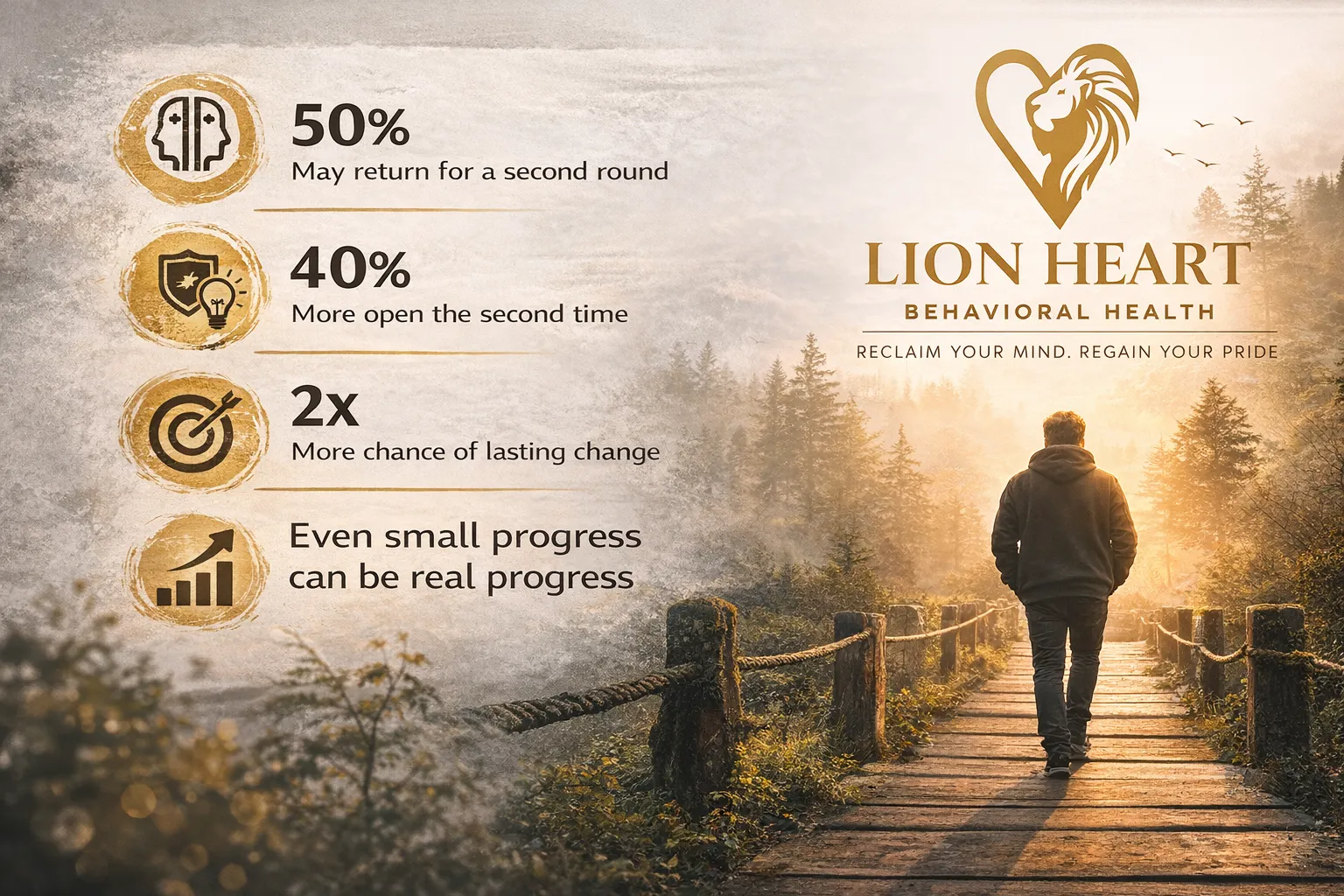
I Stopped Performing and Started Showing Up Honestly
The biggest difference wasn’t the structure. It wasn’t the schedule. It wasn’t even the people.
It was me.
The first time, I filtered everything:
- What I shared
- How I said it
- What I held back
I didn’t want to look like I was struggling more than I “should” be.
The second time, that mask got exhausting.
So I stopped trying to look okay.
I said things that felt unfinished. Messy. Unimpressive.
And instead of things falling apart, something else happened:
People met me there.
Not the polished version. The real one.
It Didn’t Feel Better Right Away — And That Threw Me Off
I expected that if this was “working,” I would feel it quickly.
Relief. Clarity. Something noticeable.
But that’s not what happened.
It felt slow. Uneven. Sometimes pointless.
And honestly, that made me question everything again.
But here’s what I didn’t realize at the time:
Not feeling better right away doesn’t mean nothing is happening.
Some of the most important shifts don’t feel like progress when you’re in them. They feel like discomfort. Like resistance. Like sitting in something longer than you want to.
That doesn’t mean it’s not working.
It might mean it’s finally reaching something real.
The Small Changes Were Easy to Miss — But They Mattered
There wasn’t a single breakthrough moment.
No big realization that suddenly changed everything.
Instead, it was smaller:
- I stayed in conversations instead of shutting down
- I noticed patterns instead of ignoring them
- I admitted things out loud that I used to avoid
At the time, those felt like nothing.
But looking back, they were everything.
Because those small changes added up.
Quietly. Gradually.
Until one day, I realized I was engaging differently than I had before.
I Let Go of Comparing It to My First Experience
For a while, I kept measuring everything against my first time in treatment.
“This part feels the same.”
“This didn’t help before.”
“Why would this be different?”
That comparison made it impossible to see what was different.
Because I wasn’t actually present—I was evaluating.
The shift happened when I stopped asking, “Is this better than last time?” and started asking, “What’s actually happening right now?”
That question is simpler. Less loaded.
And it gave me space to notice things I had been missing.
I Realized the First Time Wasn’t a Waste
This one took time to accept.
I used to think:
“That didn’t work. I failed.”
But the truth is, I learned things the first time.
I just didn’t use them yet.
Coming back, I started recognizing ideas, tools, even conversations—but now they landed differently.
Not because they changed.
Because I did.
That doesn’t mean the first attempt was pointless.
It means it wasn’t finished.
The Environment Felt Different Because I Was Different in It
It’s easy to assume that if something didn’t work before, the setting is the problem.
And sometimes, that’s true.
But sometimes, the shift comes from how you engage with the same structure.
This time, I:
- Asked more honest questions
- Let myself sit in discomfort instead of avoiding it
- Stopped trying to “win” treatment
That last one matters more than it sounds.
Because when you stop trying to prove you’re doing well, you create space to actually be where you are.
And that’s where change starts.
Doubt Didn’t Go Away — It Just Stopped Running Everything
I didn’t suddenly become confident in the process.
I still had doubts.
I still questioned whether it would last.
I still had moments where I thought about leaving.
But those thoughts stopped being the only voice in the room.
They became part of the experience—not the thing controlling it.
That’s a different kind of progress.
Not the absence of doubt, but the ability to keep going anyway.
For Some People, the Second Time Feels More Real
I’ve talked to others who’ve had similar experiences.
People who said:
“I didn’t get it the first time.”
“I wasn’t ready yet.”
“I thought it didn’t work for me.”
And then something changed—not overnight, not dramatically—but enough to make the second experience feel more grounded.
In places like New Bedford, Massachusetts, where people often juggle work, family, and personal struggles all at once, stepping back into care can feel like adding more weight.
But sometimes, it’s actually what helps redistribute that weight.
Not by removing everything—but by giving you a different way to carry it.
You Don’t Have to Believe — You Just Have to Show Up Differently
If you’re skeptical, I get it.
You’re not wrong for feeling that way.
But here’s something I wish someone had told me:
You don’t need to believe this will work.
You don’t need confidence.
You don’t even need hope.
You just need a small willingness to try differently.
That might look like:
- Saying one thing you’ve been avoiding
- Staying one extra day when you feel like leaving
- Letting yourself be seen, even a little
That’s it.
Not perfection. Not certainty.
Just a shift.
The Turning Point Was Quieter Than I Expected
There wasn’t a dramatic moment where everything clicked.
No sudden clarity.
Just a slow realization:
“This feels different.”
Not easier. Not perfect.
But different enough to keep going.
And sometimes, that’s all you need.
FAQs: For People Who Think Treatment Didn’t Work
What if I already tried and it didn’t help?
That experience matters.
But sometimes the first attempt builds awareness that only becomes useful later. Going back isn’t repeating—it’s continuing.
How do I know this time will be different?
You don’t.
But small changes in how you engage can create a very different experience, even in a familiar setting.
What if I still feel resistant?
That’s okay.
You don’t need to eliminate resistance to move forward. You just need to not let it make every decision for you.
What if I leave again?
That’s a real possibility—and it doesn’t erase your effort.
Instead of focusing on staying forever, focus on staying longer than before.
Is it worth trying again if I don’t believe in it?
It can be.
You don’t need full belief. Sometimes curiosity, frustration, or even exhaustion is enough to open the door.
A Final Thought
I didn’t go back because I trusted it.
I went back because something in me wasn’t ready to give up completely.
And that small part—the one that was still willing—ended up being enough to change how the experience felt.
In communities like Raynham, Massachusetts, where people often carry a lot quietly, that willingness can be easy to overlook.
But it matters.
More than you think.
Ready to Explore What This Could Look Like?
If part of you is even slightly open to trying again, that’s enough to start.
Call (774) 341-4502 to learn more about our programs, Partial Hospitalization Program in Bristol County, MA.