

You don’t expect to become the parent who’s Googling therapy programs at midnight. But here you are.
Not because you failed.
Not because your child is broken.
But because something is happening—and it feels bigger than you.
Maybe your teen used to talk, and now they barely look at you. Maybe your college-aged child suddenly came home and won’t leave their room. Maybe it’s subtle. Maybe it’s loud. But something in your gut says: This isn’t just growing pains.
If this is where you are, please know: you are not alone. You’re not crazy. And you’re not supposed to fix this all by yourself.
This is how an Anxiety Therapy Program in Raynham, MA can help you—and your child—navigate the moments that feel impossible.
What Anxiety in Teens and Young Adults Really Looks Like
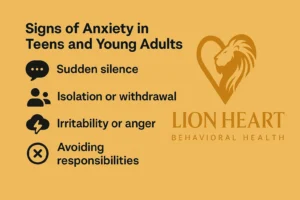
Anxiety is not always panic attacks or hyperventilation. It’s not always a clear cry for help. In many cases, especially for teens and young adults, it looks like:
- Sudden silence
- Isolation that used to be introversion—but now feels like a shutdown
- Anger that flashes and disappears, leaving confusion in its place
- Missed classes, skipped meals, abandoned responsibilities
- Vague “I’m fine” responses that don’t match what you’re seeing
As a parent, you may find yourself asking questions you never imagined:
- Do I push, or back off?
- Is this rebellion or something deeper?
- Am I making it worse by worrying too much—or not enough?
This uncertainty is its own kind of grief. You miss the version of your child who laughed, opened up, or even just showed up. But right now, you’re stuck navigating a fog no one trained you for.
You’re Not Weak for Needing Support
Many parents hit this wall silently. They try to be patient. Try to stay calm. They Google coping tips at 2 a.m., skim articles on adolescence, and wonder when it became so hard to simply connect.
You are not weak for feeling overwhelmed.
You are not too late.
You are not the only one whose child is unraveling in a way you don’t know how to hold.
When you reach out to an anxiety therapy program—whether it’s in Raynham, New Bedford, or Bristol County, MA—you’re not “sending them away.” You’re giving your child (and yourself) a space that isn’t loaded with fear, history, and parental pressure.
What an Anxiety Therapy Program Actually Does
Let’s demystify it.
An anxiety therapy program isn’t just about talking through fears. At Lion Heart Behavioral Health, it’s about creating a new kind of safety—especially when the old ways of parenting aren’t enough to reach what’s really going on.
The program supports both the individual (your child) and the system (your family). It provides:
- Assessment that goes beyond surface symptoms. Is it anxiety? Is it depression showing up like anxiety? Is it trauma? We help clarify, gently.
- Tools to regulate the nervous system. Breathing, grounding, movement, and body-awareness exercises that work for young people in real-life scenarios.
- Language. So they can say, “I feel overwhelmed,” instead of acting out or shutting down.
- Relationship repair. Often, we guide family communication—not to fix blame, but to build understanding.
- Consistency and containment. Weekly sessions give structure when everything else feels chaotic.
Therapy isn’t about “fixing” your child. It’s about helping them access more of who they are—without the weight of unspoken fear, unprocessed overwhelm, or unrealistic expectations.
The Parent Experience: What It Feels Like to Get Help
When your child starts therapy, something strange happens.
You begin to breathe differently, too.
You realize that the responsibility isn’t only on you anymore.
You stop monitoring every eye roll for deeper meaning.
You begin to feel supported—not just as a parent, but as a person who is also carrying too much.
At Lion Heart, we honor parents as part of the process. Some therapy includes family sessions. Some includes check-ins. Some simply gives you tools to navigate your side of the emotional equation.
The point is: we don’t leave you out. And we don’t blame you.
A Note About Resistance
If your child is resistant to therapy—you’re not doing anything wrong.
And they’re not doomed.
Most young people who resist therapy aren’t being difficult. They’re afraid. Of being misunderstood. Of being labeled. Of being told they’re the problem.
That’s why our first job is to make therapy feel safe—not just say it is.
We build trust slowly. We listen first. We don’t demand vulnerability right away. And we never force a child to become someone they’re not just to be “okay.”
What Progress Might Look Like
You may not get dramatic changes overnight.
What you may see is something quieter—and more hopeful.
- Your child says one true thing, instead of “I don’t know.”
- They sleep through the night.
- They smile for the first time in weeks.
- They don’t explode when you ask if they’re okay—they just say “not really,” and that’s enough.
Therapy isn’t magic. But when it works, it creates a space where small truths become the foundation for big change.
What If You’re Not Sure It’s Anxiety?
That’s okay. You don’t need to diagnose your child to get them help.
Sometimes anxiety shows up as shutdown. Sometimes it looks like rage. Sometimes it blends with trauma or sadness or sensory overwhelm.
That’s why professional evaluation matters.
We help you figure out what’s really going on—not just manage behavior or assign labels.
You’re Doing Better Than You Think
If you’re still here, still searching, still reading—please know:
You are not failing.
You are not powerless.
You are doing the most important thing a parent can do in a hard moment: not looking away.
Your child may not have the words right now. But one day, they may say, “You helped me get through the part of life I couldn’t handle alone.”
And that starts with a call. A conversation. A brave next step.
FAQs: What Parents Like You Often Ask
What if my child refuses to go?
That’s common. We work with hesitant or resistant clients often. We don’t force—we build trust slowly. If they won’t walk in right away, sometimes it starts with you having a consult.
Is anxiety therapy just talk?
Not at Lion Heart. We use tools tailored to the client—body-based, cognitive, creative. Some teens respond better to art or grounding exercises than sitting still and “talking.”
Will I be involved?
When appropriate, yes. Family support is part of the care plan, especially for teens or emotionally dependent young adults. We’ll guide the best-fit involvement based on your family’s needs.
How do I know if this is serious?
If your child’s anxiety is interfering with daily life—school, relationships, eating, sleep, safety—it’s serious enough to explore help. You don’t need a formal diagnosis to begin.
What if they’ve tried therapy before and it didn’t help?
That doesn’t mean therapy can’t work—it means that therapy wasn’t the right match. We often see clients after a “didn’t work” experience, and tailor the approach differently.
Call (774) 238-5533 or visit our Anxiety Therapy Program page to learn more about how we support families like yours—right here in Raynham, MA.
You’re not failing. You’re parenting through a storm. We’re here to help you find the ground again.