

You’ve seen your child work so hard. Therapy. Medication. Maybe even treatment. And for a while, they seemed okay.
They were coming to family dinners. They looked you in the eye. You even started to let yourself exhale a little.
Then—something changed. They withdrew. They missed an appointment. Maybe you found something you weren’t supposed to find.
Now the questions creep in:
Is this a relapse? Are we back at square one? Have we lost all that progress?
You are not alone. And more importantly—your child is not starting over.
At Lion Heart Behavioral Health in Raynham, Massachusetts, we work with families navigating exactly this: the heartbreak of a setback, the hope that refuses to die, and the deeply human need to understand what comes next.
This is not a reset. It’s a recalibration. And the right anxiety therapy program can help your child reconnect—not just to treatment, but to themselves.
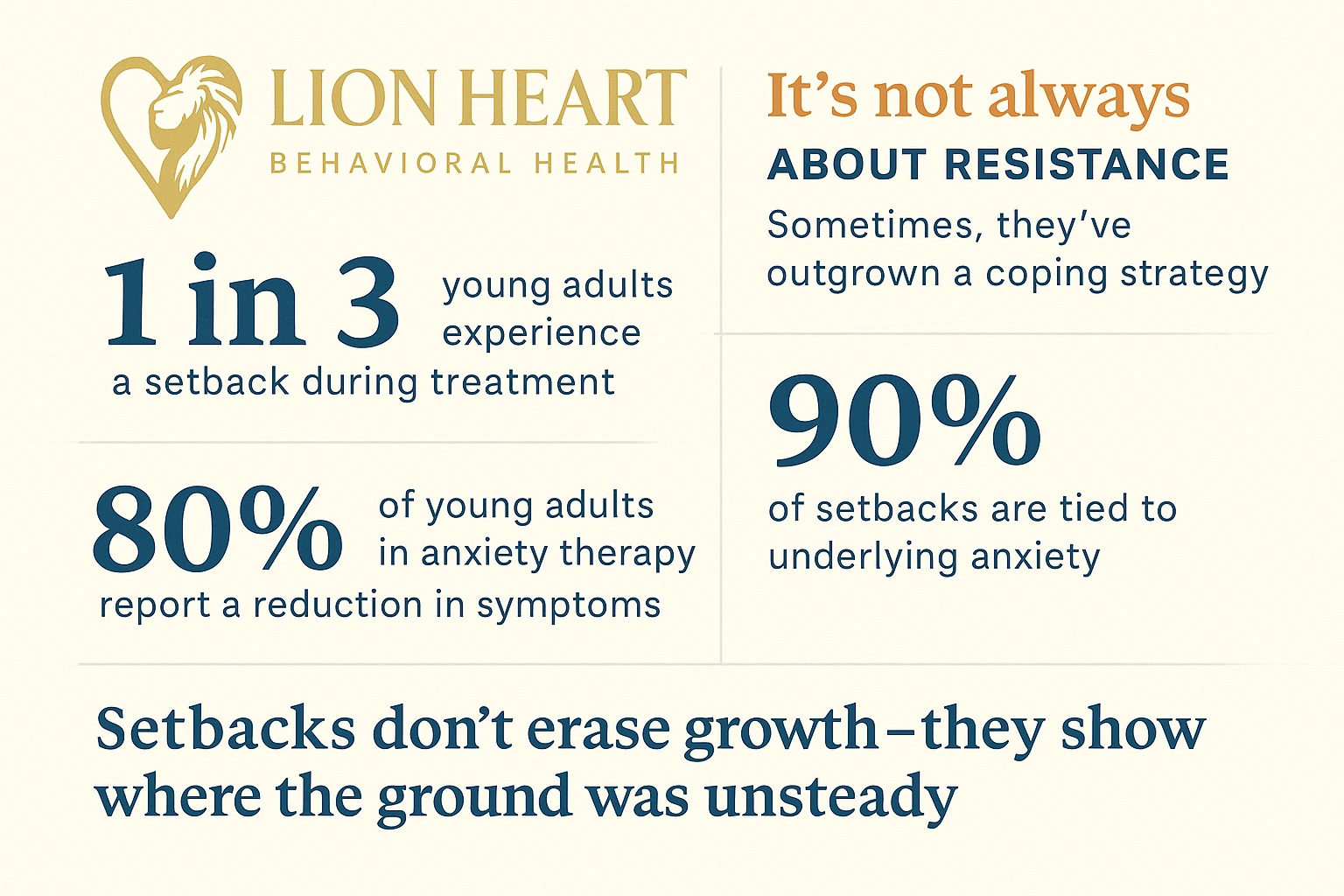
Setbacks Don’t Erase Growth—They Show Where the Ground Was Unsteady
When a young adult hits a wall—whether it’s emotional shutdown, substance use, or missed appointments—what we’re often seeing is the nervous system overwhelmed.
It’s not always about resistance.
It’s not even always about “bad choices.”
Sometimes, they’ve outgrown a coping strategy. Sometimes, their anxiety creeps in sideways—through perfectionism, avoidance, or control. Sometimes, they’re simply tired of fighting to seem okay.
In therapy, we don’t start over. We build on what’s already there.
We ask:
- What was working before?
- What was fragile?
- Where did shame slip in unnoticed?
This approach gives your child credit for the work they’ve done—while gently guiding them forward.
Anxiety Is Often the Hidden Root of the Setback
You might be worried about the behaviors. The missed calls. The silence.
But underneath all of it, we often find this: anxiety was quietly building.
We’ve seen this play out in our anxiety therapy program in Raynham, MA:
- A young man returns to therapy after missing two weeks. He says he felt “stupid” for feeling anxious again.
- A college student relapses after an internship interview, terrified she’ll never live up to the version of success her parents hoped for.
- A 20-year-old stops showing up to group after hearing a friend was hospitalized. “It made everything feel real again,” he says.
Anxiety isn’t weakness. It’s information.
But most young adults haven’t been taught to listen to it in a way that helps.
Anxiety therapy helps them turn that panic into something useful: a signal, not a threat.
Shame Makes the Setback Worse—Therapy Interrupts That Loop
When your child feels like they’ve failed, the instinct is often to withdraw.
They might:
- Lie about how they’re doing
- Skip therapy to avoid “disappointing” their therapist
- Lash out at family members asking questions
What they’re really saying is:
“I feel like I’ve let everyone down—and I don’t know how to come back.”
This is exactly where anxiety therapy becomes vital. Not because we’re trying to “get them back on track,” but because we create a space where shame doesn’t get the last word.
In session, they get to:
- Be honest without fearing punishment
- Explore why they disengaged without judgment
- Rebuild trust with themselves and others
And when that safety is re-established? Progress resumes—often faster than you’d think.
Therapy Doesn’t Restart—It Re-Routes
Your child may not need to start over in therapy. In fact, trying to restart everything from scratch can backfire.
At Lion Heart, we treat setbacks like recalibrations, not failures.
We ask:
- Is the therapist still a good fit for who they are now?
- Have their anxiety symptoms changed?
- Are they craving a different format—maybe switching from group to individual sessions, or vice versa?
Sometimes, all it takes is one strong session to reopen the path.
And if your child is looking for an anxiety therapy program in Bristol County, MA, we provide continuity across the region—so transitions don’t have to feel like disruptions.
Family Patterns Matter—But They’re Not the Whole Story
If you’re wondering what you could’ve done differently, pause right there.
Blame doesn’t help your child—and it doesn’t help you.
But family systems do shape recovery.
In therapy, we often explore:
- The unspoken expectations (be strong, don’t feel too much)
- The rescue patterns (parents solving everything, unintentionally creating helplessness)
- The grief (of watching a child suffer, and not being able to fix it)
If your child is in therapy and you’re still carrying fear, guilt, or exhaustion—you’re not wrong for feeling that way.
You just don’t have to hold it all alone.
This Isn’t the End of Their Progress—It’s a Deeper Chapter
We’ve seen this enough to say it with certainty: setbacks often lead to deeper growth than initial progress ever could.
Because this time:
- They know what support can look like
- They remember the tools—they just need help finding them again
- They’re no longer naïve about how hard healing can be—and that’s powerful
Some of our strongest outcomes come from clients who “came back.” Not because they failed—but because they realized healing takes more than one try.
And if you’re looking for an anxiety therapy program in New Bedford, MA, we welcome returning clients and new ones alike—with zero judgment and a lot of compassion.
FAQ: Supporting Your Child After a Setback
Is a setback the same as relapse?
Not always. A setback can include increased anxiety, isolation, missed appointments, or returning to old patterns. Relapse is one type of setback—but many emotional or behavioral shifts happen before that point.
Will my child have to start over in their therapy program?
No. At Lion Heart, we build on existing progress. Therapists adjust treatment plans to address new concerns without making your child feel like they’re back at zero.
What if my child refuses to go back to therapy?
That’s common. We encourage gentle, non-shaming conversations like:
“I know it’s hard to return, but I believe in how much it helped you last time.”
We can also offer transitional support options, including intake reassessment or therapist changes.
How can I support without enabling?
Stay present without over-controlling. Offer logistical help (like rides or schedule reminders), but let them take ownership of the decision to return. Consider family therapy or parent coaching if you’re feeling stuck.
What if I’m afraid they’re using again?
Talk to us. We won’t rush to assume—but we will take your concern seriously. An updated clinical assessment can provide clarity and help guide next steps.
Let’s Rebuild—With Grace, Not Guilt
Your child is not a lost cause. This is not the end of their healing.
It’s a messy, honest middle—and there’s support for that.
Call (774) 341-4502 or visit our Anxiety therapy program services in Raynham, Massachusetts to learn how Lion Heart can help your child reset—not restart—their path to stability and peace.
We’re here. You don’t have to hold this alone.