

You had a streak going.
Ninety days. Maybe more. You felt clear, proud, stable—maybe even hopeful for the first time in a while. And then it happened. A drink. Then another. Maybe it was a single night. Maybe it turned into a week.
Now you’re sitting with that old familiar knot in your chest.
How do I come back from this?
What will they think?
Did I just lose everything I worked for?
If this is you, hear this clearly: relapse does not erase your progress. It does not undo your worth. And it does not mean you have to start over from scratch.
At Lion Heart Behavioral Health, our alcohol treatment program in Raynham, MA is built for moments exactly like this. Because healing is not linear. And courage doesn’t only show up on day one—it shows up again, and again, and again.
When Shame Hits Harder Than the Hangover
Relapse is rarely just about the drink. It’s about what happens afterward.
That crushing sense of shame. The loop of “I should’ve known better.” The fear that people will treat you differently—that they’ll see you differently.
Many people who return to treatment after a relapse say the same thing:
“I wasn’t afraid of the program. I was afraid of the looks. The questions. The silence.”
We want to be clear: you will not get that here.
At Lion Heart, relapse is never treated as a moral failure. It’s not a mark against you. It’s a sign that something in your system—your support network, your stress levels, your coping tools—needed more help than it had in that moment. That’s it.
Why We Expect (and Prepare For) Relapse
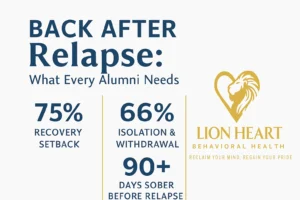
Statistically, many people in recovery will experience at least one relapse—especially within the first year. This isn’t something we hope for. But it is something we prepare for, compassionately and clinically.
Relapse isn’t an end. It’s a data point.
We ask:
- What was happening in your life before the slip?
- What tools did you have—or not have—at that moment?
- What support was missing?
- How can we rebuild in a way that feels more solid?
No lectures. No shame. Just curiosity, compassion, and clinical support.
What Coming Back Really Looks Like
You don’t have to walk in with your head down.
You don’t need a speech or a perfect explanation. You don’t need to prove that you’re “serious this time.” All you need is a willingness to return. We’ll meet you there—with dignity, not distance.
Here’s what re-entry looks like in our alcohol treatment program:
- A private check-in to talk through what’s changed
- A personalized re-engagement plan that fits your current needs (not just repeating everything you did before)
- Flexible care options—whether that means group, individual sessions, or a short-term reset
- Clinicians trained to support returning alumni without bias or assumptions
We believe it’s braver to come back than it was to start the first time. Because now you know how hard it is—and you’re still showing up.
You Don’t Lose What You Learned
One of the biggest lies shame tells you is: “You’re starting over.”
That’s not true.
You still have every lesson, every moment of clarity, every relationship you built in treatment. Those things don’t disappear. In fact, they often come back stronger once you reconnect with them—because now, they’re not just theory. They’re tested.
Relapse might mean some wounds reopened. But it also means you have another chance to heal them more deeply, more fully, and with more self-awareness than before.
You’re not new. You’re seasoned. That’s powerful.
If You’re Reading This, You Haven’t Given Up
You might feel broken right now. You might be scared to reach out. But if you’re here—if you’re even considering it—you are still in this.
Recovery isn’t a pass/fail test. It’s a relationship with yourself that evolves. That includes pauses, setbacks, even reversals. But each time you choose to reconnect with it, you’re strengthening it—not weakening it.
Whether you live in Raynham or you’re looking for an alcohol treatment program in New Bedford, MA, our team welcomes you—not just because you’ve been here before, but because you matter now, still.
Common Triggers That Catch Alumni Off Guard
You’re not the only one who didn’t see it coming. Many alumni relapse after 90+ days because something subtle—but significant—shifted.
Here are some common relapse triggers we help alumni work through:
- Complacency: “I feel fine—I probably don’t need meetings anymore.”
- Emotional numbness: Sobriety doesn’t automatically fix everything. Feeling flat or disconnected can sneak up quietly.
- Isolation: The disconnection can happen slowly. You skip one group. Then two. Then suddenly, no one knows how you’re doing.
- High-functioning stress: Jobs, family roles, and performance pressure don’t stop. Sometimes they even increase after initial sobriety.
- Unprocessed grief or trauma: When the old coping mechanism is gone, unresolved pain can surface unexpectedly.
None of these make you weak. They make you human.
FAQ: Returning to Treatment After Relapse
Q: Will I have to start over from the beginning of the program?
A: Not necessarily. We’ll create a re-entry plan based on what’s changed and what you need now. Sometimes that means revisiting core material. Other times, it means building on what you already know.
Q: I’m scared I’ll be judged by the group. What if they treat me differently?
A: Many people in group have relapsed themselves or supported others who have. Our clinicians actively protect the emotional safety of every group member, including returners.
Q: I’m not sober right now. Can I still reach out?
A: Yes. You don’t have to be abstinent to ask for help. In fact, reaching out during active use can prevent further harm and help you re-engage safely.
Q: What if I only drank once or twice—does that still count?
A: If you’re questioning it, it counts. You don’t need a full spiral to deserve support. Any return to alcohol after sobriety deserves care and attention.
Q: Do you offer support for people who’ve relapsed multiple times?
A: Absolutely. Relapse is a pattern we know how to support. Whether this is your first return or your fifth, you’ll be met with compassion—not judgment.
You’re Still Worthy of a New Chapter
One of the hardest things to believe after relapse is that you’re still worth it.
Worth the time. Worth the energy. Worth the care.
But you are.
Not because of your sobriety count. Not because of your “success.” But because you’re a human being in pain—and you’re still trying. That counts for everything.
At Lion Heart, we don’t measure people by their setbacks. We welcome them as whole people, capable of healing—even if they’re scared. Especially if they’re scared.
You’re not a failure. You’re a person with a story that isn’t over yet.
Need help reconnecting after a relapse?
Call (774)238-5533 or visit Lion Heart’s Alcohol Treatment Program in Raynham, Massachusetts. You’re not alone. You’re not starting over. And you are always welcome here.