

You don’t forget the moment you realize things aren’t okay again.
It might be a text that doesn’t make sense. A smell you recognize instantly. A shift in tone that tells you your child is hiding something—again. Fear rises fast for parents. Faster than logic. Faster than hope. And when your child is using alcohol again, that fear can take over everything.
As clinicians at Lion Heart Behavioral Health, we work with parents who are living in that fear every day. Our goal isn’t to rush you or overwhelm you. It’s to help you move from panic and paralysis toward clarity, grounded decisions, and real options—starting with understanding how an alcohol treatment program can support not only your child, but you as well.
Within the first conversations we have, many parents find relief simply learning what treatment actually is—and what it isn’t. That’s why our alcohol treatment program focuses as much on education and support as it does on clinical care.
Fear Is a Natural Response—but It’s Not a Strategy
When a parent realizes their child is drinking again, fear often becomes the loudest voice in the room.
Fear says:
- If I don’t act now, something terrible will happen.
- If I push too hard, I’ll lose them.
- If I don’t step in, no one will.
None of those thoughts mean you’re doing something wrong. They mean you care deeply.
But fear is reactive. It pushes parents toward extremes—either tightening control or backing away completely. Neither position is sustainable, and neither supports long-term recovery.
An alcohol treatment program introduces something fear can’t: structure. A plan. Professional guidance that allows you to respond rather than react.
What Parents Often Get Wrong About Treatment—and Why That’s Okay
Many parents approach treatment with understandable misconceptions. They assume:
- Treatment will “fix” their child quickly
- Relapse means failure
- Their role is to enforce sobriety
- If treatment didn’t work once, it won’t work again
These beliefs don’t come from ignorance. They come from desperation.
In reality, an alcohol treatment program is not a reset button. It’s a stabilizing force. It provides consistent support while your child learns how to live without alcohol as their primary coping tool.
Recovery is a process. Treatment gives it a starting structure.
How an Alcohol Treatment Program Creates Stability
When alcohol use takes over, daily life becomes unpredictable. Mood swings. Missed commitments. Broken trust. Everyone is on edge.
Treatment changes that environment.
A comprehensive alcohol treatment program provides:
- Predictable schedules that calm the nervous system
- Clear expectations that remove constant negotiation
- Clinical oversight that parents are not equipped to provide
- Accountability that doesn’t rely on parental enforcement
This stability is often the first thing parents notice. Even before sobriety feels secure, the chaos begins to quiet.
That quiet creates room—for insight, for honesty, and eventually for change.
Parents Are Not Meant to Be the Treatment Plan
One of the hardest truths parents face is this: love alone cannot treat addiction.
Parents try everything—monitoring, pleading, threatening, rescuing, withdrawing. Most do all of it, cycling through approaches as the fear intensifies.
An alcohol treatment program allows parents to step out of the impossible role of manager and enforcer. Instead, you become what you were always meant to be: a parent, informed and supported, no longer carrying responsibility that belongs to a clinical team.
This shift is not abandonment. It’s alignment.
The Role of Family Support in Alcohol Treatment
Effective treatment doesn’t shut parents out. It brings them in—carefully and intentionally.
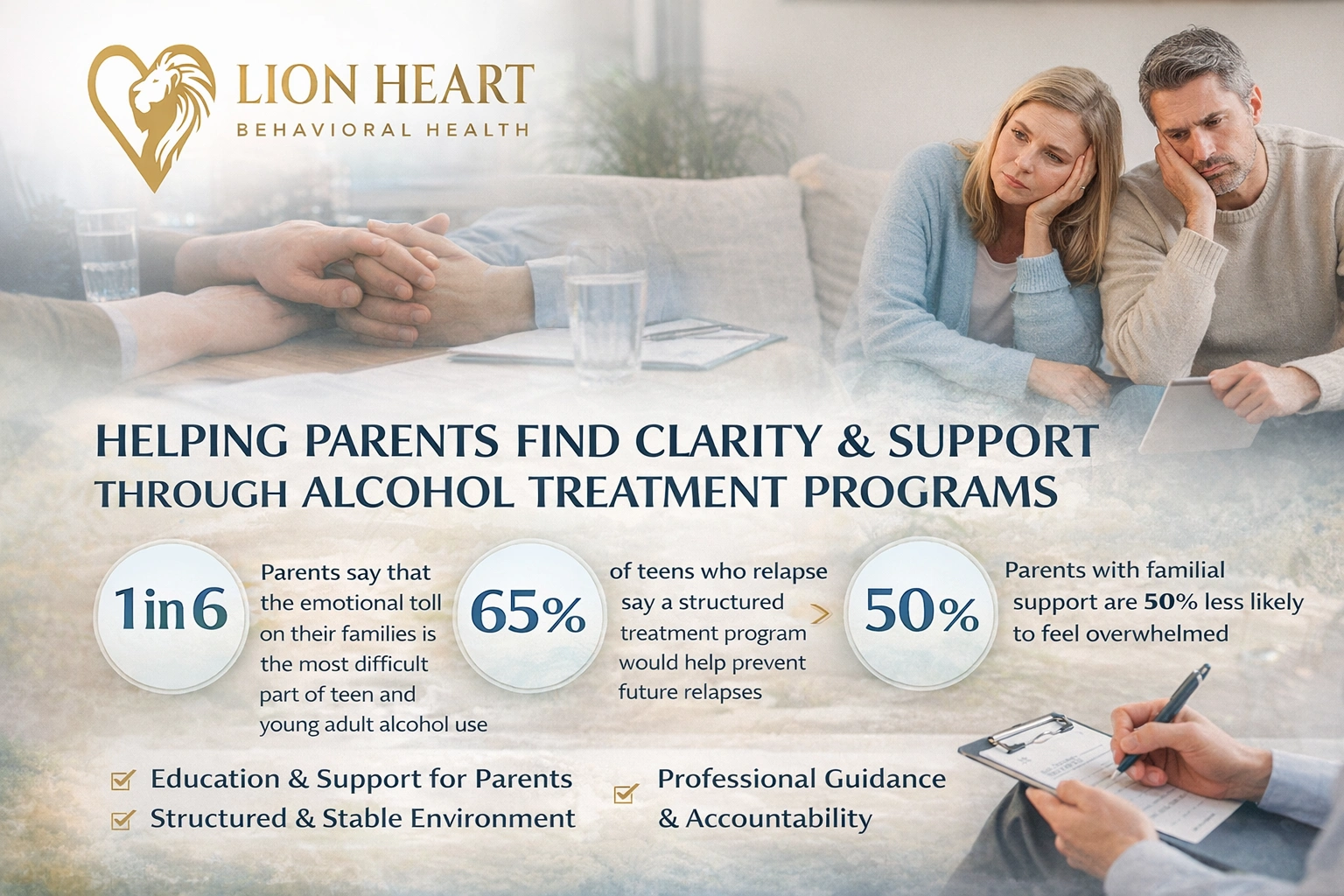
Within our program, family involvement focuses on:
- Education about addiction and relapse
- Communication skills that reduce conflict
- Boundary-setting that supports recovery without enabling
- Processing guilt, grief, and fear that parents often suppress
Many parents tell us this is the first time they feel seen in the process. Their pain matters too. And when parents gain clarity, the entire family system begins to shift.
From Crisis Response to Informed Action
Before treatment, parents are often stuck in crisis mode. Every decision feels urgent. Every mistake feels catastrophic.
An alcohol treatment program slows things down.
It helps parents move from:
- “What do I do right now?”
to - “What supports long-term recovery?”
This change in perspective is powerful. It doesn’t mean the fear disappears—but it becomes manageable. Decisions become steadier. Boundaries become clearer. And parents begin to act from values instead of panic.
Real Stories, Real Shifts
We’ve seen parents arrive exhausted, convinced they’ve tried everything.
We’ve watched mothers who were ready to cut contact learn how to stay connected without enabling. We’ve supported fathers who believed anger was the only way to motivate change discover calmer, firmer ways to show love.
In many cases, the biggest transformation happens around the person in treatment. The family becomes less reactive. More grounded. Better prepared for whatever comes next.
That shift alone can change outcomes.
When Relapse Has Already Happened
If your child has been in treatment before and is drinking again, the disappointment can feel unbearable.
Relapse does not mean treatment failed. It means recovery needs reinforcement, adjustment, or a different level of care. Many people return to treatment with more insight and readiness than the first time.
For parents, the key is this: relapse is information, not a verdict.
An alcohol treatment program helps interpret that information and decide what to do next—without blame or shame.
Geography Doesn’t Change the Fear—but It Can Shape the Support
For parents raising a young adult in New Bedford, MA, concerns about visibility, stigma, and limited resources often add another layer of stress. It can feel like everyone knows your business—and no one knows how to help.
And for families connected to Raynham, MA, navigating treatment options while balancing work, siblings, and daily responsibilities can feel overwhelming. Having a centralized program that understands local realities can make an enormous difference.
Support should fit your life, not disrupt it further.
What Parents Can Expect Emotionally
Parents often ask us, “Will this get easier?”
The honest answer: not immediately—but it becomes clearer.
Treatment doesn’t remove uncertainty, but it replaces chaos with direction. Parents begin to understand what is within their control—and what isn’t. That understanding alone reduces emotional burnout.
Over time, many parents report:
- Less constant anxiety
- Fewer reactive decisions
- Improved communication
- A stronger sense of self-trust
Those changes matter, regardless of where your child is in their recovery.
FAQs
How do I know if my child truly needs an alcohol treatment program?
If alcohol use is affecting their health, safety, relationships, or ability to function—and attempts to stop haven’t worked—treatment is an appropriate next step. You don’t need certainty to ask for help.
What if my child refuses treatment?
While adults can’t usually be forced into treatment, parents can still receive guidance. We help families explore communication strategies, boundaries, and intervention options tailored to their situation.
Will I be blamed for my child’s addiction?
No. Addiction is not caused by parenting mistakes. Our approach is nonjudgmental and focused on forward movement—not assigning fault.
How involved should I be during treatment?
Involvement is guided and intentional. Parents are supported in ways that help recovery without increasing conflict or enabling behavior.
What if I’m emotionally exhausted and don’t know how much more I can do?
That exhaustion is a sign you need support too. Treatment isn’t just for your child—it’s an opportunity for you to stop carrying this alone.
You Don’t Have to Navigate This Alone
Fear may have brought you here—but clarity can carry you forward. Call (774) 341-4502 to learn more about our alcohol treatment program in Bristol County, MA.