

You’re still showing up. Still answering emails. Still handling responsibilities most people would struggle to carry.
From the outside, nothing looks wrong.
But inside? It’s getting harder to keep pretending this is sustainable.
There’s a kind of struggle that doesn’t interrupt your life—it quietly drains it. And because it doesn’t look like a crisis, it often gets ignored far longer than it should.
If you’ve been holding it together while quietly falling apart, this is for you.
Early on, many people start exploring options like structured daytime care—not because everything collapsed, but because they don’t want it to.
You’re Still Functioning—But It’s Taking Everything Out of You
This is where things get complicated.
You’re not missing deadlines.
You’re not disappearing.
You’re not losing control in obvious ways.
But it’s costing you more than anyone realizes.
You wake up tired.
You move through your day on autopilot.
You rely on something—alcohol, substances, or even just constant distraction—to take the edge off.
And at night, when everything gets quiet, there’s that thought:
“This isn’t working.”
Not dramatically. Not loudly. Just honestly.
The Version of You People See Isn’t the Whole Story
You’ve built a life that looks stable.
Maybe even impressive.
But there’s a gap between how you appear and how you actually feel.
That gap? It’s exhausting to maintain.
You become good at managing perception:
- Saying the right things
- Keeping conversations surface-level
- Avoiding anything that might expose what’s really going on
And over time, it starts to feel like you’re performing your own life.
Not living it.
You Keep Telling Yourself It’s Not “Bad Enough”
This is one of the biggest traps.
“I’m not that bad.”
“I can still stop if I need to.”
“Other people have it worse.”
All of that might be true.
But it’s also beside the point.
Struggle doesn’t have to reach a certain level before it deserves attention.
And waiting until it does? That’s usually what makes things harder to unwind later.
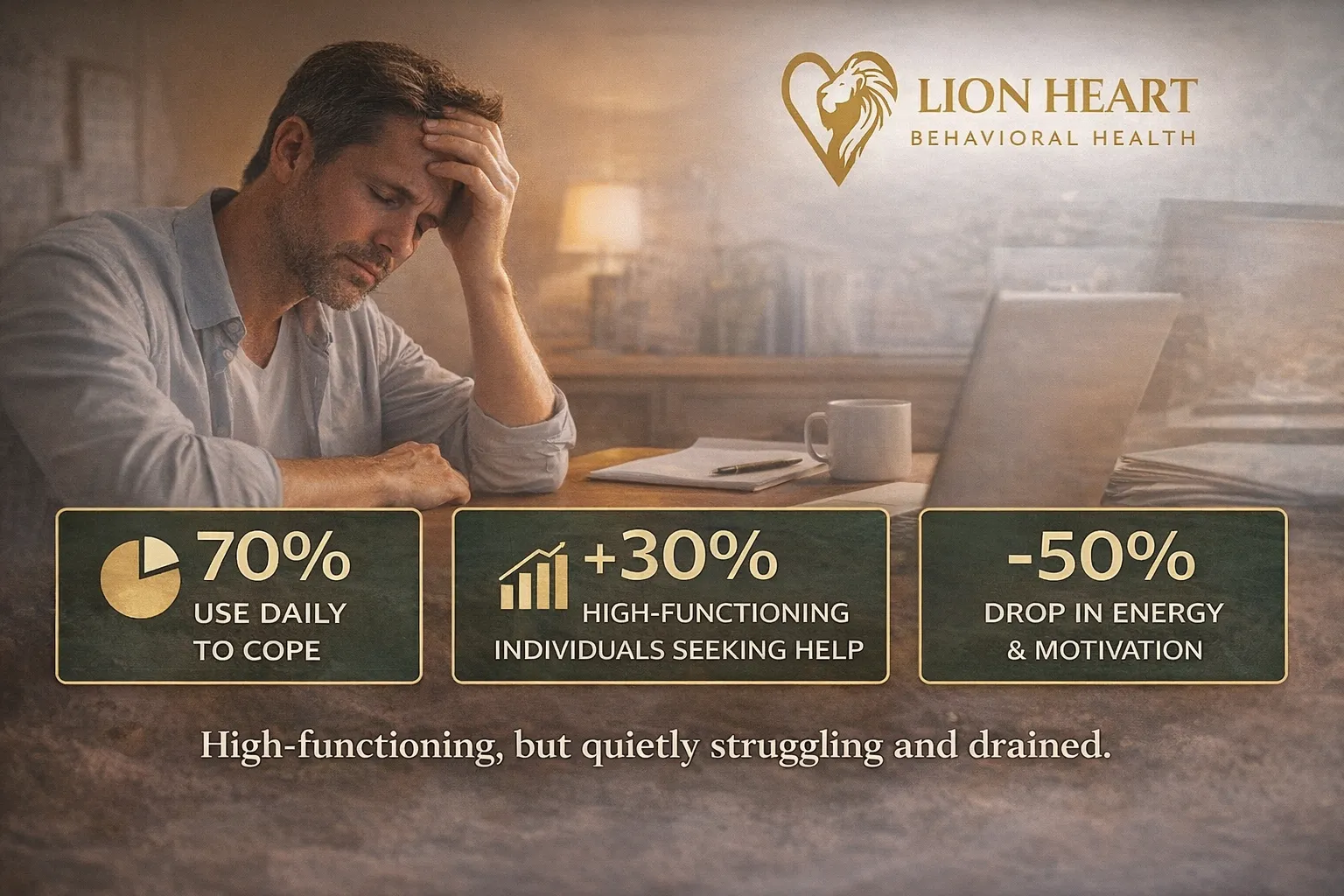
High-Functioning Can Be a Perfect Disguise
High-functioning individuals rarely get flagged.
You’re too capable. Too responsible. Too put-together.
But that capability becomes a mask.
It hides:
- Emotional burnout
- Growing dependence on coping mechanisms
- A slow loss of connection to yourself
And because nothing is visibly “falling apart,” it’s easy to keep going.
Until you can’t.
The Quiet Signs You’re Not Actually Okay
This isn’t about labels. It’s about patterns.
You might recognize this:
- You need something to unwind every single day
- You feel restless even when you’re “relaxing”
- You’ve tried to cut back—and it didn’t last
- You feel disconnected in conversations
- You avoid being alone with your thoughts
There’s no dramatic moment here.
Just a slow accumulation of weight you’ve been carrying too long.
Why People Like You Often Don’t Get Help Early
Because your life hasn’t “broken,” it feels like help isn’t justified.
But that belief is what keeps people stuck.
Support isn’t reserved for crisis.
It exists for prevention. For clarity. For relief before things escalate.
I’ve worked with people from New Bedford, Massachusetts who waited years because they thought they needed to hit a visible low point first.
They didn’t.
What they needed was space to step out of the cycle before it deepened.
There’s a Middle Ground Most People Don’t Talk About
A lot of people assume there are only two options:
Keep going as you are
Or completely step away from your life
That’s not true.
There’s a middle path designed for people who:
- Want to stay engaged in their responsibilities
- Need more support than they can manage alone
- Aren’t in crisis—but aren’t okay either
This is where programs, php come in—not as a last resort, but as an earlier intervention point.
A way to stabilize without disappearing.
You Don’t Need to Prove You Deserve Help
There’s no threshold you have to meet.
No checklist that qualifies you.
If you’re tired of:
- Managing the same patterns
- Feeling like you’re barely keeping up internally
- Wondering how long you can keep this going
That’s enough.
You’re allowed to interrupt the pattern before it gets worse.
The Cost of Staying Silent About It
This kind of struggle doesn’t explode.
It erodes.
Slowly.
You lose:
- Energy
- Focus
- Emotional connection
- Confidence in yourself
And eventually, what used to feel manageable starts to feel heavy.
Not because you failed.
Because you’ve been carrying too much, for too long, without support.
What Change Actually Looks Like at This Stage
It’s not dramatic.
It’s not about starting over.
It’s about:
- Getting honest with yourself
- Letting someone else see what’s been hidden
- Trying support that fits into your life
I’ve seen individuals from Raynham, Massachusetts reach this point—not because everything fell apart, but because they recognized the direction things were heading.
That awareness matters.
It’s often the turning point.
You’re Not Weak for Needing More Support
If anything, this is where strength actually shows up.
Not in pushing through.
But in pausing long enough to ask:
“Is this how I want to keep living?”
That question alone can change everything.
FAQs
Is it really necessary to get help if I’m still functioning?
Yes—and not because something is “wrong” with you, but because functioning isn’t the same as being well. Many people maintain careers and relationships while struggling internally. Getting support early often prevents deeper burnout or dependency.
What if I’m not sure I have a real problem?
You don’t need a diagnosis or label to take your experience seriously. If something feels off, repetitive, or harder to control than you’d like, it’s worth paying attention to. Uncertainty is often the first sign something needs care.
Will getting help disrupt my daily life completely?
Not necessarily. Many forms of care are designed specifically for people who want to maintain parts of their routine while receiving consistent support. The goal is integration, not disruption.
What if I’ve tried to fix this on my own already?
That’s actually very common. Most people don’t seek help right away—they try to manage it themselves first. The problem is that willpower alone rarely addresses deeper patterns. Support changes the structure, not just the effort.
How do I know if I’m “bad enough” to need support?
That question itself is often the sign.
You don’t need to be “bad enough.”
You just need to be honest enough to admit something isn’t working.
You don’t have to keep managing this alone.
Call (774) 341-4502 to learn more about our Partial Hospitalization Program in Massachusetts.