
If you or a loved one are struggling with addiction or mental health, we can help. Request a call.

Topbar Forms

This field is for validation purposes and should be left unchanged.
Name(Required)

High-Functioning Depression: When You’re Doing Fine and Falling Apart at the Same Time

High-Functioning Depression When You're Doing Fine and Falling Apart at the Same Time

You wake up on time. You answer emails. You make dinner.

You laugh when someone tells a joke. From the outside, your life looks…normal. Maybe even successful.

But somewhere underneath all of that, you’ve been carrying a quiet weight for so long that you’ve almost forgotten what it feels like not to.

If you’ve been searching for high functioning depression, there’s a good chance you’re not looking for permission to stop functioning.

You’re looking for an explanation. Because you’re tired in a way sleep doesn’t fix.

You’re showing up, but you don’t feel present. You’re getting through the day, but it feels like you’re surviving it instead of living it. One of the hardest parts is that people keep telling you how well you’re doing. They say things like:

“You always have it together.” “I wish I were as productive as you.” “You seem happy.”

Meanwhile, you’re wondering how much longer you can keep pretending that “fine” and “okay” are the same thing. If any of that sounds familiar, know this: Your pain does not become less real because you’re still functioning.

If you’re beginning to wonder whether depression could be part of what you’re experiencing, learning about depression treatment can help you understand your options.

What Is High-Functioning Depression?

The first thing that’s important to know is this:

High-functioning depression is not an official DSM-5 diagnosis.

You won’t find it listed as a formal mental health disorder.

That doesn’t mean it isn’t real.

It’s a phrase many people use to describe living with depressive symptoms while continuing to meet everyday responsibilities.

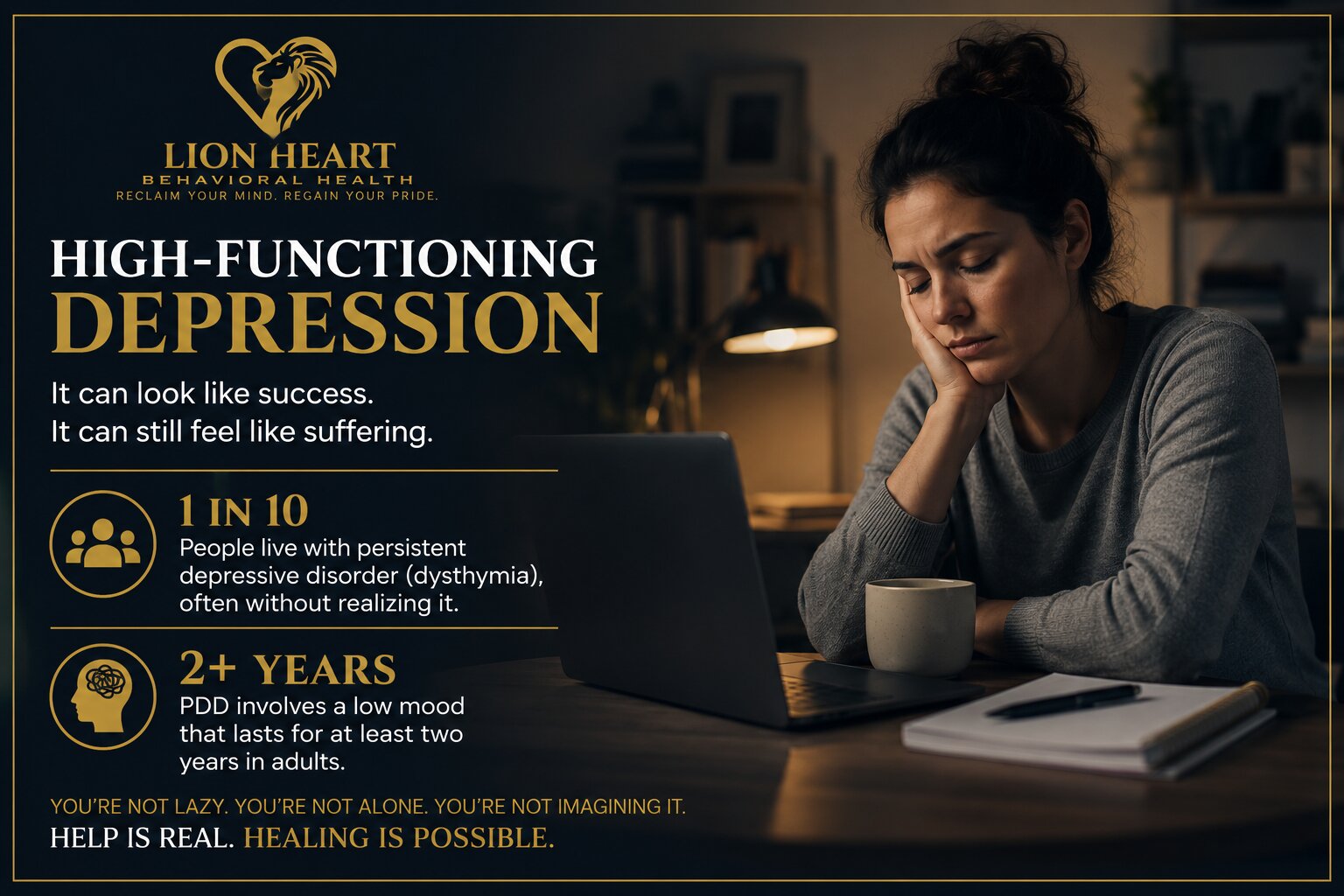
Often, it overlaps with persistent depressive disorder (PDD), formerly called dysthymia.

Persistent depressive disorder involves a depressed mood that lasts for at least two years in adults, along with other symptoms such as low energy, poor self-esteem, difficulty concentrating, changes in appetite or sleep, or feelings of hopelessness.

Unlike major depressive episodes, which can be severe and disabling, PDD is often quieter.

It doesn’t always stop someone from working. Or paying bills. Or taking care of children.

Instead, it becomes the background noise of daily life. Some people describe it like living with the emotional equivalent of gray skies. Nothing is catastrophic. Nothing feels vibrant, either.

Over time, that can become so familiar that a person assumes this is simply what adulthood feels like.

Signs of High-Functioning Depression

Depression doesn’t always look like someone staying in bed all day.

Sometimes it looks like someone who never stops moving because slowing down would mean feeling everything they’ve been trying to outrun. Some common high functioning depression symptoms include:

Feeling emotionally flat

You’re not necessarily crying every day. You’re just…not feeling much of anything.

Excitement is muted. Pride disappears quickly. Moments that should feel joyful barely register. People around you celebrate milestones.

You mostly feel relief that they’re over.

Going through the motions

You complete tasks because they’re on the list. Not because you enjoy them. Life starts feeling like checking boxes instead of actually experiencing it.

Morning routine. Work. Dinner. Laundry. Sleep. Repeat.

Eventually you stop asking whether you’re happy because surviving the schedule feels like enough.

Constant fatigue

You’re exhausted. Not the kind of tiredness that follows a long week.

The deeper kind. The kind where your body works but your spirit feels permanently drained.

You sleep. You’re still tired. You take a vacation. You come home just as exhausted.

Nothing feels especially enjoyable anymore

Psychologists call this anhedonia. Most people simply describe it as losing interest in things they used to love.

Your favorite hobby feels like work. Vacations feel strangely empty. Friends invite you out. You go because you know you should—not because you’re looking forward to it.

Irritability replaces sadness

Depression isn’t always obvious sadness. Sometimes it’s frustration. Short patience.

Feeling annoyed by small inconveniences. Snapping at people you care about and wondering afterward why everything feels so overwhelming.

Your inner voice is relentlessly critical

Outwardly, you may appear confident.

Internally, the conversation sounds very different.

“You’re lazy.”

“You’re behind.”

“You’re disappointing everyone.”

“Other people have real problems.”

No matter what you accomplish, it rarely feels like enough.

You’re functioning—but barely

Perhaps the clearest sign is this: You keep doing everything people expect. You simply don’t know how much longer you can keep doing it.

What High-Functioning Depression Looks Like Day to Day

One of the reasons this kind of depression hides so well is because success and suffering can exist at the same time.

Someone with high-functioning depression may:

  • Earn promotions.
  • Raise children.
  • Exercise regularly.
  • Maintain friendships.
  • Volunteer.
  • Smile in meetings.
  • Remember birthdays.
  • Respond to every text.

None of those things automatically mean they’re emotionally healthy.

There’s often an invisible second shift happening underneath everything else. Every conversation requires effort.

Every decision feels heavier than it should. Every interaction is carefully managed so no one notices how depleted they actually feel.

The outside world sees consistency. The person living it experiences constant emotional labor. One sentence captures it better than almost anything else:

High-functioning depression isn’t the absence of struggle—it’s becoming so practiced at hiding the struggle that other people stop looking for it.

That performance becomes exhausting.

Not because you’re pretending every second.

But because you’ve learned how to compartmentalize your pain well enough that it rarely interrupts your responsibilities.

People compliment your resilience.

They don’t see what resilience is costing you.

You become the reliable one

Friends call you first. Coworkers depend on you.

Family members assume you’ll handle everything. Part of you appreciates being trusted.

Another part quietly wonders: “Would anyone notice if I stopped holding everything together?”

Being dependable can become its own trap. The more capable you appear, the less permission people seem to give you to struggle. Eventually, you stop giving yourself permission too.

Rest starts feeling uncomfortable

People often assume someone with depression wants to stay in bed. Many people with high-functioning depression have the opposite problem.

Stopping feels dangerous. If they’re busy, they don’t have to think.

If they’re productive, they don’t have to notice the emptiness. Work becomes distraction. Cleaning becomes distraction.

Helping everyone else becomes distraction. Silence becomes the thing they’re trying hardest to avoid.

Joy feels unfamiliar

Perhaps the strangest part isn’t overwhelming sadness. It’s how unfamiliar genuine happiness begins to feel. Someone compliments you.

You don’t believe them. Something wonderful happens. You immediately expect something bad to follow.

A free afternoon appears on your calendar. Instead of excitement, you feel guilty.

Depression has a way of convincing people they should always be doing more, fixing more, producing more. Even rest begins to feel like failure.

You wonder if you’re just being dramatic

This thought appears constantly.

“Maybe I’m making this bigger than it is.”

“Other people have it worse.”

“I’m still paying my bills.”

“I’m still going to work.”

“Maybe I’m just lazy.”

Ironically, many people with high-functioning depression minimize their symptoms precisely because they remain functional.

Functioning becomes evidence against asking for help.

It shouldn’t.

Broken bones don’t stop being broken because someone keeps walking on them.

Emotional pain doesn’t become less deserving of care because you’re still answering emails.

Why It’s So Often Missed

One of the cruelest things about high-functioning depression is that it rarely looks like the version of depression most people expect.

There is no obvious crisis.

No dramatic collapse.

No moment that clearly tells everyone around you something is wrong.

Instead, it settles into your life quietly.

You keep showing up, so people assume you’re okay.

Eventually, you start believing that too.

“I’m Not Depressed Enough”

Many people living with high-functioning depression spend years talking themselves out of getting help. They compare themselves to someone whose depression seems more severe.

“I’m still working.”

“I’m still taking care of my family.”

“I’m not in bed all day.”

“Other people have it worse.”

Depression is not a competition. Your suffering does not have to reach a certain level before it deserves attention. If getting through every day feels like carrying an invisible backpack full of bricks, that’s worth talking about.
High-Functioning Depression Signs & When to Get Help

High Standards Can Hide Depression

People who are driven, responsible, or perfectionistic often become exceptionally good at masking emotional pain. They don’t stop functioning. They simply push harder. They become the employee who never takes time off. The parent who always volunteers.

The friend who always says yes. The person everyone describes as “having it together.” Meanwhile, they may be privately wondering how much longer they can keep pretending. High-functioning depression often survives because achievement becomes camouflage.

Even Clinicians Can Miss It

Mental health professionals are trained to look beyond appearances, but symptoms can still be overlooked—especially if someone minimizes what they’re experiencing.

If a person says:

“I’m fine.”

“Work is going well.”

“Everything is under control.”

…without also describing the exhaustion, hopelessness, or emotional numbness underneath, depression can remain hidden. That is one reason honesty during an evaluation matters so much. You don’t have to protect your therapist from your real experience.

The more accurately you describe what life feels like, the better they can help.

High-Functioning Depression vs. Major Depression vs. Dysthymia

These terms are often used interchangeably, but they don’t mean exactly the same thing.

High-Functioning Depression Persistent Depressive Disorder (Dysthymia) Major Depressive Disorder
Not an official diagnosis Formal DSM-5 diagnosis Formal DSM-5 diagnosis
Describes someone who continues functioning despite depressive symptoms Long-lasting depression lasting at least two years More severe depressive episodes lasting at least two weeks
Often overlaps with PDD Symptoms may be milder but are chronic Symptoms are typically more intense
Many people continue working and meeting responsibilities Daily functioning may continue, though it often feels difficult Functioning may become significantly impaired
A descriptive phrase rather than a medical diagnosis Diagnosed by a qualified mental health professional Diagnosed by a qualified mental health professional

Think of high-functioning depression as a description of how depression can appear rather than a diagnosis itself.

Many—but not all—people who describe themselves this way ultimately receive a diagnosis of persistent depressive disorder. Others may be experiencing major depression while continuing to function at a surprisingly high level. Only a qualified clinician can determine what diagnosis best fits your symptoms.

The important takeaway is this: Whether your depression is chronic, episodic, mild, or severe, you deserve support.

When and How to Get Help

You don’t have to wait until everything falls apart.

In fact, one of the biggest misconceptions about mental health is that treatment is only for people in crisis. Sometimes the strongest reason to seek help is much quieter: You’re tired of surviving every day.

Consider reaching out if:

  • Life feels consistently joyless.
  • You haven’t genuinely felt like yourself in months—or years.
  • You’re relying on work, productivity, or constant busyness to avoid your feelings.
  • You’re withdrawing from people who matter to you.
  • You constantly feel exhausted despite sleeping.
  • You’re beginning to wonder how much longer you can keep pretending everything is okay.

Starting doesn’t have to mean making a huge commitment.

Often it begins with one conversation.

A therapist or mental health provider may ask about:

  • Your mood over time
  • Sleep and energy
  • Relationships
  • Stress levels
  • Work and daily functioning
  • Medical history
  • Whether you’ve experienced periods of depression before

There isn’t a test you pass or fail.

There isn’t a certain amount of suffering required before you’re “allowed” to ask for help.

There is only the question:

Is life feeling harder than it needs to?

If the answer is yes, it’s worth talking to someone. Learning more about depression treatment can be a meaningful first step.

Frequently Asked Questions

Is High-Functioning Depression a Real Diagnosis?

No. High-functioning depression is not an official diagnosis in the DSM-5. It is a commonly used term that describes people who continue managing daily responsibilities while living with persistent depressive symptoms. Many people who identify with this description are ultimately diagnosed with persistent depressive disorder (PDD), though others may have a different depressive disorder.

Can You Have Depression and Still Function?

Yes. Many people continue working, raising children, maintaining relationships, and meeting responsibilities while experiencing depression. Being productive does not mean someone is emotionally healthy. Depression affects everyone differently, and outward success does not eliminate internal suffering.

How Is High-Functioning Depression Treated?

Treatment depends on each person’s needs. Many people benefit from psychotherapy, lifestyle changes, social support, and, when appropriate, medication prescribed by a qualified healthcare provider. The first step is receiving an accurate assessment rather than trying to determine the diagnosis alone.

Final Thoughts

For a long time, I thought functioning meant I couldn’t really be depressed. I paid my bills. I showed up. People depended on me.

Surely someone who was truly struggling couldn’t keep doing all of that. I was wrong. Looking functional and feeling alive are not the same thing.

If you’re carrying a version of yourself through each day that everyone else believes is effortless, you’re probably already exhausted. You don’t have to earn help by falling apart first. You don’t have to wait until you can’t get out of bed. You don’t have to prove your pain.

You only have to acknowledge that constantly surviving is not the same as living. If you’re near New Bedford, or Bristol County, Lion Heart offers programs with that same approach.

If this article felt uncomfortably familiar, consider taking the next small step. Call (774) 341-4502 or learn more about depression treatment at Lion Heart.

*The stories shared in this blog are meant to illustrate personal experiences and offer hope. Unless otherwise stated, any first-person narratives are fictional or blended accounts of others’ personal experiences. Everyone’s journey is unique, and this post does not replace medical advice or guarantee outcomes. Please speak with a licensed provider for help.

Tom believes that meaningful change begins with feeling heard, respected, and genuinely understood. His therapeutic approach is grounded in compassion, authenticity, and trauma-informed care, creating a safe, supportive, and judgment-free environment where clients feel empowered to explore challenges, build resilience, and move toward lasting healing.

As a Licensed Alcohol and Drug Counselor II (LADC II), Tom has experience working with individuals facing a wide range of mental health and substance use concerns across multiple levels of care. He is passionate about helping clients recognize their strengths while developing practical tools to navigate life’s challenges with greater confidence, emotional awareness, and self-compassion. Tom views therapy as a collaborative partnership, tailoring his approach to meet each person’s unique experiences, goals, and values.

Currently pursuing a Master of Science in Clinical Mental Health Counseling at Bay Path University with a concentration in Trauma-Informed Care, Tom is committed to continually expanding his clinical knowledge and providing evidence-based, culturally responsive care. He has a particular passion for working with LGBTQ+ individuals, supporting men’s mental health, and helping adolescents and young adults navigate anxiety, depression, trauma, life transitions, and identity development.

Known for his calm presence, genuine empathy, and approachable style, Tom strives to foster meaningful therapeutic relationships built on trust, respect, and collaboration. He believes that healing occurs when individuals feel accepted for who they are while being encouraged to discover who they can become.

Outside of the therapy room, Tom enjoys spending time with family and friends, camping, weightlifting, and staying active. He believes that maintaining balance, practicing self-care, and prioritizing overall wellness enhances his ability to support others as they pursue healthier, more fulfilling lives.

Arielle is a compassionate mental health clinician who believes that meaningful change begins with feeling safe, heard, and genuinely understood. As a Licensed Certified Social Worker (LCSW), she is dedicated to creating a welcoming, collaborative therapeutic environment where clients feel empowered to explore their experiences, build on their strengths, and move toward lasting emotional wellness.

Arielle’s approach is rooted in authenticity, empathy, and trust. She believes the therapeutic relationship serves as the foundation for growth and strives to balance compassion with thoughtful accountability. By helping clients recognize patterns, deepen self-awareness, and develop practical coping strategies, she supports individuals in creating meaningful, sustainable change both inside and outside of the therapy room.

Working collaboratively with each client, Arielle tailors treatment to meet their unique needs, values, and goals. She has experience supporting individuals navigating anxiety, depression, stress, and major life transitions, meeting clients where they are while encouraging growth at a pace that feels both supportive and achievable. Her person-centered approach emphasizes resilience, self-compassion, and empowering clients to develop the confidence and skills needed to navigate life’s challenges.

Arielle earned her Master’s degree from Salem State University and completed her undergraduate education at The Pennsylvania State University. She is passionate about helping individuals discover their strengths, cultivate resilience, and create fulfilling lives built on hope, healing, and personal growth.

Jill is a dedicated behavioral health clinician who believes that healing begins when individuals feel truly seen, heard, and accepted for who they are. Since beginning her career in behavioral health in 2015, she has been honored to support children, adolescents, adults, and families through some of life’s most challenging moments. Her diverse clinical experience has reinforced her belief that meaningful and lasting change begins with genuine connection, compassion, and a therapeutic relationship built on trust.

Throughout her career, Jill has served in a variety of clinical roles, including high school intervention specialist, family specialist and outreach worker, program clinician in a children’s emergency residence, and Partial Hospitalization Program (PHP) clinician before joining Lion Heart Behavioral Health in 2026. These experiences have provided her with a broad understanding of the unique challenges individuals and families face across the lifespan while strengthening her commitment to providing personalized, client-centered care.

Jill earned her Master of Science in Psychology with dual specializations in Educational and Counseling Psychology from Capella University and her Bachelor of Science in Criminal Justice with a concentration in Forensic Psychology from Kaplan University. Her therapeutic approach is grounded in Cognitive Behavioral Therapy (CBT), integrating evidence-based interventions with warmth, authenticity, and genuine curiosity about each client’s unique experiences.

Known for her compassionate and approachable style, Jill creates a welcoming, nonjudgmental environment where clients feel safe exploring challenges, identifying strengths, and developing practical skills to navigate life’s obstacles. She recognizes the courage it takes to seek support and considers it a privilege to walk alongside individuals as they build resilience, foster self-understanding, and work toward meaningful, lasting recovery.

Jill is passionate about helping every client leave therapy feeling empowered, supported, and hopeful. She believes that with the right support, meaningful change is always possible and is committed to helping individuals discover the confidence and resilience needed to create fulfilling, purpose-driven lives.

Kevin brings a unique combination of professional expertise, lived experience, and genuine compassion to his work as a therapist. Since beginning his own recovery journey in 2016, he has remained committed to helping others discover that lasting recovery is not only possible, but transformative. His personal experiences have shaped his deep understanding of addiction, resilience, and the courage it takes to create meaningful change.

Over the past seven years, Kevin has dedicated his career to working with individuals navigating substance use disorders and recovery. He earned his Licensed Alcohol and Drug Counselor II (LADC II) credential in 2024, further strengthening his clinical knowledge and commitment to evidence-based care. Clients appreciate Kevin’s authenticity, empathy, and ability to build trust through genuine connection. His approach is grounded in the belief that every individual possesses the strength and capacity for growth, regardless of where they are in their recovery journey.

Kevin’s work is driven by a passion for empowering others to rediscover hope, develop confidence, and build fulfilling lives in recovery. He recognizes that healing extends beyond sobriety and focuses on helping clients develop the tools, insight, and resilience needed for long-term success.

Outside of the therapy room, Kevin is a devoted husband, father, brother, son, and friend. He has also been deeply involved in music throughout his life, performing as a lead vocalist with local bands for more than 30 years. His love of music, combined with his personal and professional experiences, allows him to connect with people from all walks of life in an authentic and meaningful way.

Kevin believes that some of life’s greatest challenges can become the foundation for purpose, healing, and personal transformation. His warmth, humility, and unwavering commitment to those he serves make him a trusted guide for individuals seeking lasting recovery and a renewed sense of hope.

Nicole brings nearly a decade of experience in substance use disorder treatment, having worked across multiple levels of care since 2015. With a background in psychology and extensive experience supporting individuals throughout their recovery journeys, she has developed a compassionate, person-centered approach that recognizes there is no single path to healing. Nicole believes that every individual’s lived experience is unique and deserving of respect, understanding, and individualized care.

Throughout her career, Nicole has been dedicated to helping clients move beyond symptom management by exploring the underlying patterns that contribute to substance use. She works collaboratively with individuals to strengthen emotional regulation, develop effective coping strategies, and build the insight and resilience necessary to support long-term recovery. Her therapeutic approach considers the whole person, recognizing the powerful connection between thoughts, emotions, behaviors, relationships, and life experiences.

Known for her calm presence, genuine empathy, and ability to foster meaningful therapeutic relationships, Nicole creates a safe and supportive environment where clients feel empowered to explore challenges, celebrate progress, and embrace lasting change. She is passionate about helping individuals discover their strengths, restore hope, and build lives that reflect their values and recovery goals.

Nicole believes recovery is about more than achieving sobriety—it is about creating a fulfilling, balanced life built on self-awareness, resilience, and purpose. She is committed to walking alongside each client as they navigate the challenges of recovery while helping them develop the confidence and skills needed to sustain meaningful, lifelong change.

Emily is a Licensed Certified Social Worker (LCSW) dedicated to helping individuals navigate mental health challenges, substance use disorders, and the path toward lasting recovery. She earned her Master of Social Work, with a Certificate in Trauma Practice, from Simmons University in 2024 and has continued to expand her clinical expertise through advanced training in co-occurring disorders and evidence-based treatment. Emily completed a Substance Use Disorders Certificate in Assessment and Treatment Strategies with Teens and Adults through Bridgewater State University and is currently pursuing a Certificate in Substance Abuse Counseling at Bristol Community College to further strengthen her clinical knowledge and specialized skills.

Emily’s therapeutic approach is grounded in Cognitive Behavioral Therapy (CBT) and Dialectical Behavior Therapy (DBT), integrating practical, evidence-based interventions with genuine compassion and collaboration. She works alongside clients to better understand the relationship between their thoughts, emotions, and behaviors while helping them develop healthier coping strategies, strengthen emotional regulation, and create meaningful, sustainable change. Emily believes that healing begins with feeling understood, and she is committed to creating a safe, supportive environment where every individual feels empowered to grow at their own pace.

Known for her warmth, authenticity, and positive energy, Emily quickly builds strong therapeutic relationships founded on trust, respect, and encouragement. She is passionate about helping clients recognize their strengths, overcome life’s challenges, and move toward lives that are aligned with their values and goals.

Outside of the therapy room, Emily is an accomplished lacrosse coach at both the club and collegiate levels. Having played competitively throughout high school and college, she enjoys mentoring athletes and helping them develop confidence, resilience, and leadership skills that extend far beyond the field. In her free time, Emily enjoys reading and creating diamond art, finding creativity and balance through these hobbies.

Emily believes that growth is possible for everyone and is honored to walk alongside clients as they build resilience, discover hope, and create lasting change.

Amanda Campbell, MSN, PMHNP-BC, is a board-certified Psychiatric Mental Health Nurse Practitioner dedicated to providing compassionate, evidence-based psychiatric care to adults experiencing a wide range of mental health and co-occurring conditions. 

Amanda provides comprehensive psychiatric evaluations, medication management, and ongoing treatment planning as part of a multidisciplinary team. She believes in partnering with patients through shared decision-making, recognizing that each individual’s experiences, goals, and recovery journey are unique.

Amanda is committed to fostering a safe, supportive, and nonjudgmental therapeutic environment where patients feel heard and respected. She emphasizes evidence-based treatment, patient education, and practical strategies that empower individuals to build resilience, improve daily functioning, and achieve lasting mental wellness.

Nicole Hunter serves as Program Director with a leadership style rooted in authenticity, compassion, and lived experience. She has been in recovery from substance use for several years, and while recovery is the foundation of the life she has built, it is far more than something in her past—it continues to shape who she is, how she leads, and why she is so deeply passionate about helping others find their own path forward.

Nicole remembers what it felt like to walk into treatment, unsure of what life could look like on the other side. She also understands that recovery isn’t something we simply “graduate” from. Even years later, there are seasons when we need to reconnect with the tools, principles, and support that keep us grounded. Having experienced her own mental health challenges alongside recovery, she understands that healing is rarely one-dimensional. This perspective allows her to genuinely relate to individuals navigating both substance use and mental health, meeting them with empathy instead of judgment and hope instead of shame.

For Nicole, this work has never been just a career—it is deeply personal. Her passion comes from walking alongside people who are making one of the hardest and bravest decisions of their lives: choosing to rebuild. She believes there is something incredibly powerful about witnessing someone begin to believe in themselves again, often before they are able to see their own potential. Being trusted to share in that journey is something she never takes for granted.

Nicole believes every person deserves to feel seen, heard, and valued—not for who they might become someday, but for who they are the moment they walk through the door. No two clients are the same, and she is committed to ensuring treatment reflects the unique strengths, challenges, goals, and experiences of each individual. She believes healing happens through individualized care, genuine connection, and creating an environment where people feel safe enough to be honest and supported enough to grow.

Nicole’s clinical philosophy combines evidence-based practices with the belief that the therapeutic relationship itself is one of the most powerful tools for change. Throughout her years working in behavioral health across a variety of clinical and leadership roles, she has developed a flexible, person-centered approach that meets individuals where they are while empowering them to discover where they are capable of going. She celebrates every step forward, knowing that meaningful progress is often made through small, consistent victories rather than dramatic breakthroughs.

Whether she is supporting clients or leading the multidisciplinary team at the program, Nicole lives by the principle of unconditional positive regard. She believes people grow when they feel respected, challenged, supported, and genuinely believed in. She strives to create a culture where clients and staff alike feel empowered to learn, take healthy risks, and recognize their own strengths.

Above all, Nicole believes that recovery is possible, healing is possible, and that every person deserves individualized care, unwavering respect, and the opportunity to build a life they are proud of. Her goal is simple: to help create a space where people feel safe enough to be honest, supported enough to grow, and empowered enough to realize that lasting change is within reach.

Bill Abbate brings more than 16 years of experience in the substance use disorder field, along with over 17 years of sustained recovery, providing him with a unique combination of professional expertise and lived experience. Throughout his career, Bill has remained deeply committed to helping individuals and families discover hope, healing, and lasting recovery through compassionate, person-centered care.

Beginning his career as a Recovery Aide, Bill gained invaluable hands-on experience across the continuum of addiction treatment, developing a comprehensive understanding of the challenges individuals face at every stage of recovery. His dedication, leadership, and passion for serving others have guided his progression into his current role as Director of Patient & Family Services.

At Lion Heart Behavioral Health, Bill leads the Patient and Family Services Department, overseeing the Family Support and Recovery Coaching Program. He is responsible for developing and coordinating recovery coaching services, supporting and training family coaches, and ensuring patients and their loved ones receive consistent, evidence-informed care throughout the recovery process. Bill believes that lasting recovery extends beyond the individual and that empowering families is an essential component of long-term healing.

Bill holds credentials as a Licensed Alcohol and Drug Counselor II (LADC II), Certified Addiction Recovery Coach (CARC), and National Certified Peer Recovery Support Specialist (NCPRSS). His leadership style blends clinical best practices with the power of lived experience, allowing him to build authentic relationships while fostering resilience, accountability, and hope among both patients and staff.

Known for his warmth, authenticity, and unwavering commitment to the recovery community, Bill is passionate about helping individuals recognize that recovery is not only possible—it can become a foundation for a fulfilling and purpose-driven life.

Outside of his professional role, Bill remains actively involved in recovery communities and enjoys attending recovery-focused events across the country. When he’s not supporting others, he enjoys traveling, motorcycling, surfing, and snowboarding. He is also a proud father who values family, connection, and living a life rooted in gratitude and service.

From the beginning of her career, Liz Forgue-McRae has believed that the best leaders are coaches first.

Her passion for helping others began long before entering the counseling profession as a competitive swim coach and manager at the YMCA, where she coached and mentored nearly 200 swimmers. Known for her unwavering encouragement and enthusiasm, Liz spent years helping young athletes push beyond perceived limitations, celebrate accomplishments, and develop confidence both in and out of the water. That same philosophy continues to shape her leadership and clinical approach today.

Liz earned her Bachelor of Arts in Philosophy from the University of Massachusetts Dartmouth before completing her Master of Arts in Mental Health Counseling at Bridgewater State University. She is a Licensed Mental Health Counselor in both Massachusetts and Rhode Island and is a Certified Clinical Supervisor through the Massachusetts Mental Health Counselors Association (MAMHCA).

With more than a decade of experience across the behavioral healthcare continuum, Liz has provided leadership and clinical services within inpatient, outpatient, partial hospitalization (PHP), intensive outpatient (IOP), and community-based treatment settings. Her professional experience includes program development, clinical supervision, staff training, compliance and quality improvement, and multidisciplinary leadership.

Liz has extensive experience working with first responders, active-duty service members, veterans, healthcare professionals, and individuals navigating co-occurring mental health and substance use disorders. She is passionate about creating environments where individuals feel supported, empowered, and equipped to achieve lasting recovery and personal growth.

As Clinical Director, Liz is dedicated to fostering a culture of clinical excellence through compassionate leadership, evidence-based treatment, and meaningful collaboration. She believes exceptional care begins with exceptional teams and is committed to mentoring clinicians while ensuring every client receives high-quality, individualized treatment.

Whether leading a clinical team, developing innovative programming, or supporting individuals through life’s most difficult challenges, Liz remains guided by the same principle that first inspired her career: helping people recognize their strengths, overcome obstacles, and realize their full potential.