

You’re not falling apart.
That’s what makes this harder to admit.
From the outside, your life still works. You’re reliable. Productive. Capable. But there’s a quieter truth underneath that most people don’t see—and maybe you haven’t fully said out loud yet.
Something isn’t right anymore.
If you’ve gotten to the point where you’re even considering support, you can start by looking at options like structured outpatient care that fits into your real life—not because everything collapsed, but because you don’t want it to.
The Shift Is Subtle—Until It Isn’t
It rarely starts with a crisis.
It starts with small changes you almost ignore:
You feel more drained than usual.
Things that used to feel manageable now feel heavier.
You need more effort to stay at the same level.
At first, you tell yourself it’s temporary.
A busy week. A stressful stretch.
But then it lingers.
And eventually, there’s a moment—usually quiet, usually alone—where you realize:
“This isn’t just a phase.”
That realization doesn’t come with drama.
It comes with honesty.
High-Functioning Can Hide a Lot
From a clinical perspective, high-functioning individuals are often the hardest to reach—not because they don’t need support, but because they’ve learned how to carry everything without letting it show.
You might:
- Keep your responsibilities intact
- Maintain relationships
- Show up exactly how people expect you to
And still feel disconnected, restless, or quietly exhausted.
The problem isn’t that you’re not functioning.
The problem is how much it’s costing you to maintain that level.
The Cost Builds in Ways You Don’t Immediately Notice
This isn’t always about obvious consequences.
It’s more subtle than that.
You might notice:
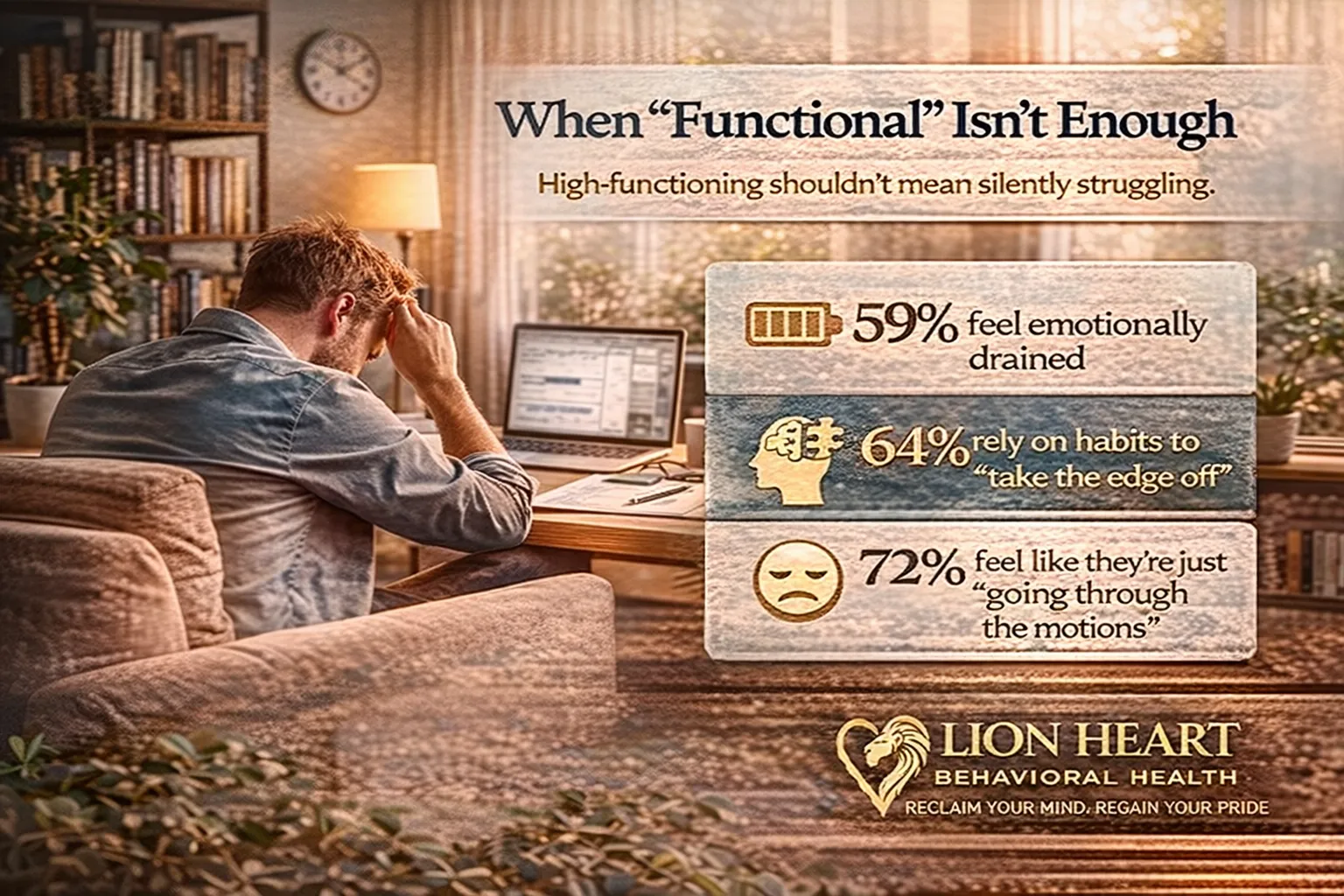
- You’re present physically, but not emotionally
- You rely on certain habits just to “take the edge off”
- You feel like you’re performing your life instead of living it
Over time, that becomes your baseline.
Not terrible. Not unbearable.
Just… not you.
And that’s the part people often tolerate for too long.
Why “I’ll Deal With It Later” Doesn’t Work the Way You Think
A lot of people in your position make a quiet deal with themselves:
“I’ll handle this if it gets worse.”
But here’s what tends to happen instead.
It doesn’t suddenly get worse.
It slowly becomes harder to manage.
The patterns deepen. The exhaustion builds. The disconnection becomes normal.
And by the time you decide to act, there’s more to untangle.
Addressing it now doesn’t mean you’re overreacting.
It means you’re catching it early.
You’re Not Looking for a Reset—You’re Looking for Relief
This is where the misunderstanding usually happens.
You’re not trying to blow up your life and start over.
You’re trying to feel like yourself again.
That’s a very different goal.
And it’s exactly why something like an outpatient mental health program becomes relevant—not as a last resort, but as a practical way to get support without stepping away from everything you’ve built.
It gives you space to:
- Slow down and actually process what’s going on
- Rebuild consistency without isolation
- Stay connected to your responsibilities while addressing what’s underneath
It’s not about removing you from your life.
It’s about helping you stay present in it.
The Resistance You Feel Makes Sense
Most high-functioning people hesitate here.
Not because they don’t need support—but because they don’t identify with needing it.
You might be thinking:
- “It’s not bad enough.”
- “Other people have it worse.”
- “I should be able to handle this.”
That last one is usually the strongest.
And it’s also the one that keeps people stuck the longest.
Because being able to handle something doesn’t mean you should have to keep carrying it alone.
There’s a Version of You That Doesn’t Feel Like This
This is the part that matters.
Because somewhere in you, there’s a reference point.
A version of yourself that felt:
- Clearer
- More present
- Less weighed down
You haven’t lost that version.
You’ve just gotten further away from it.
And the longer you stay in this in-between space, the harder it becomes to remember what that felt like.
Support isn’t about becoming someone new.
It’s about reconnecting to who you already were.
What We See When People Act at This Stage
When people step in before things fall apart, the process looks different.
Less crisis.
More clarity.
Less urgency.
More intention.
In Raynham, Massachusetts, we’ve worked with individuals who came in saying, “Nothing is wrong, but something isn’t right.” That awareness changed everything about how they moved forward.
And in New Bedford, Massachusetts, we’ve seen people who waited until they were overwhelmed—and wished they had trusted that earlier feeling instead.
That quiet awareness you have right now?
That’s the moment most people overlook.
This Isn’t About Rock Bottom—It’s About Realignment
There’s a cultural idea that you have to hit bottom before you deserve help.
Clinically, that’s not just untrue—it’s harmful.
Because it teaches people to wait.
To ignore early signals.
To push through until something breaks.
You don’t need a breaking point.
You need alignment.
And alignment often starts with acknowledging:
“This isn’t working the way it used to.”
What Happens When You Stop Carrying It Alone
When people step into support at this stage, the change isn’t dramatic.
It’s steady.
They start to:
- Feel less reactive and more grounded
- Understand patterns instead of just coping with them
- Reconnect with parts of themselves they thought were gone
And most importantly—they stop feeling like they have to hold everything together by themselves.
Because that’s usually what’s been exhausting them the most.
FAQs: For People Who Are “Fine” But Not Really Okay
Do I actually need help if nothing is falling apart?
Not everything has to fall apart for something to need attention.
If something feels off consistently, that’s worth exploring—regardless of how things look externally.
What if I’m just stressed?
Stress is part of life.
But ongoing stress that changes how you feel day-to-day isn’t something to ignore.
It’s something to understand.
Do I have to stop working or pause my life?
Not necessarily.
Many people choose support that fits around their schedule so they can continue their responsibilities while getting help.
What if I’m overthinking this?
That’s a common concern.
But most people don’t question their well-being without a reason.
Paying attention is not overthinking—it’s awareness.
What’s one sign I shouldn’t ignore?
That quiet, persistent thought:
“I don’t feel like myself anymore.”
That’s often the earliest—and most honest—signal.
What if I wait and it gets better on its own?
Sometimes it does.
But often, it slowly becomes more ingrained.
Addressing it earlier usually means less disruption later.
Why does it feel harder even though I’m still functioning?
Because maintaining that level of functioning is taking more energy than it used to.
And that energy has to come from somewhere.
You Don’t Need Permission to Want Something Better
You don’t need a crisis to justify support.
You don’t need everything to fall apart to take yourself seriously.
You just need honesty.
The kind that says:
“I can keep going like this… but I don’t want to.”
That’s enough.
Call (774) 341-4502 or visit our Intensive Outpatient Program in Raynham, Massachusetts to learn more.