
Introduction: You Don’t Have to Do This Alone Anymore
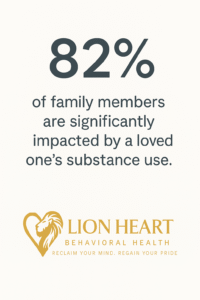
Loving someone in active addiction is like living in a house that keeps catching fire. You’re constantly putting out emotional flames—dodging lies, covering up chaos, wiping tears off your steering wheel—and all the while, the world keeps spinning like nothing’s wrong.
You don’t talk about it at work. You fake it at family gatherings. Maybe you’ve been Googling things like “signs they’re using again” or “how to help without enabling,” wondering how your life became a search bar full of quiet desperation.
At Lion Heart Behavioral Health, we meet families right there—in the mess, the heartbreak, the not-yet-fixed—and help them reclaim something real. The following stories are not polished testimonials. They’re raw, real turning points from families who walked through fire—and found healing on the other side through our family addiction support program.
1. “I Was Done Covering for Him. But I Wasn’t Done Loving Him.”
— Marie, Mom of a 22-Year-Old in Early Recovery
Marie was the kind of mom who never gave up. She pulled strings to get her son into programs, paid off his debts, answered every 2AM call. But after years of watching him relapse and lie, she realized she wasn’t helping—she was disappearing.
“I thought helping him meant fixing it all. Family support taught me that helping doesn’t mean losing yourself. It means standing your ground and still showing up—with boundaries and a backbone.”
She attended her first session reluctantly. But the way other families spoke—with honesty, without shame—hit her hard. It wasn’t just her.
Breakthrough Moment: When she stopped enabling and started attending sessions for her own healing, her son felt the shift. He started taking his own recovery seriously—for the first time in years.
2. “Addiction Was the Third Person in Our Marriage.”
— Jason, Husband of a Woman in Treatment
Jason spent years resenting his wife’s alcohol use in silence. To the outside world, they were still the “strong couple.” Behind closed doors, it was cold detachment, empty promises, and a growing emotional chasm.
“Addiction made me feel like I was losing her piece by piece. I went to family support hoping it would fix her. Turns out, it fixed something in me.”
He learned to communicate in ways that didn’t come from fear or anger. He learned what codependency actually meant—and how to step out of it.
Breakthrough Moment: In a facilitated session, his wife said, “This is the first time I feel like you see me—not just the addiction.” They left the meeting holding hands, something they hadn’t done in months.
3. “My Daughter’s Addiction Nearly Took My Son Too.”
— Andrea, Single Mom of Two Teens
Andrea was laser-focused on saving her daughter from fentanyl. But in the background, her younger son was slowly spiraling—skipping school, vaping, numbing out on screens. She didn’t notice until the school called about him too.
“I thought being a good mom meant focusing on the crisis. But I was losing both of them. The family program helped me zoom out. I didn’t just need to manage the crisis—I needed to heal our whole home.”
Family addiction support helped her reconnect with both her kids and learn to parent from a place of calm authority—not panic.
Breakthrough Moment: Her son, once closed off and angry, leaned into her after a family education session and said, “Thanks for seeing me too.”
4. “I Didn’t Want to Go. I Went for Her. I Stayed for Me.”
— Leo, Dad of a 19-Year-Old in Detox
Leo grew up in a family that didn’t talk about emotions. His daughter’s addiction shattered that silence. After her third overdose, he broke down in the car but still didn’t know how to ask for help.
“I used to think crying was weakness. But the first time I broke down in a support session, I felt something shift. That wasn’t weakness—it was relief.”
Support sessions didn’t just give him tools. They gave him connection. A place to process grief, anger, guilt—without judgment.
Breakthrough Moment: His daughter said, “I used to think you didn’t care. But seeing you in that circle? It made me want to try again.”
5. “He Got Better. I Was Still a Wreck.”
— Carly, Sister of a Sober Sibling
Carly’s brother was six months sober and doing “everything right.” Everyone applauded his recovery, but no one asked Carly how she was doing after years of fear, broken trust, and trauma.
“I didn’t realize how much I’d been holding until I got to speak it out loud. Family support wasn’t about him—it was about me having a voice. For the first time in a long time, I felt like a whole person again.”
She used the program’s journaling prompts, communication strategies, and boundary-setting workshops to rebuild not just her relationship with her brother—but with herself.
Breakthrough Moment: She wrote him a letter through a family exercise and read it aloud in session. He cried. So did she. It was the beginning of forgiveness—for both of them.
You Deserve a Place to Land, Too
You’ve been strong long enough.
You’ve played the peacekeeper, the detective, the emergency contact, the punching bag, the provider, the secret keeper.
But who’s been taking care of you?
At Lion Heart Behavioral Health, our family addiction support program isn’t about “fixing” your loved one. It’s about giving you space to breathe, grieve, learn, connect, and grow. Because when families heal, recovery gets stronger—for everyone involved.
Frequently Asked Questions (FAQs)
What is a family addiction support program?
It’s a structured program designed to support the entire family system, not just the person in active addiction. It includes education, group support, individual coaching, and tools for healthy communication, boundaries, and healing.
Do I need to attend with my loved one?
No. Many family members begin their support journey even when their loved one is still using or refusing treatment. Healing can begin independently and often influences the entire family dynamic.
How is this different from Al-Anon?
While both offer support, Lion Heart’s program includes clinical facilitation, trauma-informed approaches, and personalized strategies tailored to your family’s unique needs—not just peer-led discussion.
Is this just about setting boundaries?
No. Boundaries are important, but they’re just one part. You’ll also learn how addiction affects family roles, how to rebuild trust, and how to move from survival mode to true emotional recovery.
What if I’m angry or burned out?
That’s exactly when you should come. This is a safe space for real emotions—grief, resentment, confusion, and everything in between. You don’t have to be “on” here. You just have to be real.
Take the First Step. You Don’t Have to Be Perfect—Just Present.
Your healing matters. And your story isn’t over. If you’re ready to take one small step toward peace, clarity, and connection—we’re here. Call us at (774) 341-4502.