

Choosing a therapy approach can feel like being asked to make an important decision before you fully understand the options.
You may have been referred to cognitive behavioral therapy, heard someone recommend dialectical behavior therapy, or come across both while searching for support. Now you are trying to compare DBT vs CBT and wondering whether choosing the wrong one could slow your progress.
Both are evidence-based approaches. They also overlap in meaningful ways. However, they tend to emphasize different problems, skills, and treatment goals.
You can learn more about Lion Heart’s individual approaches to DBT and CBT. This guide focuses on the practical differences between them and how a clinician may determine which approach fits your situation.
You do not need to arrive at your first appointment already knowing the answer.
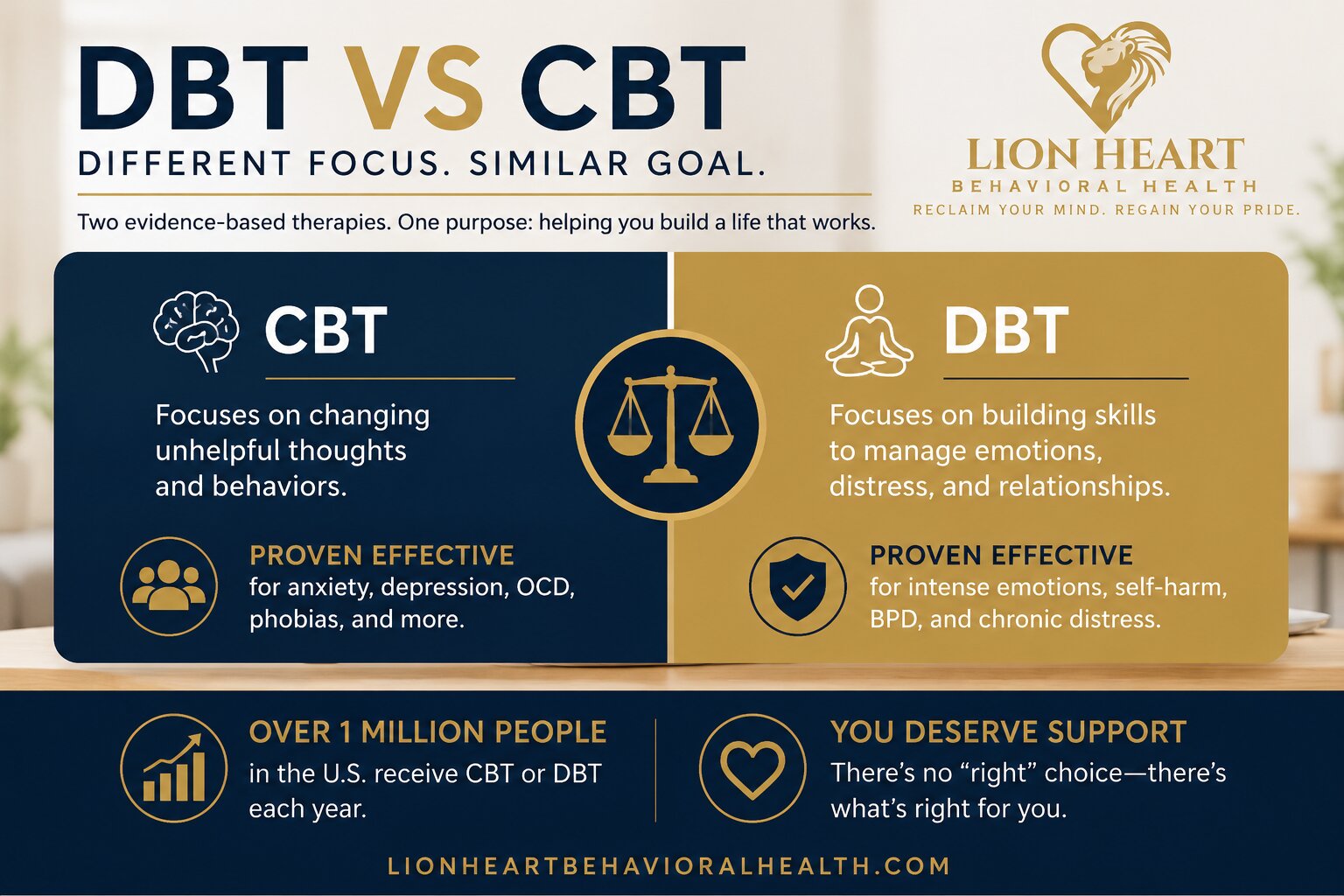
DBT vs CBT: The Core Difference
The simplest difference between DBT and CBT is where each approach places its primary focus.
CBT helps people recognize how thoughts, emotions, and behaviors influence one another. It often focuses on identifying patterns that are inaccurate, unhelpful, or keeping a problem going—and then practicing more useful ways of thinking and responding.
DBT developed from CBT but adds a stronger emphasis on accepting present emotions while learning how to survive distress, regulate intense reactions, communicate effectively, and make healthier decisions.
In other words:
CBT often asks: “Is this thought accurate or useful, and what could I do differently?”
DBT often asks: “How can I accept what I feel right now without letting that feeling control what I do next?”
Neither question is better in every situation. The right question depends on what is causing the greatest difficulty in your life.
Area |
CBT |
DBT |
|---|---|---|
| Origin | A broad form of behavioral therapy developed to change unhelpful patterns of thinking and behavior | Evolved from CBT and was initially developed for people experiencing chronic suicidality and borderline personality disorder |
| Core philosophy | Thoughts, emotions, and behaviors affect one another and can be changed | Acceptance and change are both necessary |
| Primary focus | Identifying and changing unhelpful thoughts and behaviors | Managing intense emotions, distress, impulsive behavior, and relationship conflict |
| Main skills | Cognitive reframing, behavioral activation, exposure, problem-solving, and coping strategies | Mindfulness, distress tolerance, emotion regulation, and interpersonal effectiveness |
| Typical structure | Often individual therapy, although group-based CBT also exists | Comprehensive DBT commonly includes individual therapy, a skills group, between-session coaching, and therapist consultation |
| Commonly used for | Anxiety, depression, phobias, obsessive-compulsive symptoms, insomnia, and other concerns | Borderline personality disorder, chronic self-harm, suicidal behavior, severe emotional dysregulation, and unstable relationships |
| Time emphasis | Often examines current thoughts and behaviors that maintain symptoms | Strongly emphasizes surviving the present moment while building a life that feels worth living |
| Therapeutic stance | Collaborative examination and testing of thought and behavior patterns | Validation of the person’s current experience alongside active encouragement to change harmful patterns |
DBT does not ignore thoughts, and CBT does not ignore emotions. The distinction is one of emphasis rather than a rigid dividing line.
What Is CBT, in Brief?
CBT is a structured form of therapy that helps people understand connections among thoughts, emotions, and behaviors. A therapist may help you identify patterns that intensify anxiety, depression, avoidance, or self-criticism and practice more balanced responses.
It is typically practical, goal-oriented, and focused on skills you can use outside appointments.
What Is DBT, in Brief?
DBT combines behavioral change strategies with acceptance, mindfulness, and skills for handling intense emotions. It was developed by psychologist Marsha Linehan and is particularly associated with treating chronic suicidal behavior and borderline personality disorder.
A central principle is dialectics: two ideas that appear opposite can both be true. You can accept yourself as you are while also working toward change.
Key Differences: Skills, Structure, and What Each Treats Best
Understanding DBT therapy vs CBT therapy becomes easier when you consider what actually happens in treatment.
CBT Often Focuses on Thought and Behavior Patterns
Imagine that you are invited to a gathering and immediately think:
“No one will want to talk to me. I will embarrass myself.”
That thought may create anxiety. The anxiety may lead you to cancel. Canceling brings temporary relief, but it also reinforces the belief that social situations are dangerous.
A CBT therapist may help you:
- Examine the evidence supporting the prediction.
- Notice all-or-nothing thinking or mind-reading.
- Develop a more balanced interpretation.
- Gradually approach social situations instead of avoiding them.
- Review what actually happened afterward.
The goal is not to force positive thinking. It is to help you respond to situations based on a fuller picture rather than an automatic fear.
CBT has been studied extensively for anxiety and depressive disorders and can be adapted for concerns such as panic, phobias, obsessive-compulsive disorder, insomnia, substance use, and chronic health conditions. Lion Heart describes its CBT services as helping clients address negative thought patterns related to anxiety, depression, addiction, and other mental health concerns. (Behavioral Health Center)
DBT Often Focuses on Emotional Intensity and Behavioral Control
Now imagine that an argument with someone you care about creates an immediate wave of panic, anger, shame, or fear of abandonment.
Within minutes, you may feel driven to send dozens of messages, end the relationship, use substances, hurt yourself, or do something else you later regret.
A DBT therapist may not begin by debating whether your thoughts are logical. First, they may help you survive the emotional wave without making the situation more dangerous.
You may practice how to:
- Pause before acting.
- Bring attention back to the present moment.
- Lower the intensity of a crisis.
- Identify and name emotions.
- Understand what makes emotions more vulnerable.
- Ask for what you need without attacking or withdrawing.
- Set boundaries while protecting important relationships.
DBT is particularly designed for people who struggle with emotional regulation. Its four major skills areas are mindfulness, distress tolerance, emotion regulation, and interpersonal effectiveness. (Cleveland Clinic)
The Treatment Structure Can Be Different
CBT is frequently delivered through individual weekly sessions, although it can also be offered through groups, intensive programs, guided self-help, or other formats.
Traditional comprehensive DBT is more structured. It generally includes:
- Individual therapy
- Group-based skills training
- Coaching for applying skills between sessions
- A consultation team that supports DBT clinicians
Not every program offering “DBT-informed” care provides all four elements. Some therapists integrate DBT skills into individual therapy without running a comprehensive DBT program.
That does not automatically make the care inappropriate, but it is worth asking what the provider means when they use the term DBT.
CBT May Be a Strong Fit for Specific Fears and Avoidance
CBT is often considered when a problem is maintained by predictable cycles of fear, avoidance, or rigid thinking.
Examples may include:
- Avoiding driving because of panic
- Repeatedly seeking reassurance about health concerns
- Withdrawing from activities during depression
- Performing rituals to reduce obsessive fear
- Assuming one mistake means complete failure
- Avoiding social interaction because rejection feels certain
Exposure-based strategies may also be incorporated when appropriate. Exposure does not mean being forced into the most frightening situation immediately. It usually involves approaching feared experiences gradually and intentionally while learning that anxiety can be tolerated without relying on avoidance.
DBT May Be a Strong Fit When Emotions Become Crises
DBT is often considered when the immediate concern is not simply what someone thinks but what happens when emotions become overwhelming.
Examples may include:
- Repeated self-harm
- Suicidal behaviors or recurring crises
- Intense anger that damages relationships
- Rapid emotional shifts
- Impulsive decisions during distress
- Persistent fear of abandonment
- Difficulty returning to baseline after conflict
- Feeling emotionally out of control
DBT was originally developed to treat chronically suicidal people diagnosed with borderline personality disorder. It has since been adapted for other populations involving severe emotional dysregulation and high-risk behaviors.
Which Therapy Is Right for You?
There is no single test that determines the answer, and a blog cannot replace a clinical assessment.
However, you can begin by asking what tends to happen when you struggle.
CBT May Be Worth Discussing When:
Your main difficulties involve anxious predictions, harsh beliefs, avoidance, low motivation, specific fears, compulsive patterns, or behaviors that repeatedly reinforce depression or anxiety.
You may know that your thoughts are unhelpful but feel unsure how to challenge them or act differently.
DBT May Be Worth Discussing When:
Your emotions rise quickly, feel physically overwhelming, or lead to impulsive and potentially harmful actions.
You may understand a situation intellectually but still feel unable to control what happens during anger, panic, shame, rejection, or conflict.
You May Benefit From Elements of Both When:
You experience both unhelpful thinking patterns and severe emotional reactions.
For example, someone with anxiety may use CBT to examine catastrophic predictions while using DBT distress-tolerance skills to manage a panic surge without escaping the situation.
Someone with depression may use behavioral activation from CBT while learning DBT emotion-regulation skills that make it easier to care for their body, communicate needs, and cope with setbacks.
Therapists often integrate approaches because people rarely fit neatly inside one treatment category.
Consider the Level of Support You Need
Another important question is how much structure would help you engage consistently.
Would weekly individual therapy and between-session exercises be enough?
Would you benefit from repeated skills practice in a group?
Do crises occur between appointments?
Are self-harm, suicidal behavior, substance use, or impulsive decisions creating immediate safety concerns?
A clinician may recommend a more structured approach when symptoms are severe or when weekly outpatient therapy has not provided enough support.
Consider What You Want to Change First
You do not need to solve everything at once.
Your first treatment target may be:
- Reducing panic attacks
- Getting out of bed more consistently
- Stopping self-harm
- Improving relationships
- Managing anger
- Reducing compulsive behavior
- Tolerating distress without using substances
- Rebuilding daily routines
The most urgent or disruptive goal often helps determine where treatment should begin.
Which Is Better for Anxiety: DBT or CBT?
For many anxiety disorders, CBT is commonly used because it directly addresses anxious predictions, avoidance, reassurance-seeking, and fear-based behaviors.
However, that does not mean DBT has no place in anxiety treatment.
DBT skills may be especially helpful when anxiety creates intense emotional flooding, impulsive coping, relationship conflict, or difficulty tolerating uncertainty. Mindfulness and distress-tolerance strategies may help someone stay present long enough to use CBT techniques effectively.
Therefore, the answer to DBT vs CBT for anxiety depends on how anxiety operates.
If avoidance and catastrophic thinking are the primary problems, CBT may receive more emphasis. If emotional intensity and crisis behaviors are getting in the way, DBT skills may be incorporated.
Which Is Better for BPD: DBT or CBT?
When comparing DBT vs CBT for BPD, DBT is often the more directly relevant treatment because it was specifically developed for people experiencing chronic suicidality and borderline personality disorder.
DBT addresses several concerns commonly associated with BPD, including intense emotions, self-harm, unstable relationships, impulsivity, anger, and fear of abandonment. It combines acceptance with clear behavioral expectations and repeated skills practice.
That does not mean someone diagnosed with BPD can never benefit from CBT techniques. A clinician may still use cognitive and behavioral interventions as part of an individualized plan.
Diagnosis alone does not determine treatment. Current symptoms, safety, treatment history, goals, and available programs all matter.
Is DBT a Type of CBT?
Yes. DBT grew out of the cognitive behavioral tradition.
Marsha Linehan initially applied behavioral change strategies to chronically suicidal clients. She found that focusing heavily on change could leave some people feeling criticized or misunderstood.
DBT was developed to create a stronger balance between change and acceptance.
It retained behavioral methods while adding mindfulness, validation, distress tolerance, emotional regulation, and a dialectical perspective. That is why DBT is often described as a specialized form or “third-wave” development of CBT.
The two approaches are related, but they are not interchangeable.
Where EMDR Fits
If traumatic memories, flashbacks, nightmares, or trauma-related triggers are the primary drivers of your symptoms, it may also be worth asking about EMDR therapy.
EMDR focuses more directly on processing distressing memories than either standard CBT or DBT. However, some people need CBT or DBT skills before or alongside trauma processing so they can manage the emotions that arise.
What Therapy Actually Requires From You
People sometimes worry that they will not be “good at therapy.”
You do not need to arrive with perfect insight. You do not need to describe every feeling clearly. You also do not have to believe with complete confidence that treatment will work.
Both CBT and DBT involve active participation, but that activity develops gradually.
In CBT, you may be asked to track thoughts, practice a new behavior, complete an exposure exercise, or test a prediction between appointments.
In DBT, you may complete diary cards, practice skills, examine behaviors step by step, and try new ways of responding during distress.
Homework is not meant to grade you.
It gives you a chance to notice what happens in daily life, where you get stuck, and which skills need more practice. Not completing an exercise is also useful information. A clinician can explore what got in the way rather than treating it as failure.
Progress may be uneven.
A person can understand a skill before they are able to use it in the hardest moment. Repetition helps close that gap.
Getting Started
You do not need to choose DBT or CBT alone before contacting a provider.
During an intake, a clinician may ask about:
- Your current symptoms
- How long they have been occurring
- What happens during emotional distress
- Any history of self-harm or suicidal thoughts
- Patterns of avoidance or compulsive behavior
- Trauma and relationship history
- Substance use
- Previous therapy experiences
- What you hope will change
You can ask the clinician:
- Why do you recommend this approach for me?
- What would sessions look like?
- Is the treatment individual, group-based, or both?
- How will we measure progress?
- What happens if the approach does not seem helpful?
- Do you combine CBT and DBT skills?
- How much practice is expected between appointments?
A good recommendation should be connected to your symptoms and goals—not simply to whichever method the provider happens to offer.
Choosing treatment is not a permanent contract.
Your plan can be reviewed. Skills can be combined. The pace can change. Another approach can be considered when your needs become clearer.
The first step is not picking the perfect therapy.
It is beginning an honest conversation about what has been happening and what kind of support could make life feel more manageable. If you’re near New Bedford, Raynham, or Bristol County, Lion Heart offers programs with that same approach.
Frequently Asked Questions
Is DBT a Type of CBT?
Yes. DBT developed from cognitive behavioral therapy and continues to use behavioral change strategies. It differs by placing greater emphasis on acceptance, mindfulness, distress tolerance, emotional regulation, and relationship skills.
Which Is Better for Anxiety—DBT or CBT?
CBT is commonly used for anxiety because it addresses catastrophic thoughts, avoidance, and fear-based behaviors. DBT may be particularly useful when anxiety causes overwhelming emotions, impulsive coping, or difficulty tolerating distress. Some people benefit from a combination.
Which Is Better for BPD—DBT or CBT?
DBT is often preferred for borderline personality disorder because it was specifically developed to address chronic suicidality, self-harm, emotional dysregulation, and unstable relationships. CBT strategies may still be incorporated depending on the person’s symptoms and goals.
Can You Do Both DBT and CBT?
Yes. The approaches share behavioral foundations, and clinicians often combine their techniques. A person may use CBT to challenge anxious thinking while using DBT skills to tolerate distress and regulate emotions.
Final Thoughts
When people ask which is better, DBT or CBT, the most accurate answer is that the right fit depends on what you are experiencing.
CBT may help when anxious, depressive, obsessive, or avoidant patterns are keeping you stuck.
DBT may help when emotions become so intense that it is difficult to remain safe, communicate clearly, or make decisions that reflect your long-term goals.
You may need parts of both.
You may also begin with one and incorporate the other later.
Not knowing which approach you need does not mean you are unprepared for treatment. It is one of the questions an assessment is designed to answer.
Call (774) 341-4502 to talk through which approach—DBT or CBT—fits your situation.