

You wake up on time. You answer emails. You make dinner.
You laugh when someone tells a joke. From the outside, your life looks…normal. Maybe even successful.
But somewhere underneath all of that, you’ve been carrying a quiet weight for so long that you’ve almost forgotten what it feels like not to.
If you’ve been searching for high functioning depression, there’s a good chance you’re not looking for permission to stop functioning.
You’re looking for an explanation. Because you’re tired in a way sleep doesn’t fix.
You’re showing up, but you don’t feel present. You’re getting through the day, but it feels like you’re surviving it instead of living it. One of the hardest parts is that people keep telling you how well you’re doing. They say things like:
“You always have it together.” “I wish I were as productive as you.” “You seem happy.”
Meanwhile, you’re wondering how much longer you can keep pretending that “fine” and “okay” are the same thing. If any of that sounds familiar, know this: Your pain does not become less real because you’re still functioning.
If you’re beginning to wonder whether depression could be part of what you’re experiencing, learning about depression treatment can help you understand your options.
What Is High-Functioning Depression?
The first thing that’s important to know is this:
High-functioning depression is not an official DSM-5 diagnosis.
You won’t find it listed as a formal mental health disorder.
That doesn’t mean it isn’t real.
It’s a phrase many people use to describe living with depressive symptoms while continuing to meet everyday responsibilities.
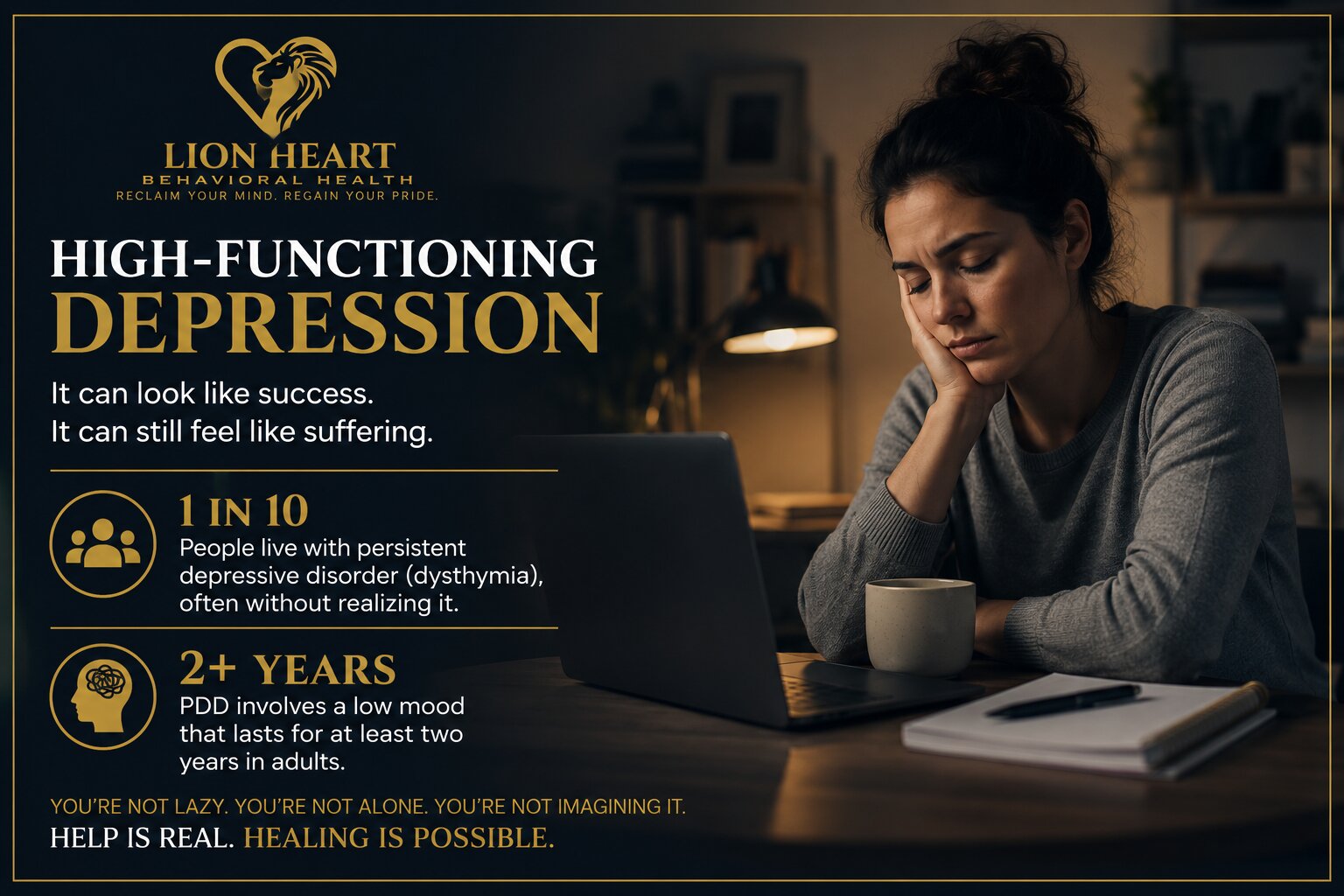
Often, it overlaps with persistent depressive disorder (PDD), formerly called dysthymia.
Persistent depressive disorder involves a depressed mood that lasts for at least two years in adults, along with other symptoms such as low energy, poor self-esteem, difficulty concentrating, changes in appetite or sleep, or feelings of hopelessness.
Unlike major depressive episodes, which can be severe and disabling, PDD is often quieter.
It doesn’t always stop someone from working. Or paying bills. Or taking care of children.
Instead, it becomes the background noise of daily life. Some people describe it like living with the emotional equivalent of gray skies. Nothing is catastrophic. Nothing feels vibrant, either.
Over time, that can become so familiar that a person assumes this is simply what adulthood feels like.
Signs of High-Functioning Depression
Depression doesn’t always look like someone staying in bed all day.
Sometimes it looks like someone who never stops moving because slowing down would mean feeling everything they’ve been trying to outrun. Some common high functioning depression symptoms include:
Feeling emotionally flat
You’re not necessarily crying every day. You’re just…not feeling much of anything.
Excitement is muted. Pride disappears quickly. Moments that should feel joyful barely register. People around you celebrate milestones.
You mostly feel relief that they’re over.
Going through the motions
You complete tasks because they’re on the list. Not because you enjoy them. Life starts feeling like checking boxes instead of actually experiencing it.
Morning routine. Work. Dinner. Laundry. Sleep. Repeat.
Eventually you stop asking whether you’re happy because surviving the schedule feels like enough.
Constant fatigue
You’re exhausted. Not the kind of tiredness that follows a long week.
The deeper kind. The kind where your body works but your spirit feels permanently drained.
You sleep. You’re still tired. You take a vacation. You come home just as exhausted.
Nothing feels especially enjoyable anymore
Psychologists call this anhedonia. Most people simply describe it as losing interest in things they used to love.
Your favorite hobby feels like work. Vacations feel strangely empty. Friends invite you out. You go because you know you should—not because you’re looking forward to it.
Irritability replaces sadness
Depression isn’t always obvious sadness. Sometimes it’s frustration. Short patience.
Feeling annoyed by small inconveniences. Snapping at people you care about and wondering afterward why everything feels so overwhelming.
Your inner voice is relentlessly critical
Outwardly, you may appear confident.
Internally, the conversation sounds very different.
“You’re lazy.”
“You’re behind.”
“You’re disappointing everyone.”
“Other people have real problems.”
No matter what you accomplish, it rarely feels like enough.
You’re functioning—but barely
Perhaps the clearest sign is this: You keep doing everything people expect. You simply don’t know how much longer you can keep doing it.
What High-Functioning Depression Looks Like Day to Day
One of the reasons this kind of depression hides so well is because success and suffering can exist at the same time.
Someone with high-functioning depression may:
- Earn promotions.
- Raise children.
- Exercise regularly.
- Maintain friendships.
- Volunteer.
- Smile in meetings.
- Remember birthdays.
- Respond to every text.
None of those things automatically mean they’re emotionally healthy.
There’s often an invisible second shift happening underneath everything else. Every conversation requires effort.
Every decision feels heavier than it should. Every interaction is carefully managed so no one notices how depleted they actually feel.
The outside world sees consistency. The person living it experiences constant emotional labor. One sentence captures it better than almost anything else:
High-functioning depression isn’t the absence of struggle—it’s becoming so practiced at hiding the struggle that other people stop looking for it.
That performance becomes exhausting.
Not because you’re pretending every second.
But because you’ve learned how to compartmentalize your pain well enough that it rarely interrupts your responsibilities.
People compliment your resilience.
They don’t see what resilience is costing you.
You become the reliable one
Friends call you first. Coworkers depend on you.
Family members assume you’ll handle everything. Part of you appreciates being trusted.
Another part quietly wonders: “Would anyone notice if I stopped holding everything together?”
Being dependable can become its own trap. The more capable you appear, the less permission people seem to give you to struggle. Eventually, you stop giving yourself permission too.
Rest starts feeling uncomfortable
People often assume someone with depression wants to stay in bed. Many people with high-functioning depression have the opposite problem.
Stopping feels dangerous. If they’re busy, they don’t have to think.
If they’re productive, they don’t have to notice the emptiness. Work becomes distraction. Cleaning becomes distraction.
Helping everyone else becomes distraction. Silence becomes the thing they’re trying hardest to avoid.
Joy feels unfamiliar
Perhaps the strangest part isn’t overwhelming sadness. It’s how unfamiliar genuine happiness begins to feel. Someone compliments you.
You don’t believe them. Something wonderful happens. You immediately expect something bad to follow.
A free afternoon appears on your calendar. Instead of excitement, you feel guilty.
Depression has a way of convincing people they should always be doing more, fixing more, producing more. Even rest begins to feel like failure.
You wonder if you’re just being dramatic
This thought appears constantly.
“Maybe I’m making this bigger than it is.”
“Other people have it worse.”
“I’m still paying my bills.”
“I’m still going to work.”
“Maybe I’m just lazy.”
Ironically, many people with high-functioning depression minimize their symptoms precisely because they remain functional.
Functioning becomes evidence against asking for help.
It shouldn’t.
Broken bones don’t stop being broken because someone keeps walking on them.
Emotional pain doesn’t become less deserving of care because you’re still answering emails.
Why It’s So Often Missed
One of the cruelest things about high-functioning depression is that it rarely looks like the version of depression most people expect.
There is no obvious crisis.
No dramatic collapse.
No moment that clearly tells everyone around you something is wrong.
Instead, it settles into your life quietly.
You keep showing up, so people assume you’re okay.
Eventually, you start believing that too.
“I’m Not Depressed Enough”
Many people living with high-functioning depression spend years talking themselves out of getting help. They compare themselves to someone whose depression seems more severe.
“I’m still working.”
“I’m still taking care of my family.”
“I’m not in bed all day.”
“Other people have it worse.”
Depression is not a competition. Your suffering does not have to reach a certain level before it deserves attention. If getting through every day feels like carrying an invisible backpack full of bricks, that’s worth talking about.
High Standards Can Hide Depression
People who are driven, responsible, or perfectionistic often become exceptionally good at masking emotional pain. They don’t stop functioning. They simply push harder. They become the employee who never takes time off. The parent who always volunteers.
The friend who always says yes. The person everyone describes as “having it together.” Meanwhile, they may be privately wondering how much longer they can keep pretending. High-functioning depression often survives because achievement becomes camouflage.
Even Clinicians Can Miss It
Mental health professionals are trained to look beyond appearances, but symptoms can still be overlooked—especially if someone minimizes what they’re experiencing.
If a person says:
“I’m fine.”
“Work is going well.”
“Everything is under control.”
…without also describing the exhaustion, hopelessness, or emotional numbness underneath, depression can remain hidden. That is one reason honesty during an evaluation matters so much. You don’t have to protect your therapist from your real experience.
The more accurately you describe what life feels like, the better they can help.
High-Functioning Depression vs. Major Depression vs. Dysthymia
These terms are often used interchangeably, but they don’t mean exactly the same thing.
| High-Functioning Depression | Persistent Depressive Disorder (Dysthymia) | Major Depressive Disorder |
|---|---|---|
| Not an official diagnosis | Formal DSM-5 diagnosis | Formal DSM-5 diagnosis |
| Describes someone who continues functioning despite depressive symptoms | Long-lasting depression lasting at least two years | More severe depressive episodes lasting at least two weeks |
| Often overlaps with PDD | Symptoms may be milder but are chronic | Symptoms are typically more intense |
| Many people continue working and meeting responsibilities | Daily functioning may continue, though it often feels difficult | Functioning may become significantly impaired |
| A descriptive phrase rather than a medical diagnosis | Diagnosed by a qualified mental health professional | Diagnosed by a qualified mental health professional |
Think of high-functioning depression as a description of how depression can appear rather than a diagnosis itself.
Many—but not all—people who describe themselves this way ultimately receive a diagnosis of persistent depressive disorder. Others may be experiencing major depression while continuing to function at a surprisingly high level. Only a qualified clinician can determine what diagnosis best fits your symptoms.
The important takeaway is this: Whether your depression is chronic, episodic, mild, or severe, you deserve support.
When and How to Get Help
You don’t have to wait until everything falls apart.
In fact, one of the biggest misconceptions about mental health is that treatment is only for people in crisis. Sometimes the strongest reason to seek help is much quieter: You’re tired of surviving every day.
Consider reaching out if:
- Life feels consistently joyless.
- You haven’t genuinely felt like yourself in months—or years.
- You’re relying on work, productivity, or constant busyness to avoid your feelings.
- You’re withdrawing from people who matter to you.
- You constantly feel exhausted despite sleeping.
- You’re beginning to wonder how much longer you can keep pretending everything is okay.
Starting doesn’t have to mean making a huge commitment.
Often it begins with one conversation.
A therapist or mental health provider may ask about:
- Your mood over time
- Sleep and energy
- Relationships
- Stress levels
- Work and daily functioning
- Medical history
- Whether you’ve experienced periods of depression before
There isn’t a test you pass or fail.
There isn’t a certain amount of suffering required before you’re “allowed” to ask for help.
There is only the question:
Is life feeling harder than it needs to?
If the answer is yes, it’s worth talking to someone. Learning more about depression treatment can be a meaningful first step.
Frequently Asked Questions
Is High-Functioning Depression a Real Diagnosis?
No. High-functioning depression is not an official diagnosis in the DSM-5. It is a commonly used term that describes people who continue managing daily responsibilities while living with persistent depressive symptoms. Many people who identify with this description are ultimately diagnosed with persistent depressive disorder (PDD), though others may have a different depressive disorder.
Can You Have Depression and Still Function?
Yes. Many people continue working, raising children, maintaining relationships, and meeting responsibilities while experiencing depression. Being productive does not mean someone is emotionally healthy. Depression affects everyone differently, and outward success does not eliminate internal suffering.
How Is High-Functioning Depression Treated?
Treatment depends on each person’s needs. Many people benefit from psychotherapy, lifestyle changes, social support, and, when appropriate, medication prescribed by a qualified healthcare provider. The first step is receiving an accurate assessment rather than trying to determine the diagnosis alone.
Final Thoughts
For a long time, I thought functioning meant I couldn’t really be depressed. I paid my bills. I showed up. People depended on me.
Surely someone who was truly struggling couldn’t keep doing all of that. I was wrong. Looking functional and feeling alive are not the same thing.
If you’re carrying a version of yourself through each day that everyone else believes is effortless, you’re probably already exhausted. You don’t have to earn help by falling apart first. You don’t have to wait until you can’t get out of bed. You don’t have to prove your pain.
You only have to acknowledge that constantly surviving is not the same as living. If you’re near New Bedford, or Bristol County, Lion Heart offers programs with that same approach.
If this article felt uncomfortably familiar, consider taking the next small step. Call (774) 341-4502 or learn more about depression treatment at Lion Heart.