

You may have read that EMDR can bring traumatic memories rushing back, leave someone emotionally overwhelmed, or make symptoms worse.
Perhaps you tried following an EMDR video or app on your own and felt unsettled afterward. Now you are wondering whether trying again with a therapist would be helpful—or dangerous.
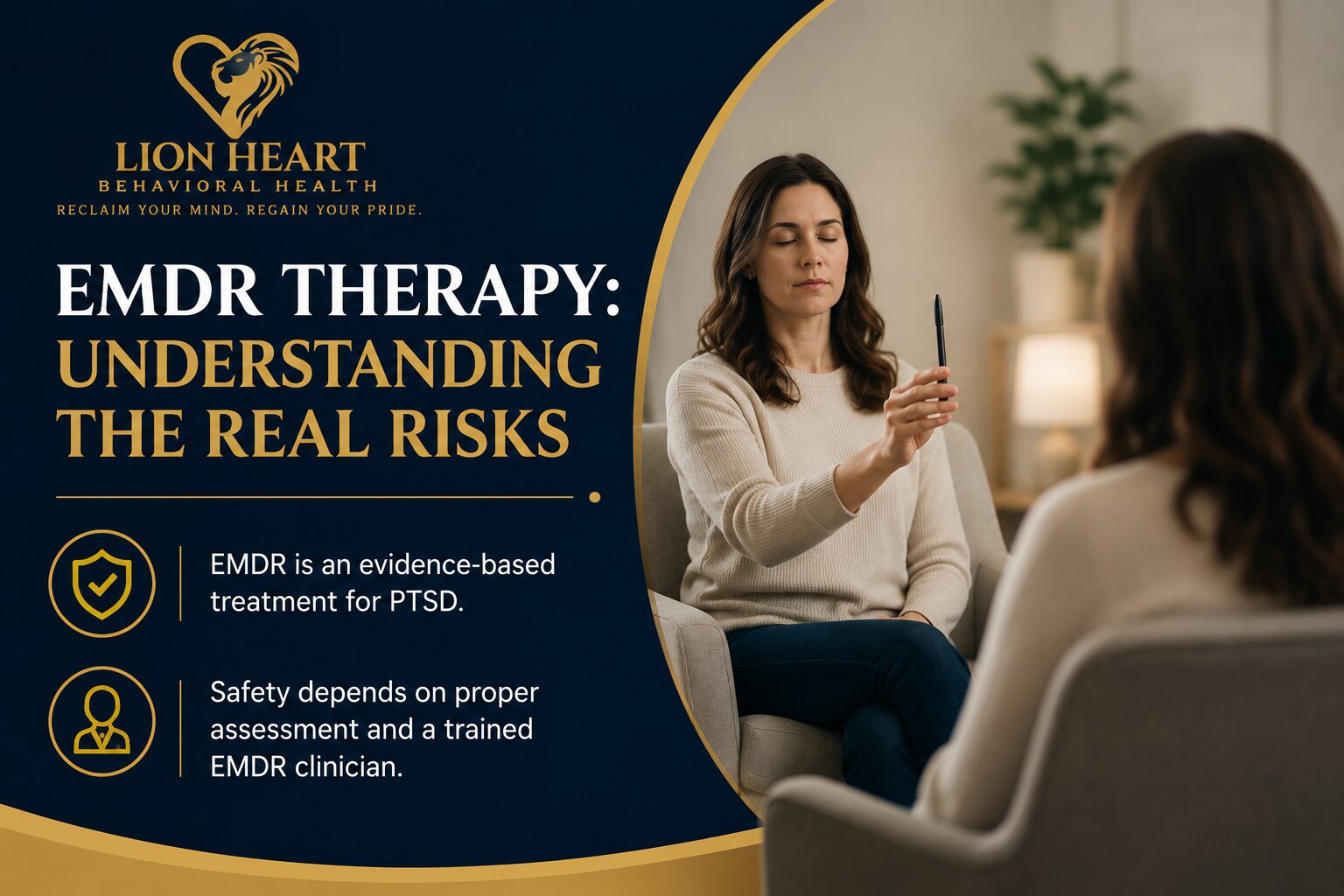
Concerns about the dangers of EMDR therapy deserve an honest answer. EMDR can cause temporary distress, and poorly timed or improperly delivered trauma processing can destabilize someone. However, the risks are specific and manageable. A trained clinician does much more than guide eye movements. They assess readiness, build regulation skills, control the pace, monitor reactions, and help close each session safely.
New to the approach? Here is an overview of how EMDR therapy works.
Is EMDR Therapy Safe?
For appropriately assessed adults working with a trained clinician, EMDR is generally considered a safe, evidence-based treatment.
EMDR is recognized in major clinical guidelines as a trauma-focused treatment for post-traumatic stress disorder. The U.S. Department of Veterans Affairs describes it as one of the most studied PTSD treatments and notes that it receives strong recommendations in several clinical practice guidelines. The American Psychological Association also includes EMDR among recommended treatments for adults with PTSD. (American Psychological Association)
That does not mean EMDR is effortless, appropriate for everyone at every moment, or guaranteed to work.
The process intentionally brings a distressing memory into awareness while the person attends to bilateral stimulation, such as guided eye movements, alternating sounds, or tapping. That can activate difficult emotions and body sensations. The goal is not to overwhelm the person. It is to engage the memory while they remain connected to the present and able to tolerate what arises.
EMDR safety therefore depends on more than the technique itself. It depends on assessment, preparation, pacing, therapist competence, honest communication, and the person’s current stability.
The Real Risks to Understand
Most EMDR therapy risks involve temporary emotional activation rather than physical danger. The greatest problems tend to occur when trauma processing begins before someone is ready, continues after they have become overwhelmed, or is attempted without qualified clinical support.
Emotional Distress During and After Sessions
EMDR may bring up fear, sadness, anger, shame, grief, or physical tension connected to a traumatic experience.
A person may cry, feel temporarily anxious, or notice that a memory seems vivid during processing. Difficult emotions can also continue for a limited period after the appointment. Cleveland Clinic identifies negative thoughts or feelings between sessions as one of the more common negative effects associated with EMDR. (Cleveland Clinic)
Some activation is expected because meaningful material is being processed. However, the person should still be able to communicate, orient to the room, respond to the therapist, and regain stability.
Intense distress is not something a clinician should dismiss as proof that the therapy is “working.”
Physical Reactions
Some people report temporary fatigue, headaches, muscle tension, vivid dreams, lightheadedness, or changes in sleep after a session.
These reactions are usually discussed during informed consent and monitored over time. Persistent, severe, or medically concerning symptoms should not automatically be attributed to EMDR. They should be evaluated by an appropriate healthcare professional.
The Emergence of Additional Memories
As one memory is explored, related images, sensations, thoughts, or fragments of other experiences may come to mind.
This does not necessarily mean EMDR has uncovered a perfectly accurate “repressed memory.” Human memory is reconstructive rather than a literal recording. New material may feel meaningful, but it should be approached carefully and without suggestion from the therapist.
A responsible clinician does not tell a client what must have happened, pressure them to produce memories, or treat every image that arises as confirmed fact. The focus remains on the person’s present distress and experience.
Delayed Reactions Between Sessions
Processing can continue after the appointment ends.
A person may notice dreams, emotional sensitivity, new associations, memories, or changes in how they understand an event. This is why a therapist should explain what may happen between sessions and establish a plan for managing distress.
Delayed reactions become more concerning when someone cannot sleep, function, work, eat normally, remain present, or maintain their safety.
Re-Traumatization and Overwhelming Activation
The greatest practical risk is not that EMDR permanently damages the brain. It is that traumatic material is activated too quickly or intensely for the person’s current capacity.
When someone moves outside their manageable emotional range, they may experience panic, severe dissociation, emotional flooding, numbness, confusion, or a sense of reliving the event rather than remembering it from the present.
This is sometimes described as re-traumatization, although that term is used differently across clinical settings.
Risk increases when:
- Trauma processing begins without adequate preparation.
- The therapist moves faster than the client can tolerate.
- Dissociation is not assessed or recognized.
- The person feels pressured to continue.
- A session ends without sufficient closure.
- The person attempts intensive processing alone with an app or video.
A trained clinician should notice signs of overload, stop or modify the process, and return to stabilization.
EMDR May Not Work for Everyone
EMDR is effective for many adults with PTSD, but no psychotherapy works for every person.
Someone may experience little improvement, dislike the format, struggle to stay engaged, or find another evidence-based approach more suitable. Treatment may also take longer when trauma was repeated, began early in life, or occurs alongside dissociation, substance use, depression, unstable housing, or unsafe relationships.
EMDR should not be marketed as a quick cure. EMDR International Association materials emphasize that treatment length differs according to the person, their history, current needs, and the complexity of their experiences. (EMDR International Association)
Lack of progress is a reason to reassess the plan—not a sign that the client has failed.
Becoming Overly Dependent on the Therapist
A strong therapeutic relationship can support safety, but treatment should gradually strengthen the client’s ability to regulate emotions, make decisions, and use coping skills outside the therapy room.
Warning signs may include feeling unable to function without constant therapist reassurance, believing only the therapist can make distress stop, or being discouraged from using outside support.
Ethical care supports autonomy. The therapist should remain important without becoming the client’s only source of stability.
Normal Reaction vs. Warning Sign
The difference between productive emotional activation and an unsafe level of distress is not always obvious. The following comparison can help.
A reaction that may occur during normal processing |
A warning sign that the pace or plan needs to change |
|---|---|
| Feeling sad, anxious, angry, or tired for a limited period | Distress remains extreme or continues escalating between sessions |
| Remembering additional details or related experiences | Feeling unable to distinguish a memory from something happening now |
| Temporary vivid dreams or emotional sensitivity | Repeated inability to sleep, eat, work, or complete essential tasks |
| Needing grounding support near the end of a session | Leaving every session highly dissociated, panicked, confused, or unsafe |
| Feeling emotionally activated while still aware of the therapist and room | Losing significant time, becoming unresponsive, or feeling detached from reality |
| Symptoms fluctuate but gradually become more manageable | Symptoms repeatedly worsen without adjustment to the treatment plan |
| Being able to tell the therapist to pause or stop | Feeling pressured, shamed, or told that stopping means resisting recovery |
| Using coping skills and returning to baseline | Coping strategies no longer work and no additional support plan is offered |
One uncomfortable session does not automatically mean EMDR is unsafe for you. Repeated destabilization without reassessment is more concerning.
Can EMDR Make Things Worse?
EMDR can make someone feel temporarily worse, especially during the early stages of processing.
There is an important difference between temporary activation and clinical deterioration.
During temporary activation, difficult emotions or memories become more noticeable, but the person remains oriented, supported, and increasingly able to recover. Distress may rise during part of the session and then decrease through processing, grounding, or closure.
Clinical deterioration looks different. Symptoms become increasingly disruptive, the person loses functioning, dissociation intensifies, self-harm or suicidal thoughts emerge, or distress remains unmanageable between appointments.
A simplified processing timeline may look like this:
Before processing: The therapist assesses history, symptoms, safety, coping capacity, dissociation, medical concerns, and available support.
During processing: Distress may temporarily increase as the memory becomes active. The therapist monitors the person’s level of awareness and ability to stay connected to the present.
Before the session ends: The clinician uses closure and stabilization strategies, especially when a memory has not been fully processed.
Between sessions: The person tracks reactions, practices agreed-upon skills, and contacts the therapist or another appropriate support if symptoms exceed the plan.
At the next appointment: The therapist reevaluates what happened and adjusts targets, pacing, preparation, or the broader treatment approach.
The standard EMDR model includes eight phases: history taking, preparation, assessment, desensitization, installation, body scan, closure, and reevaluation. Processing is only part of the model. (EMDR International Association)
Feeling worse is not automatically proof that treatment is progressing. It is information the therapist needs.
Why Is EMDR Considered Controversial?
EMDR is controversial for two main reasons.
First, some early claims about its speed and power were broader than the evidence could support. This created skepticism and made EMDR sound unlike other trauma-focused therapies.
Second, researchers have debated exactly why it works.
EMDR involves recalling a traumatic memory while performing a secondary task, commonly bilateral eye movements. One explanation is that this taxes working memory, making the memory temporarily less vivid and emotionally intense. Other researchers emphasize the role of exposure, attention, memory reconsolidation, therapist support, or the full structured protocol.
The debate is not simply between “EMDR works” and “EMDR is fake.” A treatment can show clinical benefit even while researchers continue studying which components produce that benefit.
Current clinical guidance is based on treatment outcomes, not on the claim that every proposed mechanism has been conclusively proven. EMDR remains recommended for PTSD in major guidelines, while questions about the exact contribution of eye movements and other components continue to be studied. (PTSD.va)
A credible clinician should be able to acknowledge that uncertainty without dismissing either the evidence or your concerns.
Who Should Be Cautious With EMDR?
There is no simple list of diagnoses that permanently disqualifies every person from EMDR.
However, some circumstances require additional assessment, stabilization, adaptation, specialist experience, or coordination with medical and psychiatric providers.
Significant Dissociation
People with substantial dissociative symptoms may need a longer preparation phase and a therapist specifically trained in both trauma and dissociation.
Moving directly into traumatic memories can increase disconnection, lost time, numbness, depersonalization, or emotional flooding. EMDR resources for complex trauma emphasize stabilization and preparation rather than rushing into reprocessing. (EMDR International Association)
Active Psychosis or Severe Loss of Reality Testing
Psychosis is not necessarily a permanent exclusion. Research has explored adapted EMDR with psychotic disorders. However, active, unmanaged symptoms require careful specialist assessment because trauma processing depends on maintaining enough present-moment awareness to participate safely. (EMDR International Association)
Acute Crisis or Immediate Safety Concerns
When someone is actively suicidal, unable to care for themselves, experiencing severe self-harm urges, living in immediate danger, or undergoing another acute crisis, safety and stabilization generally take priority over intensive trauma processing.
That does not mean trauma care is abandoned. It means the order and intensity of treatment may need to change.
Unmanaged Medical or Neurological Concerns
A seizure disorder, recent neurological change, serious cardiovascular condition, pregnancy-related concern, severe migraine condition, or another significant medical issue should be discussed with the therapist and relevant medical professional.
EMDR does not require eye movements in every case; other forms of bilateral stimulation may be considered. Still, a therapist should not offer medical reassurance outside their scope.
Severe Substance Intoxication or Unstable Withdrawal
A person needs enough attention, memory, and emotional regulation to participate safely. Active intoxication or medically risky withdrawal can interfere with that capacity and may require medical or substance use treatment first.
The correct question is often not, “Am I forbidden from doing EMDR?”
It is, “What assessment, preparation, or additional support would make trauma work safer for me?”
Self-Guided EMDR Apps vs. Working With a Trained Therapist
Watching a moving dot on a screen is not the same as receiving clinician-led EMDR.
An app cannot reliably:
- Assess dissociation or readiness.
- Recognize emotional flooding.
- Notice changes in speech, breathing, posture, or awareness.
- Decide whether to continue, slow down, or stop.
- Help distinguish productive activation from destabilization.
- Modify the target when unexpected material emerges.
- Provide clinical closure.
- Respond appropriately to a psychiatric or medical emergency.
Research on fully self-administered EMDR remains limited. One review found only one small primary study and noted substantial methodological limitations, even though that study did not report serious adverse events. (PMC)
Apps may be used for therapist-approved grounding or bilateral stimulation in some circumstances. That is different from independently selecting a traumatic memory and attempting to process it without assessment or support.
A person who felt worse after self-guided EMDR has not necessarily proven that clinician-led treatment will also be harmful. They may have activated material without the preparation, pacing, monitoring, and closure that make the structured treatment safer.
Do not repeat the exercise simply to prove you can tolerate it. Tell a licensed trauma professional exactly what happened.
How a Trained EMDR Therapist Manages Risk
A trained clinician does not begin by asking you to revisit the worst moment of your life.
They begin by learning how your symptoms work.
Proper EMDR care commonly includes:
- Reviewing mental health, trauma, medical, and substance use history.
- Assessing dissociation and current stability.
- Identifying internal and external support.
- Explaining possible reactions and obtaining informed consent.
- Teaching grounding, containment, and emotional regulation strategies.
- Agreeing on a clear stop or pause signal.
- Choosing targets carefully.
- Adjusting the speed, length, and type of bilateral stimulation.
- Monitoring whether you remain oriented to the present.
- Using closure even when processing is incomplete.
- Reevaluating reactions at the next session.
EMDRIA describes history taking and preparation as the first two phases of the standard protocol, with attention to pacing, target selection, and the client’s available resources. (EMDR International Association)
Questions to Ask an EMDR Therapist
Before beginning, consider asking:
- Are you a licensed mental health professional?
- Where did you complete your EMDR training?
- Was the training approved by EMDRIA or another recognized professional body?
- Are you EMDR-trained or EMDRIA-certified, and what is the difference?
- How do you assess dissociation?
- How will we decide whether I am ready for processing?
- What preparation skills will we practice first?
- What happens if I become overwhelmed or shut down?
- How do you close an incomplete session?
- What should I expect between appointments?
- How can I contact the practice if I have a concerning reaction?
- What alternatives will we consider if EMDR is not helping?
A competent therapist should welcome these questions.
Be cautious when someone promises rapid results, minimizes your concerns, encourages you to push through severe distress, or begins trauma processing without meaningful assessment.
What to Do if EMDR Goes Wrong
Tell your therapist clearly and as soon as possible.
Describe what happened in specific terms:
- When did the reaction begin?
- How long did it last?
- Were you able to sleep and function?
- Did you experience panic, dissociation, flashbacks, confusion, or unsafe thoughts?
- What helped?
- What made it worse?
Until you are reassessed, it may be appropriate to pause self-guided bilateral stimulation and avoid deliberately activating additional traumatic memories.
Use the stabilization strategies already developed with your clinician. These may include orienting to the room, naming present-day facts, paced breathing, sensory grounding, movement, contacting a trusted support person, or using a written safety plan.
Seek urgent medical or psychiatric help when symptoms involve immediate danger, suicidal intent, an inability to stay safe, severe confusion, loss of contact with reality, a seizure, chest pain, fainting, or another potentially serious medical event.
In the United States, call or text 988 for the Suicide & Crisis Lifeline. Call 911 or go to the nearest emergency department when there is immediate danger or a medical emergency.
Considering EMDR? How to Start Safely
You do not need to decide based on frightening forum stories or marketing promises.
Start with an assessment.
Discuss your trauma history, current symptoms, dissociation, medications, substance use, medical concerns, prior therapy experiences, and what happened if you tried self-guided EMDR. Ask how the clinician prepares clients and how they respond when processing becomes too intense.
For adults in Massachusetts, Lion Heart provides individualized mental health care that may include EMDR when clinically appropriate. Some people begin processing relatively soon. Others benefit from more time building stability, addressing immediate stressors, or participating in broader trauma therapy first.
A careful pace is not a failure to progress.
It is part of responsible treatment.
Frequently Asked Questions
Is EMDR therapy safe?
EMDR is generally considered safe for appropriately assessed adults when it is delivered by a properly trained, licensed clinician. Temporary emotional activation may occur. Safety depends on preparation, pacing, monitoring, closure, and honest communication about reactions.
Can EMDR therapy make things worse?
EMDR can temporarily increase distress as traumatic material is activated. Symptoms should be monitored and should remain manageable with support. Severe, prolonged, or progressively worsening symptoms may indicate that processing is moving too quickly or that the treatment plan needs to change.
What Are the Side Effects of EMDR?
Possible short-term reactions include emotional sensitivity, fatigue, vivid dreams, headaches, temporary anxiety, or additional memories and associations coming to mind. Severe or persistent physical or psychiatric symptoms should be discussed with the therapist and evaluated appropriately rather than assumed to be normal.
Who Should Not Do EMDR?
There is no universal diagnosis-based ban. Adults experiencing an acute crisis, unmanaged psychosis, significant dissociation, unstable withdrawal, or certain medical or neurological concerns may need stabilization, specialist assessment, treatment adaptation, or medical coordination before trauma processing begins.
Is It Safe to Do EMDR on Yourself or With an App?
Self-guided trauma processing is not equivalent to clinician-led EMDR. An app cannot assess readiness, identify dissociation, manage emotional flooding, alter the protocol, or respond to an emergency. Self-help tools should not be used to process severe trauma without guidance from a qualified professional.
Why Do Some People Say EMDR Is Dangerous?
Some people experience intense distress after poorly paced, inadequately prepared, or self-guided processing. Others are concerned about debates over how EMDR works or have encountered exaggerated claims. The most serious risks are usually related to inappropriate timing, insufficient assessment, lack of stabilization, or unqualified delivery—not bilateral stimulation alone.
Final Thoughts
Being afraid that EMDR could make things worse is not irrational.
Trauma treatment asks you to approach experiences your mind may have spent years trying to avoid. You deserve more than vague reassurance.
The honest answer is that EMDR can feel intense. Temporary distress is possible. It does not help everyone, and it should not be delivered carelessly. If you’re near New Bedford, Raynham, or Bristol County, Lion Heart offers programs with that same approach.
The reassuring part is equally specific: a trained clinician does not simply open a traumatic memory and leave you alone with it. They assess your readiness, prepare you, monitor your nervous system, respect your limits, and change course when the process is not safe or useful.
Call (774) 341-4502 or explore EMDR therapy at Lion Heart.