

There is a moment that many people never talk about.
It happens before the emails.
Before the commute.
Before the coffee.
Before anyone else in the house is awake.
Your eyes open, and within seconds, something feels wrong.
Your heart is pounding.
Your chest feels tight.
Your stomach drops.
A wave of dread rolls in before you’ve even had a chance to think about your day.
You lie there wondering:
“Why does this keep happening?”
“What’s wrong with me?”
“Why do I wake up feeling scared when nothing bad has happened?”
If you’re searching for answers, you’re far from alone.
Many people who contact Lion Heart Behavioral Health describe the exact same experience. Some have been dealing with it for weeks. Others have lived with it for years.
What makes it especially confusing is that these feelings often appear before there is any obvious reason for them.
The day hasn’t started.
Nothing has gone wrong.
And yet your body feels like it’s preparing for an emergency.
If that’s happening to you, we want you to know something important.
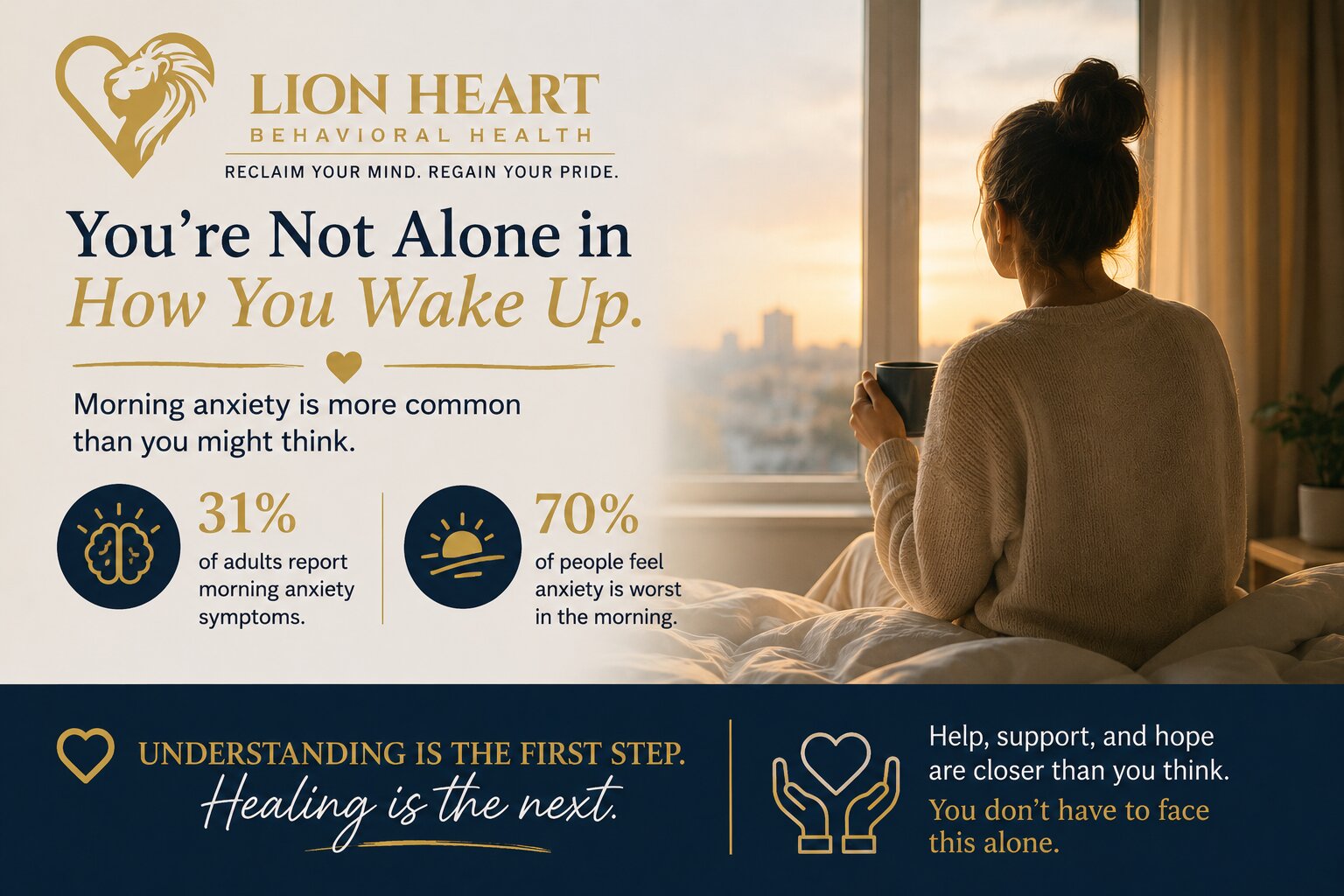
This experience is more common than many people realize.
And while it can feel frightening, it does not automatically mean something is seriously wrong with you.
Many people who eventually explore anxiety-focused mental health support begin their journey with this exact question.
Why do I wake up feeling this way?
Sometimes Your Body Reacts Before Your Mind Does
One reason morning anxiety feels so alarming is that it doesn’t always start with thoughts.
People often assume anxiety begins with worrying.
In reality, many people experience physical symptoms first.
The racing heart.
The tight chest.
The sweaty palms.
The uneasy feeling in the stomach.
Only after those sensations appear does the mind begin searching for explanations.
That process can feel incredibly unsettling.
You wake up feeling afraid, then your brain tries to figure out why.
Suddenly you’re thinking about work.
Finances.
Relationships.
Health concerns.
Responsibilities.
The anxiety didn’t necessarily start with those thoughts.
But once they appear, they can intensify what you’re already feeling.
It’s similar to hearing a smoke alarm in the middle of the night.
Even if there’s no fire, your body reacts immediately.
Your nervous system doesn’t wait for proof.
It responds first and asks questions later.
Why Morning Can Feel Harder Than The Rest Of The Day
Many people notice something strange.
Their anxiety is often worst immediately after waking up.
Then it gradually improves as the day goes on.
This can feel confusing.
If anxiety is related to stress, why isn’t it strongest during the busiest part of the day?
Part of the answer may involve anticipation.
Morning represents possibility.
Everything that could happen today is still unknown.
The difficult conversation.
The deadline.
The appointment.
The uncertainty.
For someone already carrying stress, waking up can feel like standing at the bottom of a mountain and trying to see the entire climb at once.
The mind begins scanning ahead.
The body responds accordingly.
Many people tell us they feel calmer by evening.
Not because life became easier.
Because the uncertainty of the day has already been resolved.
The meeting happened.
The work got done.
The anticipated problems either occurred or they didn’t.
Morning anxiety often thrives in the space between now and what might happen next.
Anxiety Doesn’t Always Look Like Panic
This is something many first-time treatment seekers don’t realize.
When people think of anxiety, they often imagine panic attacks.
Hyperventilating.
Crying.
Feeling completely overwhelmed.
Sometimes anxiety looks like that.
Often it doesn’t.
Many people experiencing anxiety continue functioning.
They go to work.
They take care of family responsibilities.
They show up for obligations.
From the outside, everything appears normal.
Internally, however, they may be battling constant tension.
They may feel like their nervous system never fully relaxes.
They may spend every day waiting for something to go wrong.
That’s why so many people dismiss their symptoms for years.
They tell themselves:
“I’m still functioning.”
“Other people have it worse.”
“I’m probably just stressed.”
Meanwhile, the anxiety continues growing quietly in the background.
The Fear Of The Symptoms Can Become Part Of The Problem
One of the most frustrating parts of morning anxiety is that people often start fearing the symptoms themselves.
You wake up anxious.
You notice your heart racing.
You become worried about why it’s racing.
That worry increases your anxiety.
The anxiety intensifies the symptoms.
Soon you’re caught in a cycle.
Many people eventually begin dreading bedtime because they fear what will happen when they wake up.
We’ve spoken with individuals who spent more time worrying about anxiety than they spent worrying about the original stressors in their lives.
This is not a sign of weakness.
It’s a sign that the nervous system has become highly sensitive.
The good news is that sensitivity can be addressed.
But first, it helps to understand what’s happening.
Your Mind May Be Carrying More Than You Realize
Sometimes morning anxiety isn’t about a single problem.
It’s about accumulation.
Stress from work.
Relationship concerns.
Financial pressure.
Family responsibilities.
Health worries.
Life transitions.
Each individual stressor may seem manageable.
Together, they can become overwhelming.
Think of a glass filling with water.
One drop doesn’t seem important.
Neither does the second.
Or the third.
Eventually the glass overflows.
Many people wake up with anxiety not because of one major issue but because their emotional reserves have been running low for a long time.
Their mind and body have been carrying more than they can comfortably hold.
The morning simply becomes the moment when they notice it most.
The People Who Improve Usually Stop Fighting Themselves
One thing we’ve observed repeatedly is that recovery often begins when people stop treating themselves like the enemy.
Many first-time treatment seekers are incredibly hard on themselves.
They criticize their symptoms.
Judge their reactions.
Become frustrated that they can’t simply “snap out of it.”
The problem is that self-criticism rarely reduces anxiety.
It usually increases it.
People often begin feeling better when they shift from judgment to curiosity.
Instead of asking:
“What’s wrong with me?”
They start asking:
“What is my mind and body trying to tell me?”
That question creates room for understanding.
And understanding often becomes the foundation for healing.
Success Stories Usually Begin With The Same Realization
We often hear similar stories from people who eventually find relief.
Not identical circumstances.
Not identical symptoms.
But similar realizations.
Many describe the moment they understood they didn’t have to keep suffering in silence.
The moment they realized anxiety was treatable.
The moment they stopped viewing their symptoms as a personal failure.
One person described it this way:
“I spent years trying to prove I was okay. Recovery started when I admitted I wasn’t.”
That honesty can be powerful.
Not because it fixes everything immediately.
Because it opens the door to support.
And support often changes what feels possible.
Understanding What You’re Experiencing Matters
People searching for information about morning anxiety symptoms are rarely looking for a medical textbook.
They’re looking for reassurance.
They want to know whether anyone else feels this way.
They want to know whether improvement is possible.
They want to know whether they can stop waking up feeling afraid.
The answer is yes.
Many people who once dreaded mornings eventually learned how to experience them differently.
Not because life became perfect.
Not because stress disappeared.
Because they developed a better understanding of what was happening and learned healthier ways to respond.
You Don’t Have To Wake Up Bracing For The Day
If every morning feels like a battle before the day even begins, please know this:
You are not imagining it.
You are not weak.
And you are not alone.
Many people have stood exactly where you are now.
Confused.
Exhausted.
Scared.
Wondering why their body seems to wake up in survival mode.
The encouraging news is that anxiety is not the end of the story.
Understanding, support, and effective treatment can help people regain a sense of calm and confidence that once felt impossible.
The first step isn’t having all the answers.
It’s recognizing that you deserve help finding them.
Call (774) 341-4502 or visit our Anxiety Therapy Program to learn more about our Anxiety Therapy Program Bristol County, MA.
Frequently Asked Questions
Why do I wake up with my heart racing every morning?
A racing heart upon waking can be associated with anxiety, stress, sleep disturbances, medical conditions, or an activated nervous system. If symptoms persist, it is important to speak with a healthcare professional.
Can anxiety cause physical symptoms before I have anxious thoughts?
Yes. Many people experience physical symptoms such as a racing heart, sweating, nausea, or muscle tension before they consciously recognize anxious thoughts.
Why does morning anxiety feel worse than anxiety later in the day?
Morning anxiety is often linked to anticipation, accumulated stress, and the body’s response to uncertainty about the day ahead.
Is waking up with dread a sign of an anxiety disorder?
Not necessarily. However, persistent feelings of dread, fear, or anxiety may indicate that anxiety is playing a significant role in your daily experience.
Can morning anxiety go away?
Many people experience significant improvement through therapy, stress management strategies, lifestyle changes, and appropriate mental health support.
Should I be worried if my symptoms feel physical?
Physical symptoms are common with anxiety, but persistent or concerning symptoms should always be discussed with a medical professional to rule out other causes.
How do I know when it’s time to seek help?
If anxiety is affecting sleep, work, relationships, concentration, or overall quality of life, it may be time to explore professional support.
What if I’ve been experiencing this for years?
Many people live with anxiety for long periods before seeking help. Even if symptoms have been present for years, meaningful improvement is still possible.