
I was the person people trusted.
The dependable one.
The productive one.
The one who answered emails at midnight and still showed up early the next morning looking composed enough that nobody questioned anything.
If you had asked people in my life whether I needed treatment, they probably would have laughed.
I had a career.
Friends.
Bills paid on time.
A functioning social life.
A carefully managed image that made everything look stable from the outside.
Meanwhile, almost every night ended the same way:
completely emotionally exhausted, anxious, overstimulated, and needing something—anything—to finally make my brain slow down.
If you’ve been quietly searching for structured recovery support in Massachusetts while still trying to maintain work, routines, responsibilities, or the appearance that everything is okay, you are not the only person living that contradiction.
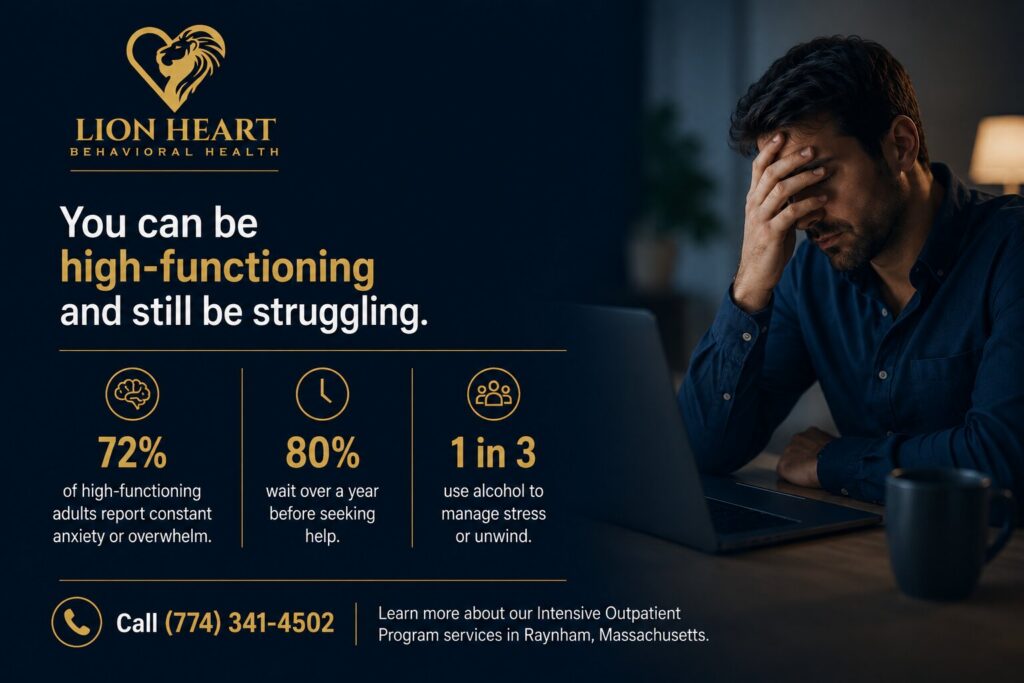
Honestly, many high-functioning adults are suffering in ways nobody around them fully sees.
High-Functioning People Often Learn How to Hide Pain Extremely Well
That’s part of what makes it dangerous.
People tend to assume someone is okay if they’re still:
- Going to work
- Returning texts
- Meeting deadlines
- Paying bills
- Showing up socially
- Smiling in public
But functioning and feeling okay are not the same thing.
I spent years confusing emotional survival with success.
I thought everyone lived with constant anxiety in the background.
I thought everyone needed alcohol to “turn their brain off.”
I thought everyone secretly felt exhausted by basic life.
One person in treatment once said:
“I looked successful because panic made me productive.”
That sentence stayed with me because it explained so much.
From the outside, I looked driven.
Internally, I was operating almost entirely from fear, stress, and emotional overload.
And eventually the nervous system starts charging interest on that kind of lifestyle.
I Kept Waiting for Some Dramatic Rock Bottom
That’s another thing high-functioning people do.
We delay help because we’re waiting for proof we’re “bad enough.”
We think:
- “I still have a job.”
- “I’m not drinking during the day.”
- “I’m not losing everything.”
- “Other people have it worse.”
- “I’m just stressed.”
Meanwhile:
- Sleep keeps getting worse
- Anxiety gets louder
- Drinking becomes emotionally necessary
- Burnout turns physical
- Relationships feel harder to maintain
- The nervous system never fully powers down
But because there’s no public collapse, we keep moving the goalposts.
I wasn’t asking:
“Do I need support?”
I was asking:
“How miserable do I need to become before I allow myself support?”
That question kept me stuck far longer than I want to admit.
Every Evening Started Feeling Like Emotional Recovery From the Day
This was the part I could no longer rationalize away.
During the day, I performed.
I smiled through meetings.
Handled responsibilities.
Stayed productive.
Acted normal.
Then I would get home and completely crash emotionally.
That’s when the anxiety got loudest.
That’s when my thoughts started spiraling.
That’s when the drinking started feeling less optional and more necessary.
A lot of high-functioning adults quietly live this exact cycle:
perform all day,
numb all night,
repeat tomorrow.
And eventually the nervous system stops recovering between rounds.
One of the strangest things about high-functioning anxiety and addiction is how gradually they become normalized. You adapt slowly enough that eventually emotional exhaustion just feels like your personality.
Until one day you realize:
you don’t actually remember what calm feels like anymore.
Searching for Help Felt More Emotional Than I Expected
I still remember typing “evening IOP near me” into Google and immediately closing the tab afterward.
Not because I didn’t want help.
Because making the search real terrified me.
As long as I stayed vague, I could keep pretending I was “managing.” But the second I started looking at actual treatment options, something shifted emotionally.
Now there was a possibility I might actually stop pretending.
And honestly? That scared me more than continuing to suffer sometimes.
A lot of high-functioning adults build their identity around being capable. We become the reliable person. The productive person. The calm person. The one other people lean on.
So needing support feels deeply threatening to the identity itself.
Not because anyone else necessarily judges us.
Because we judge ourselves first.
I Thought Treatment Would Destroy My Routine
This fear stopped me for months.
I assumed treatment meant:
- Leaving work completely
- Explaining everything to everyone
- Losing independence
- Sitting in therapy all day
- Becoming “the unstable one”
But evening treatment options changed the conversation in my head completely.
For many adults, flexibility makes treatment emotionally approachable.
Not because healing should revolve around productivity.
Because fear already makes asking for help hard enough.
The possibility of receiving support while still maintaining parts of normal life helped me stop viewing treatment as catastrophic.
That mattered more than I expected.
A lot of people do not need perfect certainty before getting help.
They just need support to feel possible instead of life-ending.
The Hardest Part Was Realizing How Exhausted I Actually Was
This surprised me most.
I thought treatment would mainly focus on drinking or anxiety.
Instead, I realized how emotionally depleted I’d become overall.
Everything felt heavy:
- Emails
- Conversations
- Grocery shopping
- Returning texts
- Social plans
- Small decisions
- Existing in my own brain
I had spent so long in survival mode that my nervous system no longer understood how to rest naturally.
One person in group once said:
“I wasn’t living. I was managing symptoms while trying to look successful.”
That sentence hit hard because it described the invisible loneliness so many high-functioning adults carry.
People praise your performance while having absolutely no idea how close you feel to collapsing privately.
Anxiety and Alcohol Often Quietly Become Teammates
This happens more often than people realize.
For many high-functioning adults, alcohol starts as relief.
It softens racing thoughts.
Slows the nervous system down.
Makes stress temporarily tolerable.
Creates a brief feeling of emotional distance from overwhelm.
And when someone has been anxious for long enough, that relief can feel incredibly powerful.
But eventually:
- Sleep worsens
- Anxiety rebounds harder
- Emotional regulation declines
- Stress tolerance shrinks
- Drinking becomes emotionally tied to survival
The cycle becomes self-reinforcing.
And because the person is still functioning externally, nobody intervenes.
Including them.
That’s why support matters.
Not because someone is weak.
Because the nervous system can only stay overloaded for so long before something starts breaking internally.
I Needed More Than One Hour a Week
Eventually this became obvious.
One therapy session every seven days could not compete with the amount of anxiety, emotional suppression, stress, drinking patterns, and burnout shaping the rest of my life.
I needed:
- More accountability
- More emotional support
- More honesty
- More structure
- More connection
- More consistency
That realization felt uncomfortable at first.
Then relieving.
Because deep down, I already knew I was exhausted from trying to carry everything alone.
A lot of high-functioning adults quietly reach this point. The current level of support no longer matches the amount of overwhelm they’re carrying internally.
And honestly? Admitting that can feel terrifying.
But continuing to suffer silently becomes exhausting too.
The Most Unexpected Part Was Feeling Less Alone
I did not expect this.
I thought treatment would make me feel exposed or ashamed.
Instead, it was the first place I met people who understood the strange loneliness of high-functioning struggle.
People who:
- Looked successful externally
- Felt emotionally overwhelmed privately
- Used alcohol to cope with anxiety
- Thought they were “not bad enough” for support
- Believed they should have been able to handle everything alone
That understanding mattered.
Because exhaustion becomes heavier when you think you’re the only person living that way.
One person said:
“I spent years being impressive while quietly falling apart.”
Almost everyone in the room nodded.
Treatment Didn’t Turn Me Into Someone Else
This fear is incredibly common.
I worried support would:
- Flatten my personality
- Remove my ambition
- Make me weak
- Turn me into someone unrecognizable
Instead, treatment helped me reconnect with parts of myself anxiety and emotional exhaustion had buried.
I laughed differently afterward.
Slept differently.
Stopped feeling emotionally absent in conversations.
Stopped living every day like my nervous system was preparing for impact.
Not perfectly.
Just more honestly.
And honestly felt better than performance eventually.
You Do Not Need to Completely Collapse Before You Deserve Support
This may be the most important thing I learned.
A lot of high-functioning adults wait for:
- Job loss
- Public breakdowns
- Relationship collapse
- Severe addiction
- Total burnout
before they “allow” themselves help.
But emotional suffering does not become more legitimate only after catastrophe.
You are allowed to need support while still functioning externally.
You are allowed to ask for help before your life becomes unmanageable.
And you are allowed to stop confusing survival with wellness.
FAQ About Evening Treatment and High-Functioning Anxiety
Can someone still work while attending treatment?
Yes. Many people continue working while attending evening treatment programs. Flexible scheduling can allow adults to receive support while maintaining work and daily responsibilities.
What if I don’t think my problem is serious enough?
This is extremely common among high-functioning adults. Many people minimize their struggles because they are still functioning externally while privately experiencing anxiety, burnout, emotional exhaustion, or unhealthy coping patterns.
Is evening treatment only for addiction?
Not necessarily. Many people seek support for anxiety, burnout, depression, emotional overwhelm, or when mental health and substance use collide together.
What if I’m afraid people will judge me?
Many adults entering treatment carry that fear. High-functioning people often experience shame around needing support because they are used to appearing capable all the time.
Can treatment help even if I haven’t completely stopped drinking?
Yes. Many people begin treatment while still exploring their relationship with alcohol. Honest conversations and emotional support often help individuals better understand their coping patterns over time.
What if weekly therapy no longer feels like enough?
That may be a sign more consistent support could help. Some adults benefit from additional structure, accountability, and emotional connection between sessions during periods of heightened stress or overwhelm.
Is it normal to feel scared before reaching out?
Absolutely.
Many people delay treatment not because they do not want help, but because asking for support makes their struggles feel emotionally real for the first time.
What if I’m successful professionally but struggling privately?
That experience is far more common than many people realize. High-functioning anxiety and addiction often stay hidden precisely because someone continues performing well externally while privately suffering.
You Are Allowed to Need More Support Than People Expect
High-functioning adults often become experts at appearing okay while carrying impossible amounts of stress privately.
But surviving quietly is still suffering.
For people exploring structured recovery support in Massachusetts, healing does not require you to completely abandon your life.
Sometimes it simply begins with admitting you’re tired of carrying everything alone.
Call (774) 341-4502 or explore our Intensive Outpatient Program services in Raynham, Massachusetts to learn more about our programs.