

A lot of people start questioning their drinking long before they ever call it a “problem.”
Usually it sounds more like:
“Why do I feel anxious all the time lately?”
“Why can’t I fully relax without a drink?”
“Why does my brain feel loud the second I’m alone?”
“Why do I wake up at 3 a.m. feeling guilty, restless, and exhausted?”
That middle space can feel incredibly confusing.
You may not feel ready to quit drinking completely. You may not even know if alcohol is technically “the issue.” But you also know something feels off emotionally, physically, or mentally—and trying to manage it alone is becoming exhausting.
If you’ve been exploring anxiety support options in Massachusetts while quietly wondering whether your anxiety and drinking habits might be more connected than you want to admit, you are not alone.
Honestly, many sober curious adults begin therapy before they ever make any permanent decisions about alcohol.
Anxiety and Drinking Often Start Quietly Reinforcing Each Other
This usually happens slowly.
At first, drinking feels helpful.
Your thoughts slow down.
Your shoulders unclench.
You finally stop replaying every awkward interaction from the day.
For a few hours, your nervous system gets quiet.
That relief can feel powerful when anxiety has been running your life for months—or years.
But eventually many people notice something uncomfortable:
the relief gets shorter while the anxiety gets louder.
Sleep becomes lighter.
Your heart races more in the morning.
Stress feels harder to manage.
Small problems suddenly feel emotionally enormous.
So naturally, you reach again for the thing that helped temporarily before.
Not because you’re weak.
Because your nervous system is trying to survive.
One person described it this way:
“I wasn’t drinking because I loved alcohol. I was drinking because I wanted my brain to stop chasing me.”
That sentence lands for a lot of people because many sober curious adults are not trying to “party.”
They’re trying to feel normal for a few hours.
You Do Not Need to Decide Everything Before Getting Help
This matters deeply.
A lot of people avoid therapy because they think they need certainty first.
They assume they must already know:
- Whether alcohol is officially a problem
- Whether they want sobriety
- Whether their anxiety is “bad enough”
- Whether they deserve support
- Whether they’re struggling “seriously enough”
But many people start therapy in the exact middle of uncertainty.
That’s normal.
You are allowed to explore your relationship with anxiety and alcohol without immediately committing to permanent labels or dramatic life changes.
For some people, therapy becomes the first place they can honestly admit:
“I don’t think I’m okay anymore, but I also don’t fully understand why.”
That honesty matters more than people realize.
Because anxiety often thrives in silence, confusion, and self-judgment.
High-Functioning Anxiety Can Hide for Years
Especially if you’re still handling responsibilities.
A lot of sober curious adults convince themselves they’re “fine” because they:
- Keep going to work
- Maintain relationships
- Pay bills
- Show up socially
- Look successful externally
Meanwhile internally:
- Their nervous system never fully relaxes
- Their thoughts constantly race
- They feel emotionally exhausted
- Drinking becomes the only reliable off-switch
- They avoid stillness because their brain gets too loud
High-functioning anxiety often hides behind productivity.
People compliment you for being driven while you privately feel like your body is bracing for impact all the time.
One person once said:
“I looked successful on paper and emotionally terrified in private.”
That disconnect becomes exhausting eventually.
Not dramatically at first.
Gradually.
Like carrying grocery bags so long your hands stop noticing the pain until you finally put them down.
Therapy Can Help Before Someone Decides About Sobriety
This surprises many people.
They assume therapy only “works” if they immediately stop drinking completely.
But often, therapy starts somewhere much simpler:
understanding what your nervous system has been trying to manage.
For many people exploring therapy for anxiety Massachusetts options, treatment becomes less about judgment and more about curiosity.
Questions like:
- What role is anxiety playing in daily life?
- What situations increase emotional overwhelm?
- Why does alcohol feel emotionally helpful?
- What happens emotionally before drinking?
- How much stress has the body been carrying?
- What healthier coping strategies might actually feel supportive?
That process matters because many sober curious adults have spent years criticizing themselves without truly understanding themselves.
And self-criticism rarely creates sustainable healing.
Sometimes Anxiety Is the Real Exhaustion Underneath Everything Else
A lot of people focus entirely on drinking without recognizing how overwhelmed they already were before alcohol became part of the coping system.
Anxiety can affect:
- Sleep
- Relationships
- Confidence
- Energy
- Physical health
- Emotional regulation
- Focus
- Self-esteem
- Motivation
- Sense of safety in the world
Over time, constant anxiety becomes physically exhausting.
Your nervous system stays “on” constantly.
Your body struggles to relax fully.
Your mind keeps scanning for problems even during calm moments.
Eventually, alcohol can start feeling less like recreation and more like emotional anesthesia.
Not because someone is broken.
Because humans naturally search for relief when they’re overwhelmed.
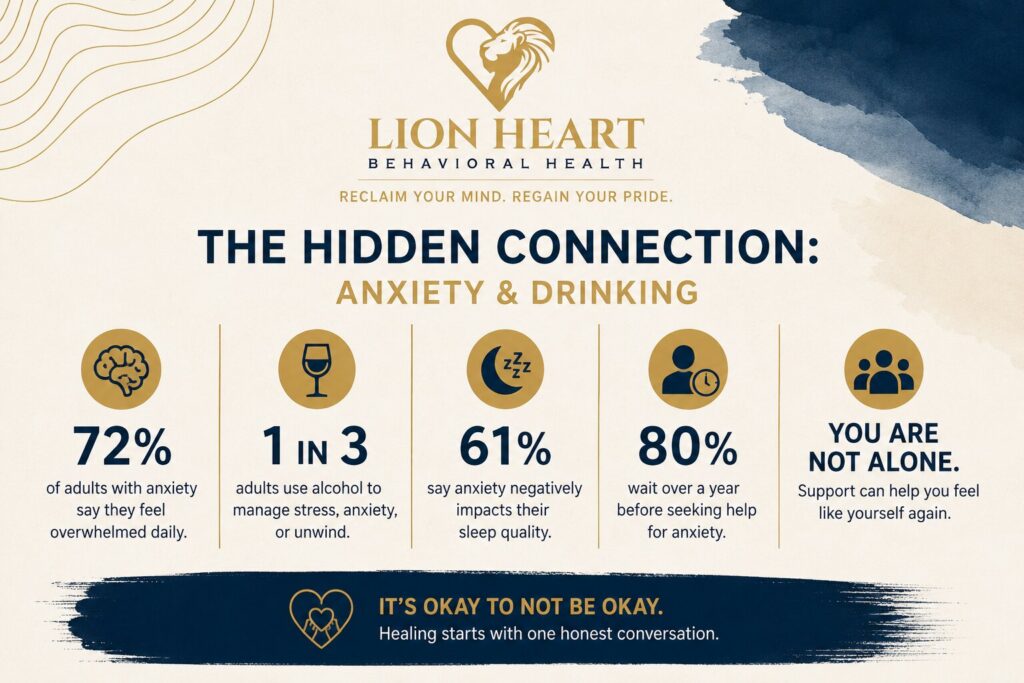
Therapy Is Not About Forcing Someone Into Shame
This is important.
A lot of sober curious adults avoid treatment because they fear judgment.
They worry therapy will immediately become:
- “You need to quit.”
- “You’re in denial.”
- “Everything wrong in your life is alcohol.”
- “You’re failing yourself.”
But good anxiety treatment should create safety before confrontation.
People open up more honestly when they feel understood—not attacked.
And often, meaningful change starts with someone finally understanding:
- what they’re feeling,
- why they’re overwhelmed,
- and how long they’ve been surviving in stress mode.
Shame usually makes people hide more.
Understanding tends to help people heal.
Anxiety Often Gets Normalized Until Someone Finally Slows Down
This is one of the hardest parts.
People adapt to anxiety slowly enough that eventually it just feels like personality.
You start believing:
- “I’m just an overthinker.”
- “I’ve always been stressed.”
- “Everyone feels like this.”
- “I just need to manage things better.”
Meanwhile:
- Your sleep keeps worsening
- Your irritability increases
- Your body stays tense constantly
- Your emotional capacity shrinks
- Drinking becomes more emotionally necessary
One person once explained it perfectly:
“I thought I had become less fun. Really, I had become emotionally exhausted.”
That realization hits many sober curious adults hard because they often don’t recognize how much anxiety has already shaped their entire life.
Therapy Is Not About Becoming a Different Person
Many people fear this quietly.
They worry treatment will:
- Flatten their personality
- Remove all emotion
- Make life feel boring
- Push them into labels they’re not ready for
- Judge their choices constantly
But healthy anxiety treatment is not about erasing identity.
It’s about helping someone feel safer inside their own nervous system again.
The goal is not perfection.
Not emotional numbness.
Not becoming “fixed.”
The goal is:
- More peace
- Better emotional regulation
- Less shame
- Healthier coping
- More ability to tolerate stress without collapsing internally
That process looks different for everyone.
Sometimes the Biggest Shift Is Realizing You’re Not Broken
This may be the most healing part.
A lot of anxious people secretly believe something is fundamentally wrong with them.
They think:
- “Why can’t I relax like everyone else?”
- “Why does everything feel so intense?”
- “Why do I need something to calm down?”
- “Why does my brain never stop?”
Then therapy becomes the first place where someone explains:
your nervous system may simply be overloaded.
That realization can feel emotional.
Not because everything suddenly becomes easy.
Because someone finally stops feeling defective for struggling.
And honestly, hope often begins there.
Not in dramatic breakthroughs.
In self-understanding.
Healing Usually Starts Smaller Than People Expect
Most people imagine healing as some giant emotional transformation.
Usually it looks quieter than that.
You notice:
- Your mornings feel less heavy
- Your thoughts slow down occasionally
- You recover from stress faster
- You stop needing immediate escape every night
- You feel emotionally present more often
- Quiet feels less uncomfortable
- Your body relaxes more easily
Small changes matter.
Because anxiety often steals peace gradually.
Recovery tends to return it gradually too.
FAQ About Anxiety Therapy and Drinking
Can therapy still help if I’m not sure I want to quit drinking?
Yes. Many people begin therapy while still exploring their relationship with alcohol. Treatment can help people better understand anxiety, stress, coping patterns, and emotional triggers without requiring immediate major decisions.
Is anxiety commonly connected to drinking?
For many people, yes. Alcohol may temporarily reduce anxious feelings short-term while worsening anxiety, emotional regulation, sleep disruption, or stress sensitivity over time.
What if I’m still functioning normally?
Many high-functioning adults experience significant anxiety while continuing to work, maintain relationships, and appear successful externally. Functioning does not always mean someone feels emotionally healthy internally.
Will therapy pressure me to stop drinking completely?
Good therapy should prioritize honesty, safety, and understanding rather than shame or pressure. Conversations about alcohol are often most productive when someone feels supported instead of judged.
What if I don’t know whether my anxiety is “serious enough”?
You do not need to reach a crisis point before seeking support. Many people benefit from therapy long before symptoms become severe or life becomes unmanageable.
Can anxiety treatment help with physical symptoms too?
Often, yes. Anxiety commonly affects the body through sleep disruption, muscle tension, panic symptoms, racing heart, digestive issues, fatigue, and chronic stress responses.
Is it normal to feel nervous about starting therapy?
Absolutely.
Many first-time treatment seekers worry about being misunderstood, judged, or pushed too quickly. Those fears are common and often soften once someone experiences a supportive therapeutic environment.
What if I’ve tried to manage anxiety on my own for years?
That’s incredibly common. Many people spend years trying to self-manage anxiety before seeking support. Reaching out now does not mean you failed—it means you’re tired of carrying everything alone.
You Don’t Need to Have All the Answers Before Asking for Help
You are allowed to question your relationship with stress, anxiety, or drinking without already knowing exactly what comes next.
You are allowed to feel uncertain.
You are allowed to explore support before making permanent life decisions.
And you are allowed to want relief without needing to prove your pain first.
For people exploring anxiety support options in Massachusetts, healing does not begin with perfection.
Sometimes it begins with one honest conversation.
Call (774) 341-4502 or explore our Anxiety Therapy Program services in Raynham, Massachusetts to learn more about our programs.