

You already know your drinking isn’t working anymore.
That’s what makes this so hard.
You’re not in denial. You’re not being forced. You’ve had the quiet realization — maybe at 2 a.m., maybe after another promise to “cut back” — that something needs to change.
And yet the idea of actually stepping into structured help, even looking into an alcohol treatment program, makes your stomach tighten.
If you’re scared to start, this is for you.
Let’s slow this down and talk honestly about what’s underneath that fear.
You’re Not Scared of Treatment — You’re Scared of What It Means
Most first-time treatment seekers aren’t afraid of a building or a schedule.
They’re afraid of what starting represents.
It means saying, “This is real.”
It means admitting drinking has crossed a line.
It means stepping into the unknown.
That’s vulnerable.
And vulnerability feels dangerous when you’ve spent years holding it together.
If you’re in New Bedford, Massachusetts, maybe you’re also thinking about who might find out. Who might talk. What people might assume.
That fear is human.
But here’s the truth: seeking help is not an announcement of failure. It’s a decision to protect your future.
“What If I Can’t Do This?”
This is usually the loudest thought.
What if you panic and quit?
What if you miss drinking?
What if you feel exposed?
You’re imagining some test you have to pass.
But treatment is not a performance.
You’re not graded on confidence. You’re not evaluated on toughness. You’re not expected to walk in strong.
You’re expected to walk in honest.
That’s it.
Fear doesn’t disqualify you. In many cases, it confirms you understand what’s at stake.
You Don’t Have to Be at Rock Bottom
There’s a myth that you need catastrophic consequences before you “qualify” for help.
You don’t.
You don’t need:
- A DUI
- A lost job
- A public meltdown
- A relationship ending
If you’re exhausted from the mental negotiation around alcohol, that’s enough.
If you’re tired of planning your day around when you can drink, that’s enough.
If you’ve tried to cut back and can’t sustain it, that’s enough.
Starting an alcohol treatment program before everything collapses isn’t dramatic.
It’s proactive.
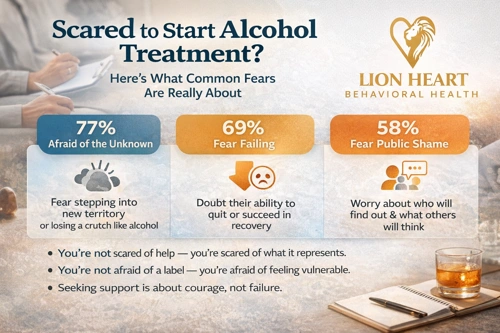
What You’re Really Afraid Of Losing
Let’s be honest.
You might be afraid of losing alcohol itself.
It’s been:
- Your stress relief
- Your social lubricant
- Your reward
- Your escape
- Your quiet
You might wonder who you are without it.
That’s not a shallow question. It’s a real one.
But alcohol doesn’t create your personality — it filters it.
Structured care helps you meet yourself without the filter.
And most people are surprised by who they find underneath.
Clearer.
More grounded.
Less anxious than expected.
The First Step Is Smaller Than Your Brain Is Telling You
Your mind might be painting a dramatic picture.
Packing bags. Long commitments. Intense confrontations.
Often, the first step is simply a conversation.
A confidential call.
An assessment.
A discussion about options — structured daytime care, multi-day weekly treatment, or more intensive support if needed.
You’re not locked in the moment you reach out.
You’re gathering information.
And information reduces fear.
Early Treatment Is Often Quieter Than You Think
People imagine chaos.
In reality, early days often feel structured and steady.
You meet people who are just as nervous.
You hear stories that sound like yours.
You begin to feel less alone.
Isolation is one of alcohol’s strongest allies.
Connection is one of recovery’s strongest antidotes.
When you enter structured support, you’re not stepping into judgment.
You’re stepping into shared humanity.
What If You Discover It’s Deeper Than Drinking?
Another common fear: “What if I find out there’s more going on?”
Sometimes alcohol has been covering anxiety.
Sometimes it’s numbing trauma.
Sometimes it’s quieting depression.
Finding that out can feel intimidating.
But clarity is stabilizing.
Right now, the unknown has power.
When you identify what’s underneath, you gain tools.
If you’re in Bristol County, Massachusetts, where access to structured support exists locally, you don’t have to carry that discovery alone. You can address it with guidance instead of guesswork.
Clarity doesn’t create problems.
It creates direction.
The Myth That You Have to Be Sure
You may be waiting to feel 100% certain.
That moment rarely comes.
Change usually begins with 60% readiness and 40% fear.
You don’t need total confidence.
You need willingness.
Willingness to have a conversation.
Willingness to consider structure.
Willingness to be honest out loud.
That’s enough to begin.
You’re Not Weak for Needing Structure
High-functioning people struggle the most with this idea.
You’ve handled work.
You’ve handled relationships.
You’ve handled responsibilities.
So why can’t you just “handle” this?
Because alcohol dependence is not a willpower issue.
It’s behavioral, neurological, emotional.
Structure isn’t a crutch.
It’s a scaffold.
And scaffolds exist so buildings don’t collapse during repair.
What Recovery Actually Builds
When people step into an alcohol treatment program, they often expect punishment or restriction.
Instead, they build:
- Emotional regulation skills
- Clear boundaries
- Accountability systems
- Stress management tools
- Honest communication
You’re not losing freedom.
You’re learning how to live without something quietly controlling you.
That’s real freedom.
The Cost of Waiting
It’s worth asking yourself this:
If nothing changes, where will this be in six months?
In a year?
Sometimes fear keeps you still.
But staying still has its own price.
Escalation.
Increased tolerance.
Greater emotional fallout.
More strain on relationships.
You don’t have to wait for proof that it’s bad enough.
You already feel the shift.
That’s enough evidence.
FAQs for First-Time Treatment Seekers
What if I change my mind after starting?
You are part of your treatment plan. Communication is ongoing. Decisions are collaborative. You’re not trapped.
Will people find out?
Confidentiality laws protect your privacy. Seeking help does not mean public exposure.
Do I have to stop drinking forever?
The initial focus is stabilization and clarity. Long-term decisions are made with guidance, not pressure.
What if I’m not as “bad” as others?
Comparison is common. But treatment isn’t about ranking severity. It’s about addressing your relationship with alcohol.
What if I fail?
Recovery isn’t measured by perfection. It’s measured by engagement. Fear of failure shouldn’t prevent starting.
Is it normal to be scared?
Completely. Fear often accompanies meaningful change.
One Honest Step Can Shift Everything
You don’t have to feel brave.
You don’t have to feel certain.
You just have to be willing to stop pretending it’s fine.
If part of you is reading this and thinking, “I can’t keep doing this the same way,” listen to that part.
It’s not weakness.
It’s awareness.
And awareness is the beginning of change.
If you’re ready to talk — even if you’re still scared — call 774-341-4502 to learn more about our alcohol treatment program in Massachusetts.