

They come to us successful, articulate, and burned out in a way that no one else sees.
They’re still showing up at work. Still posting photos of family dinners. Still the one everyone counts on. But underneath all that… is someone who’s been quietly unraveling. Someone who’s been drinking not to party, but to endure.
At Lion Heart Behavioral Health, we work with high-functioning adults every day in our alcohol treatment program in Massachusetts. Many of them don’t “look like” they need help. But they do.
And if you’re reading this while wondering whether your drinking is really a problem—or if you’re just tired enough to finally ask—this is for you.
You’re not too early. You’re not too functional. And you’re not the only one.
The Ones Who Keep It Together Until They Can’t
They’re teachers. Managers. Parents. Entrepreneurs. Nurses. People used to holding it all.
From the outside, nothing looks wrong. But they’re drinking every night—sometimes just to sleep, sometimes to numb out, sometimes because stopping feels worse than continuing.
Most of them tell us a version of the same story:
“I don’t drink in the mornings. I’ve never lost a job. But I don’t feel like myself anymore. I feel like I’m performing my own life.”
That sentence—“I feel like I’m performing my own life”—is something we hear often. And if that resonates, it might be time to let go of the idea that you have to hit bottom before you’re allowed to ask for help.
Alcohol Use That Doesn’t “Look Like a Problem” Still Hurts
We’ve been trained to picture alcohol problems a certain way: blackouts, DUIs, rock-bottom chaos. So when your drinking doesn’t look like that—when you’re still high-functioning—it’s easy to believe you don’t “qualify” for treatment.
But high-functioning doesn’t mean unaffected.
You might still be productive. Still showing up. But here’s what we look for:
- Are you drinking more days than not?
- Do you feel anxiety if you go too long without a drink?
- Is drinking part of your coping, not your enjoyment?
- Are you more irritable, withdrawn, or numb lately?
These questions don’t determine whether you’re “bad enough.” They point to something simpler—and more honest:
You deserve a better relationship with your life than this.
Inside Our Alcohol Treatment Program: What Happens and Why It Works
At Lion Heart, we’ve designed our alcohol treatment program to support people who aren’t in crisis—but are getting closer every day.
You’ll find:
- Outpatient and intensive outpatient (IOP) options, so you don’t have to step away from work or family to get support
- Trauma-informed therapy that digs beneath the drinking to understand the emotional and historical roots
- Small group sessions where people actually relate to each other—no lecture halls or shame tactics
- Optional medication support, especially helpful for managing anxiety, cravings, or insomnia
- A treatment team that understands high-functioning clients and tailors care accordingly
This isn’t about stripping you of control. It’s about giving you clarity, choice, and calm—without alcohol as your only coping mechanism.
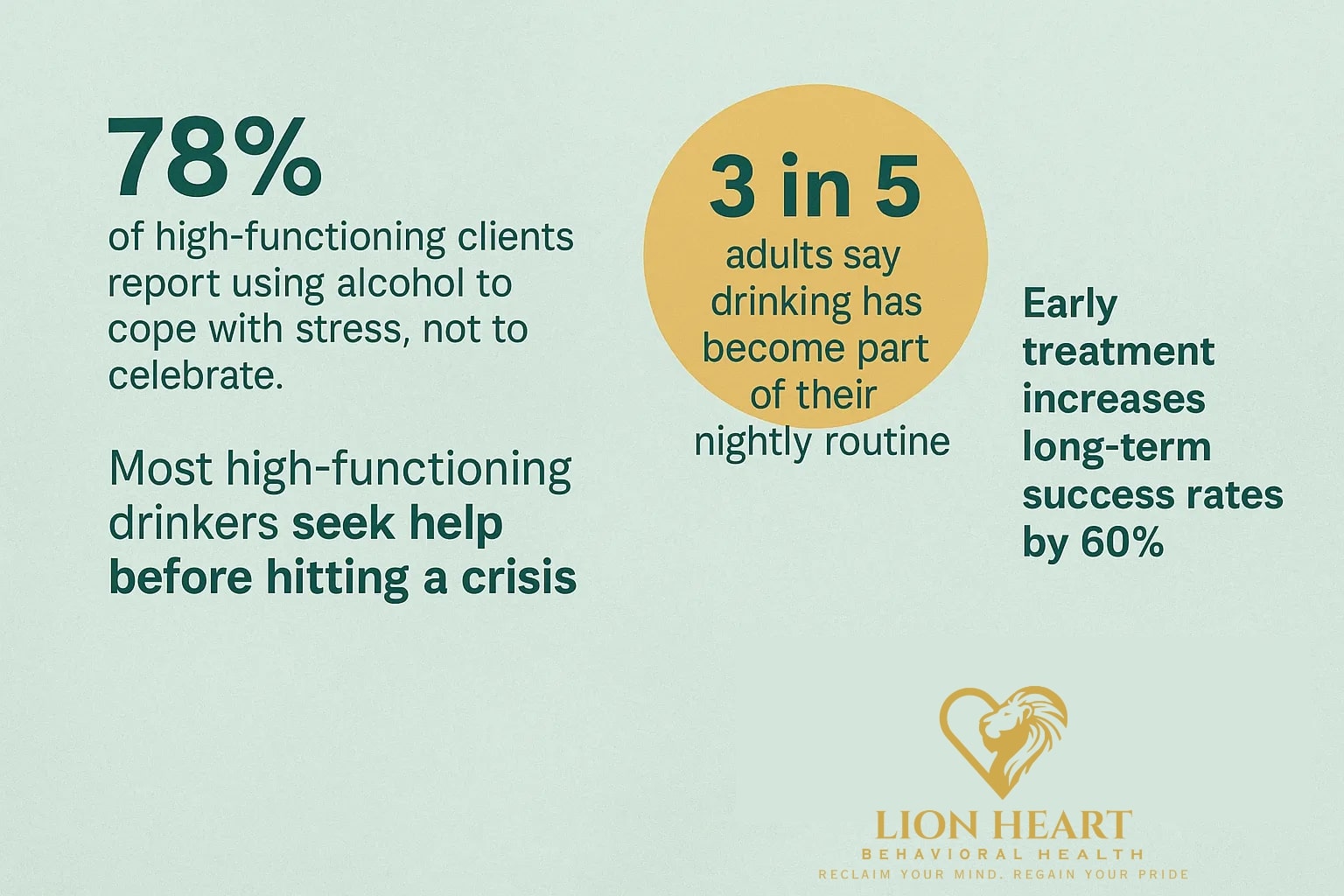
You Don’t Have to “Quit Forever” on Day One
Here’s something high-functioning clients often need to hear upfront:
You are allowed to come in unsure.
You don’t have to commit to lifelong abstinence on day one. You don’t even have to call yourself an alcoholic. We’re more interested in your relationship to alcohol than any label you’ve been avoiding.
Some of our clients come in saying, “I just want to cut back.” Others admit, “I’m scared to stop completely.” Both of those perspectives are welcome.
We don’t make assumptions. We get curious.
And we help you build a plan that aligns with what you want long-term—not what someone else thinks recovery should look like.
What Changes When High-Functioning Clients Get Real Support
We’ve seen it again and again.
- Clients who finally sleep through the night without needing to numb out first
- Marriages that begin to heal because communication isn’t clouded by alcohol anymore
- Professionals who stop feeling like imposters and start showing up as themselves
- Parents who feel present with their kids, not just performing the part
But the most powerful change?
People stop feeling like they’re constantly managing a secret.
That alone can bring more relief than any “goal” ever could.
What We Want You to Know (If You’re Still Not Sure)
If you’re reading this late at night, drink in hand, wondering whether you’re being dramatic…
If you’re already succeeding by everyone else’s standards—but still feel like something essential is missing…
If you’ve tried to quit on your own a dozen times but always return to “just one more”…
You don’t have to wait for your life to collapse to ask for support. In fact, the strongest thing you can do is catch this before everything falls apart.
You’ve worked hard to build a life worth living. You deserve to feel like you’re really in it—not just surviving it.
FAQs: Alcohol Treatment for High-Functioning Adults
Do I have to take time off work to do treatment?
Not necessarily. Our outpatient and IOP programs are designed to fit around work and life responsibilities. We’ll work with your schedule, not against it.
Will people in group relate to me?
Yes. We work with many high-functioning professionals, caregivers, and adults who are struggling quietly. Our groups are small, safe, and full of people who get it.
Do I have to stop drinking forever?
No. Our program meets you where you are. While we support long-term recovery, we focus on your goals and help you build a path that’s sustainable—not forced.
What if I’ve never been to treatment before?
That’s okay. Many of our clients are new to formal support. We’ll walk you through what to expect, answer every question, and move at a pace that feels right for you.
Can I join even if I haven’t “hit bottom”?
Absolutely. In fact, we encourage it. Early intervention means less damage, less shame, and a higher chance of lasting change.
To the Person Keeping It Together (Barely)
If you’ve been managing your drinking alone—planning around it, apologizing for it, denying how much space it’s taking up—this is your chance to try something different.
You’re not behind. You’re not weak. You’re not alone.
You’re just tired of carrying something no one else can see. And we can help you set it down—without losing the life you’ve worked so hard to build.
You don’t have to fall apart to get help.
Call (774) 341-4502 or visit Alcohol Treatment Program services in Raynham, Massachusetts to talk to someone who understands what high-functioning struggle really looks like—and how to help.