
Not everyone fears therapy because they don’t believe in it.
Some fear it because they do—and they’re afraid of what it might change.
As a clinician, I’ve met many clients over the years at Lion Heart Behavioral Health in Raynham who weren’t afraid to feel—they were afraid to stop feeling so much. These were musicians, designers, teachers, caregivers. Big-hearted people. Often gifted. Often tired.
They were sensitive, expressive, brilliant—and anxious. And somewhere along the way, those two identities started to feel inseparable.
“I don’t want to lose myself,” they’d whisper, sometimes right after opening up about their panic attacks or their 2 a.m. spirals.
It’s a deeply human fear.
So let’s talk about it.
When Anxiety Becomes Part of How You See Yourself
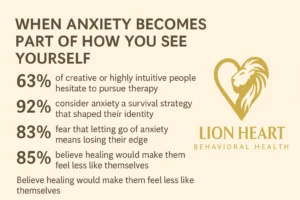
There’s a reason many creative or highly intuitive people hesitate to pursue therapy. For some, anxiety isn’t just a mental health issue—it’s become a survival strategy that shaped their identity.
It’s the reason they’re prepared for everything.
The edge behind their humor.
The intensity that fuels their art or leadership or caregiving.
It’s also the reason they can’t rest, say no, or stop overanalyzing every text they send.
And yet, in their minds, letting go of anxiety feels like letting go of a superpower—even when that power is quietly burning them out.
What If Anxiety Isn’t Your Edge—Just the Noise Around It?
One client—we’ll call her Maya—came to our Anxiety Therapy Program in Raynham, MA after years of postponing help.
“I’m scared therapy will make me boring,” she said, only half-joking.
Maya was a painter. Her best work came, she said, “from the chaos.” She’d go into a creative frenzy right after a panic spiral or an insomnia binge. Her anxiety, while painful, was also productive—until it wasn’t.
What brought her in? A blank canvas that stayed blank for weeks. No spiral. No art. Just stillness that felt unbearable.
Therapy Didn’t Dull Maya’s Spark. It Gave Her a Ground to Stand On.
In therapy, Maya started to realize that she didn’t need the highwire act to create. The creativity was hers—not anxiety’s.
She didn’t lose the depth or the passion.
She lost the self-punishment.
She lost the constant fear of being “too much” or “not enough.”
She learned that intensity isn’t the same as intimacy—with herself or with others.
And slowly, something shifted.
Her art changed. It softened. But it also got sharper. More deliberate. Less frantic.
“I thought peace would flatten me,” she said. “But I feel more like myself now than I did when I was running on fumes.”
The Real Risk Isn’t That Therapy Will Erase You
It’s that without support, anxiety will start editing your life before you get to live it.
People like Maya don’t need their spark extinguished. They need space to tend it safely.
That’s the heart of what we do in therapy. Especially for those who are used to feeling everything all the time. We don’t try to tame you. We help you live with more intention, more compassion, and yes—still more emotion. But the kind that doesn’t wreck you afterward.
What Our Anxiety Therapy Program Actually Looks Like
Our program isn’t one-size-fits-all. It’s personalized, flexible, and collaborative.
Some clients come to us needing tools to manage panic. Others need space to unravel years of internal pressure and performative calm. Some want structure. Others need room to explore their thoughts without being judged or rushed.
Whether you’re seeking support in Raynham, New Bedford, or Bristol County, MA, our clinicians are trained to adapt to your needs—not the other way around.
We’ll never ask you to become less of who you are. Just to let go of what’s hurting you.
You Don’t Need to Earn a Breakdown to Get Help
One of the most common myths I hear is: “I’m not anxious enough to need therapy.”
Here’s the truth: if anxiety is getting in the way of your relationships, your rest, your creativity, or your sense of self, that’s enough.
There’s no prize for suffering longer. No badge of honor for managing it alone.
And you don’t have to be in crisis to deserve care.
Common Signs You Might Be Merging Identity With Anxiety
Here are some gentle cues to reflect on:
- You believe your emotional intensity is what makes you valuable.
- You fear losing your creativity if your anxiety decreases.
- You see rest as laziness, and silence as a threat.
- You can’t imagine yourself without the worry.
If any of these resonate, it might be time to talk with someone who can help you explore the difference between what’s yours—and what’s anxiety wearing your voice.
Healing Doesn’t Mean You’ll Feel Less—It Means You’ll Feel Freer
Therapy doesn’t take away your feelings. It gives you agency with them.
You get to feel the full range of who you are—without being held hostage by fear, rumination, or the need to always be “on.”
At Lion Heart, we believe anxiety therapy should support your sense of identity—not threaten it. That’s especially true for our creative, expressive, deeply feeling clients.
Because healing doesn’t erase your edge. It just keeps you from cutting yourself on it.
FAQs: Anxiety Therapy for Creative or Identity-Focused Clients
Will therapy make me lose my creativity?
No. In fact, many people find that therapy enhances their creativity. By reducing the internal noise and panic, therapy can free up mental and emotional energy that fuels more intentional creative work.
What if my therapist doesn’t “get” me?
A good therapist listens, adapts, and doesn’t force you into a mold. At Lion Heart, our clinicians are trained to honor individuality. If something doesn’t fit, we adjust—together.
Is anxiety therapy just about breathing exercises?
No. While grounding tools can help, therapy often goes deeper—exploring thought patterns, emotional cycles, and the root causes of anxiety. It’s about understanding and transformation, not just symptom control.
Do I have to talk about trauma?
Only if you want to. Therapy moves at your pace. Some clients focus on present-day stress; others explore the past. You’re in charge of what gets shared and when.
How do I know if this is the right time?
If you’re thinking about it, there’s probably a reason. You don’t need to be at rock bottom to benefit from support. Even a quiet sense that something’s “off” is worth honoring.
If you’re in Raynham, New Bedford, or Bristol County, MA, and anxiety has been quietly shaping your life—or your art—know this: there’s another way forward. One that doesn’t ask you to give up your depth, your edge, or your sense of self.
Call (774) 238-5533 or visit our Anxiety Therapy Program page to explore anxiety therapy designed for who you are—not who the world thinks you should be.