

You left. Or maybe you ghosted—just kind of stopped going.
Maybe you felt like the group didn’t notice when you stopped showing up. Maybe life got messy, or heavy, or just… too much.
And now you’re wondering: Can I try again?
If you’re even thinking about coming back to treatment, that matters. That says something about your strength—yes, even now. Especially now.
You don’t need to explain yourself. You don’t need to carry the guilt in first.
What you do need is a recovery support system that makes reentry feel possible. One that doesn’t just tolerate your return—but quietly welcomes it. One that notices when you’re missing, but never shames you for it.
At Lion Heart Behavioral Health’s intensive outpatient program in Massachusetts, we see you. We remember you. And we’ve left the light on.
1. Choose a Program That Notices When You’re Gone
You shouldn’t have to disappear completely before anyone checks in.
A solid IOP doesn’t just track attendance to fill forms—it pays attention to people. If you miss a session, someone should notice. Not to scold you. Not to pressure you. Just to say, “Hey, we missed you. Are you okay?”
That kind of small nudge can be the difference between a full relapse and a soft return.
When you’re searching for programs, ask directly:
“If I miss a few days or stop coming, what happens?”
The way they answer will tell you everything about how they’ll treat you on your hardest days.
At Lion Heart’s IOP in Raynham, MA, our approach is simple: if someone stops showing up, we notice—and we reach out. Quietly, kindly, without pressure.
2. Prioritize Programs with Peer Support or Alumni Connections
There’s something powerful about being surrounded by people who get it. Not in theory—but in blood, bone, and experience.
An IOP that includes peer support—whether through a mentor system, alumni groups, or community hangouts—helps you feel less like an outsider and more like a returning friend.
Maybe you feel awkward about rejoining. Maybe you’re thinking, “They’ve probably moved on without me.”
The right community will prove you wrong in the best way.
Ask about:
- Peer-led groups or check-ins
- Alumni who help guide or support newer clients
- Whether people stay connected after finishing the program
In Bristol County, MA, we know that lasting recovery isn’t just about therapy—it’s about belonging. That’s why we build circles that stay open, even when someone steps out for a while.
3. Look for Gentle Structure, Not Just Flexibility
Life happens. Schedules shift. Mental health takes dips.
A good IOP won’t demand perfection—but it won’t be so loose that you feel lost, either.
Programs that offer some structure while still meeting you where you are can be a game-changer. That might include:
- Make-up sessions
- Virtual attendance options
- Case managers who check in between groups
- Personalized recovery planning that adjusts as you do
The goal is not to make you perform recovery—it’s to support you as a real, messy, brilliant human being trying to stay connected.
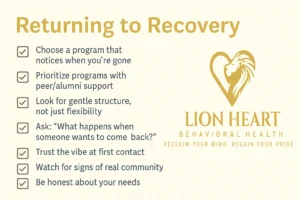
4. Ask: “What Happens When Someone Wants to Come Back?”
It’s one of the best questions you can ask.
Because let’s be honest: not every place makes it easy.
Some programs treat returns like reapplications. Some act cold or clinical, focused on paperwork and policy. And some—like ours—treat coming back as an act of courage, not a sign of failure.
What you want to hear is something like:
“We always welcome people back. No shame, no hard questions. We’ll meet you where you are.”
At Lion Heart, we know that stopping and starting again is part of how some people stay in recovery. You don’t have to have the perfect reason. You just have to reach out.
5. Trust the Vibe at First Contact
The moment you call or message a program, you’ll feel it: openness or obligation.
The intake team, the receptionist, the person who picks up the phone—that first interaction sets the tone. Do they sound like they’re trying to screen you or support you? Are they leading with rules or leading with care?
A program that really wants you back will sound like it. It’ll feel less like an interview, more like a porch light coming on.
We train our team in Raynham, MA to lead with this simple truth: If you’re reaching out, you’re worth responding to with care.
6. Watch for Signs of Real Community
Not every IOP builds real connection. Some focus only on the curriculum—and that can leave clients feeling like they’re just another case file.
Ask about what community means to them.
Do clients hang out after group? Do they check on each other during off days? Is there a sense that people actually know each other?
Programs that create meaningful connection often:
- Encourage group-led check-ins or chats
- Build rituals into group sessions (gratitude rounds, end-of-week reflections)
- Celebrate small wins, not just clinical milestones
The more human the program feels, the more likely it is to notice—and support—you when you’re slipping.
7. Be Honest About What You Need
This one’s on you—and it’s not about perfection. It’s about honesty.
If you’re someone who tends to drift when overwhelmed, tell them. If you’ve dropped out before, say so. A good IOP won’t hold that against you—in fact, it’ll help them support you better.
You deserve a space that can meet you where you are. But it helps if you show them where that is.
8. Know This: You’re Not the Only One Who’s Ghosted
It feels personal, right? Like you’re the one who couldn’t stick it out.
But the truth? So many people pause. So many people disappear, then reappear.
Ghosting treatment doesn’t mean you’re weak. It means something got too hard, too fast—or not safe enough to stay. The key isn’t to never ghost. The key is to find a place that makes it easier to come back.
Frequently Asked Questions
What is an Intensive Outpatient Program (IOP)?
An IOP is a structured, part-time treatment program for mental health or substance use issues. It usually involves several hours of group therapy and individual support each week—without requiring overnight stays.
Can I rejoin an IOP after dropping out?
Yes. Many programs, including Lion Heart, allow clients to return without judgment. Rejoining often involves a simple intake check-in and updated goals—not a restart from zero.
What if I ghosted and feel ashamed to come back?
That’s normal—and you’re not alone. The right IOP understands that recovery isn’t linear. Shame doesn’t disqualify you. You’re welcome back, just as you are.
Will I be treated differently for having left before?
You shouldn’t be. A compassionate program will treat your return as progress, not failure. If anything, returning shows your resilience.
What if I’m not sure I’m ready yet?
Then talk to someone. You don’t have to commit to a full schedule just to start the conversation. You can ask questions, feel it out, and move at your own pace.
The Door Is Still Open
If you’ve been thinking about trying again—if part of you wants to come back but isn’t sure you’re “allowed”—this is your sign.
You are welcome. No matter how long you’ve been gone. No matter how many false starts.
You don’t have to do this perfectly. You just have to not give up.
Call (774)238-5533 or visit our intensive outpatient program services in Raynham, Massachusetts to see how Lion Heart Behavioral Health can support your next step—on your terms, and in your time.