

When Going Back Feels Harder Than Starting
Your stomach drops just thinking about walking back into that room. The chairs, the faces, the fact that you left—it all feels heavier now.
It’s not just nerves. It’s the voice in your head whispering: “They’ll judge you. You messed up. You don’t belong anymore.”
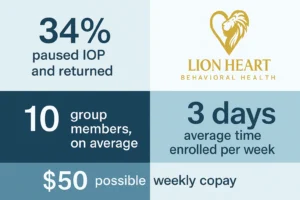
Here’s what we want you to know: you are not the only one who’s ever ghosted treatment. Many people pause, disappear, or step back at some point. And here’s the bigger truth: returning is not a punishment. It’s a form of strength. At Lion Heart Behavioral Health, our intensive outpatient treatment in Massachusetts is designed with that in mind—because healing rarely happens in a straight line.
Step 1: Name the Fear, Don’t Hide From It
Fear grows in silence. When you leave it unnamed, it multiplies in the dark.
Try saying it out loud, even if just to yourself:
- “I’m scared they’ll ask why I left.”
- “I’m scared everyone moved forward without me.”
- “I’m scared I’ll fail again.”
Naming your fear isn’t weakness. It’s honesty. And in group therapy, honesty lands better than perfection. If you walk in and say, “I was nervous to come back,” chances are someone will nod. They’ve been there.
Step 2: Remember—You’re Not the First to Leave and Return
Here’s something that doesn’t get said enough: ghosting treatment is common. People step away because of childcare, money, relapse, shame, scheduling, or just plain burnout.
It’s not a badge of failure. It’s part of being human. The people in your group? Many of them know what it’s like to start and stop. Most will meet your return with relief, not judgment, because your courage reminds them they can come back too if they ever need to.
Step 3: Reframe the Group as Practice, Not Performance
It’s easy to see group therapy like a stage. Everyone’s watching, waiting for you to perform. But group is more like a gym. You’re not expected to lift the heaviest weight on day one—or ever. You show up, practice, strengthen, and build. Some days you lift less. Some days you surprise yourself.
When you come back, you’re not “behind.” You’re simply resuming practice. And practice is always allowed.
Step 4: Use Small Re-Entry Points
You don’t have to run back at full speed. You can walk in gently.
- Call just to confirm the schedule.
- Email or text your therapist to test the waters.
- Ask if you can sit in on one group before committing to the full program.
Each of these is forward motion. Small steps are how most big comebacks actually happen.
Step 5: Anchor Yourself in Why You Started
Take a moment to remember why you enrolled in IOP in the first place.
Maybe it was because you wanted:
- A safe space to talk without judgment
- Structure when life felt unmanageable
- Accountability without losing all independence
- Connection instead of isolation
Those reasons didn’t disappear just because you left. They’re still there, waiting for you. Let them guide you back, even if fear is trying to hold the steering wheel.
Step 6: Lean on Staff to Break the Ice
You don’t have to walk in cold.
Tell a staff member: “I’m nervous to come back. Can you meet me at the door?” or “Can you check in with me before group?” That’s part of what we’re here for.
At Lion Heart, we never expect clients to re-enter flawlessly. We know the hardest part is the first step back. We’ll carry some of that weight with you.
Step 7: Treat the Return as Courage, Not Failure
Think about it: if you’d really “failed,” you wouldn’t even be reading this blog. You’d be checked out completely.
Walking back through the door isn’t evidence of failure. It’s proof that something inside you still wants more. And that “something” is worth honoring.
Every person in recovery understands how much courage it takes to keep showing up—especially after a pause. You may feel like you’re crawling back. From the outside, it looks like strength.
Quick Tips for Easing Back Into IOP
- Don’t over-explain. You don’t owe the group your full story right away.
- Sit near the exit if it makes you feel safer. Sometimes just knowing you can step out lowers the pressure.
- Plan a grounding ritual. Bring a notebook, fidget, or even a favorite pen to make the space feel more yours.
- Remind yourself: this is practice. You don’t need to be “good at therapy” to belong.
Why Group Therapy Still Matters in IOP
It’s tempting to think: “Maybe I’ll just do one-on-one therapy and skip the group.”
But group therapy is the heart of intensive outpatient treatment for a reason:
- You see yourself in other people’s stories.
- You learn things you’d never think to ask in private sessions.
- You experience belonging instead of just processing alone.
That sense of community? It’s one of the strongest predictors of recovery sticking.
FAQ: Coming Back to Intensive Outpatient Treatment
Will they be mad that I left?
No. Staff expect that people will step away sometimes. You won’t be scolded or punished.
Do I have to explain why I left?
Only if you want to. You can say, “I needed space,” and leave it at that.
What if I relapsed while I was gone?
You’re not disqualified from coming back. Relapse is part of many people’s stories, and treatment is exactly the place to process it safely.
Will the group treat me differently?
Probably not the way you fear. Most people will either welcome you back or quietly understand. Sometimes, someone may even share that your return gave them hope.
Can I return even if I didn’t finish before?
Yes. IOP isn’t a “one shot and you’re done” kind of program. It’s designed to be flexible. If you left mid-way, you can pick up again.
Taking the Next Step
If fear has kept you away, let this be your pause—and your pivot. You don’t need to have a speech prepared or a perfect plan. You just need the willingness to walk through the door. We’ll meet you there.
📞 Call (774) 341-4502 or visit our intensive outpatient program in Massachusetts to learn more about intensive outpatient treatment services at Lion Heart Behavioral Health in Raynham, MA. If you’re in New Bedford or anywhere in Bristol County, Lion Heart provides programs built on that same compassionate approach.”