

Loving someone who’s still struggling can stretch your heart in ways you never thought possible. If they’ve just entered a Partial Hospitalization Program in Massachusetts, it’s okay to hope—but it’s also okay to feel uncertain. You’re not alone in wondering what this actually means for your day-to-day life, your relationship, or their behavior.
You may be holding your breath. Waiting for things to get easier. Wondering if they’ll finally come back to themselves—or back to you. Here’s what you need to know about what changes you can expect during PHP, and what changes might take longer.
PHP Brings More Structure—But It’s Not 24/7 Care
Partial Hospitalization Programs (PHPs) provide intensive, daily treatment—but they aren’t inpatient programs. Your partner will likely attend care 5 to 6 days a week, usually for 4 to 6 hours each day. After programming, they come home.
This can be confusing at first. It’s easy to assume that once someone starts PHP, everything will start looking “normal” again. But healing doesn’t unfold in one clean motion. Structure is just the beginning—it offers a container where your partner can learn new skills, access therapy, and engage in behavioral health support. But the inner shifts happen gradually.
If you’re expecting them to emerge from their first week as a totally different person, you may feel disappointed or even resentful. That’s not your fault. It’s okay to want change—and it’s also okay to give it time.
You May See Small Shifts First—Not Grand Gestures
In the early days of treatment, changes are often subtle. You might notice your partner getting up earlier, showering more regularly, or keeping their phone out of reach during meals. These things may seem small—but they’re not.
We heard one client say, “She kept asking if I was ‘all better’ after my first week in PHP. I was just learning how to name what I was feeling.” That disconnect can create tension if expectations aren’t aligned.
What you may not see are the internal changes—sitting in group therapy and realizing they’re not the only one who shuts down when stressed. Learning how their trauma responses show up in your relationship. Starting to imagine a different way to live.
These changes might not show up in behavior right away, but they’re foundational. Let the small signs count.
Emotional Distance Might Stay for a While
Sometimes, partners expect emotional reconnection to happen as soon as treatment begins. After all, isn’t that the point? But the early phase of PHP can bring up more emotional distance before it brings closeness.
Many clients in PHP feel shame, grief, or confusion in the beginning. They may not know how to talk about what they’re uncovering in therapy. They might feel exposed—or overwhelmed. That doesn’t mean they’re disconnected from you. It means they’re reckoning with themselves.
This part is hard. It can make you feel left out or unseen. It’s okay to name that gently. Try something like, “I know this is hard for you. I just want you to know I’m here when you’re ready to talk.” You’re allowed to want connection without demanding it.
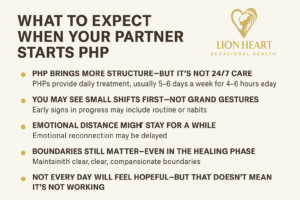
Boundaries Still Matter—Even in the Healing Phase
You don’t have to become your partner’s case manager just because they’re in treatment. In fact, one of the best things you can do is maintain clear, compassionate boundaries.
If they miss a session, that’s theirs to own. If they come home from group in a bad mood, it’s not your job to fix it. Love and accountability can live side by side.
This is also a chance to reconnect with your own support system. You might find comfort in joining a partner support group, journaling regularly, or speaking with a therapist. Your emotional life matters, too.
Not Every Day Will Feel Hopeful—But That Doesn’t Mean It’s Not Working
Some days your partner might seem energized and open. Other days, they may come home tired, short, or emotionally shut down. This is normal.
Healing is rarely linear. In fact, some of the most important breakthroughs come right after resistance. That moment when they say, “This group is stupid,” might be the prelude to a deeper truth rising up.
Try not to measure success by mood. Measure it by effort. By showing up, even when it’s hard. And by letting the process be messy.
You Can Have Hope Without Shouldering All the Pressure
You may have gotten used to being the one who holds everything together. The one who stays calm. Who scans their behavior, reads between the lines, and adjusts your mood to theirs.
That’s exhausting. And it’s not sustainable.
PHP is your partner’s program—but it’s also your chance to take a breath. To set down what isn’t yours to fix. To remember that their healing doesn’t have to depend on your sacrifice.
Hope doesn’t mean doing it all. It means believing that change is possible—even if it’s not yours to manage.
Recovery Isn’t a Performance—It’s a Practice
It can be tempting to watch your partner closely and ask, “Are they getting it?” “Are they really trying?” But that can turn into scorekeeping—and that’s painful for both of you.
Recovery is a practice. It’s showing up over and over, even on the days it doesn’t feel good. It’s learning to pause instead of react. It’s letting go of old patterns, one thread at a time.
At Lion Heart Behavioral Health, we remind clients—and their partners—that this work takes time. And that growth often looks ordinary before it looks transformative.
What You Might Notice in the First 30 Days
Every experience is different, but here are some common shifts partners often report seeing in the first month of PHP:
- More consistent daily routines (wake-up, meals, bedtime)
- Increased communication—sometimes raw, sometimes clumsy
- More engagement in family discussions or therapy (if offered)
- Periods of withdrawal followed by openness
- Hesitant accountability for past behavior
These are building blocks—not finish lines.
What Clients and Loved Ones Say
“It wasn’t dramatic—it was the little things. He started showing up on time. He stopped blaming me for everything.”
– Partner of a PHP client, 2023
“Group helped me realize I was holding onto a lot of guilt. I started writing letters I never planned to send. That helped me find the words for her.”
– PHP Client, 2024
FAQs About Partial Hospitalization Programs for Partners
What’s the difference between PHP and inpatient care?
PHP is a day treatment program—clients return home each evening. Inpatient care includes 24/7 supervision and residential stay.
Will I be involved in the program?
Sometimes, yes. Many PHPs include optional or recommended family sessions. You can ask about this directly when your partner enrolls.
What if they start missing sessions or slipping back into old behavior?
That’s not uncommon. The key is to respond without rescuing. If concerns come up, reach out to the treatment team rather than trying to manage it alone.
Can PHP help our relationship?
While PHP focuses on individual healing, many people report that as clients grow in self-awareness, their relationships improve. Some programs also offer couples or family support.
What should I do if I feel emotionally exhausted?
You’re allowed to seek support, too. Whether it’s therapy, a support group like Al-Anon, or trusted friends, your wellbeing matters.
How long does a PHP program last?
Most programs run for 3 to 6 weeks, depending on individual progress and needs. Some may transition to IOP (Intensive Outpatient) afterward.
When You’re Ready to Let Go—But Still Care
If you’re in love with someone who’s finally getting help, there’s nothing simple about that. It’s okay to feel hopeful and scared. Grateful and resentful. Still in love—but not willing to carry everything.
The start of a Partial Hospitalization Program might not fix everything—but it can open a door. To more clarity, more support, more possibility.
At Lion Heart Behavioral Health in Raynham, Massachusetts, we don’t just treat individuals—we support the whole system of love, pain, and healing around them. And we’re here when you’re ready.
Ready to Talk?
Call (774) 341-4502 or explore our PHP programs in Massachusetts to learn more about how Lion Heart Behavioral Health supports couples and families through the treatment process. If you’re near New Bedford, or Bristol County, Lion Heart offers the same compassionate, evidence-based approach to treatment.