
If you’ve been quietly wondering whether your drinking or substance use is starting to feel like a problem, you’re not alone—and you don’t have to figure it out on your own.
Many people in and around Raynham are asking the same question: Do I need help… and what kind of help would even work for me?
For those not in immediate crisis but not feeling okay either, a partial hospitalization program (PHP) can be the answer. It’s one of the fastest-growing options in addiction treatment—and for good reason. It offers real support and structure while still letting you live at home and stay connected to your life.
At Lion Heart Behavioral Health, we’re seeing more local residents choose PHP as their first step into healing. Here’s why this level of care is such a powerful option for people exploring treatment, especially those who aren’t sure they “need” it yet—but also aren’t fine.
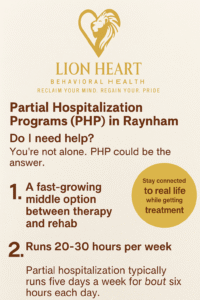
1. It’s a Middle Ground Between Rehab and Therapy
Most people think addiction treatment is all or nothing—you either check into a 30-day residential program or you’re stuck with once-a-week counseling. PHP is the often-missing middle step.
Partial hospitalization typically runs five days a week for about six hours each day. That time is filled with:
- Individual and group therapy
- Skills-based sessions (relapse prevention, stress management, emotional regulation)
- Access to psychiatric care and medication support
- Help identifying underlying patterns and triggers
Then you go home. You sleep in your own bed. You see your kids, your partner, your dog. You stay tethered to your real life.
PHP offers high-impact support without requiring you to pause everything. It’s designed for real people navigating real lives.
2. It Meets You in the “In-Between”
Maybe you’re not hitting rock bottom. Maybe you’re still going to work, paying bills, holding things together—on the outside. But inside, things feel foggy. Or heavy. Or harder than they used to be.
PHP is perfect for this emotional gray zone. It’s for people who are:
- Trying to cut back but can’t stick with it
- Feeling anxious, numb, or lost when not using
- Still “functioning,” but exhausted by it
- Curious about what life could feel like without substances
You don’t have to be certain. You just have to be curious. PHP is where people figure things out—without being pushed, labeled, or forced into a box.
3. It’s Local and Accessible in Raynham
For folks in Southeastern Massachusetts, traveling long distances or entering an out-of-state program just isn’t practical. We get it.
That’s why Lion Heart Behavioral Health is proud to offer PHP right here in Raynham. We serve clients from:
- Raynham
- Taunton
- Bridgewater
- Easton
- Middleboro and surrounding areas
You don’t have to uproot your life or wait on a big-city facility. PHP at Lion Heart is designed to be accessible, grounded, and truly connected to the community.
4. It’s Structured but Human
Some people imagine treatment as sterile, rigid, or full of judgment. That’s not what you’ll find here.
Our PHP is:
- Supportive, not shaming. We meet you where you are.
- Flexible, not forced. You’ll be part of building your treatment plan.
- Respectful. We don’t talk down to you—we talk with you.
- Trauma-informed. We recognize that substance use often comes from deeper pain.
Our clients often say it’s the first time they’ve felt truly safe in a clinical setting. The goal isn’t to control you—it’s to support you in reconnecting with yourself.
You don’t have to prove you’re “bad enough” to deserve help. Wanting things to feel better is reason enough.
5. It Opens the Door to Long-Term Healing
PHP isn’t a finish line—it’s a launchpad.
Most clients spend a few weeks in PHP, then step down into intensive outpatient (IOP) or individual therapy. Some continue with medication-assisted treatment (MAT). Others return to work or family life with new clarity and skills.
We help you figure out what makes sense—not based on a one-size-fits-all approach, but based on who you are and what you need.
Healing doesn’t always happen in one big leap. Sometimes, it starts with one honest step. PHP can be that step.
Frequently Asked Questions (FAQs)
Is a partial hospitalization program the same as inpatient rehab?
No. In PHP, you attend treatment during the day but return home at night. Inpatient rehab requires overnight stays. PHP is more flexible and often a better fit for people who are stable but still need structured support.
How long is a typical PHP?
Most people attend PHP for 2–4 weeks, depending on their needs. It’s not a forever commitment—it’s a short-term, high-support way to stabilize and build momentum.
Can I work or take care of family while in PHP?
Many clients adjust their schedules while in PHP, but it is possible to work part-time or manage caregiving responsibilities with support. We’ll help you plan realistically.
Is this only for people with severe addiction?
Not at all. PHP is ideal for people exploring their relationship with substances, especially if they’re trying to catch the issue before it escalates. You don’t have to wait for disaster.
How do I know if PHP is right for me?
If you’re feeling stuck, curious, or quietly not-okay—let’s talk. We’ll help you explore what you need, even if it turns out to be something different than PHP. There’s no pressure.
Thinking About Taking the First Step?
Call (774)238-5533 to speak with our team at Lion Heart Behavioral Health. We’re here to answer your questions, walk through what PHP involves, and help you figure out if it’s the right starting point for you or someone you care about.