
Introduction: Just Because You’re Managing Doesn’t Mean You’re Okay
You’ve got the job. The calendar. The checklists. People depend on you. To everyone else, you’ve got it all together. But privately, alcohol has crept into your life in ways you can’t ignore anymore.
Maybe it’s not every night, but it’s most nights. Maybe you tell yourself it’s to “wind down” or “treat yourself”—but deep down, you wonder if it’s become something more. If you’ve ever thought, “I don’t think I’m an alcoholic… but I don’t feel in control either,” this is for you.
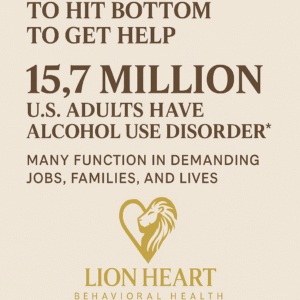
At Lion Heart Behavioral Health, we work with high-performing people who never thought they’d need help with alcohol. Our message is simple: you don’t need to hit bottom to get better. You just need to listen to what your life is trying to tell you.
If that sounds like you, it may be time to explore alcohol treatment programs in Massachusetts that are designed for professionals who appear “fine” on the outside but are struggling internally. You’re not alone—and real help is available.
Let’s start with the signs.
Section 1: The Quiet Signs You Might Need Alcohol Addiction Treatment
Not all warning signs look like DUIs or job loss. In fact, high-functioning drinking often hides behind success. Here are subtle—but serious—signs it might be time to explore treatment:
- You make promises to “cut back,” but they don’t stick.
- You avoid social plans that don’t involve alcohol.
- You drink alone more than you used to—and don’t talk about it.
- You’ve begun hiding how much you drink (or how early you start).
- You feel anxious or irritable when you can’t drink.
- You’ve had a few too many “close calls” (driving, blacking out, saying something you regret).
- You often feel tired, foggy, or emotionally flat the next day—even if you technically function.
- You’ve stopped asking whether you’ll drink—and now ask only how much.
- You’ve Googled “how to know if I need alcohol treatment” or “am I an alcoholic?”
Reality Check: If you said yes to even a few of these, it’s not about being broken. It’s about being brave enough to be honest.
Section 2: Why High-Functioning Alcohol Use Is Still Harmful
One of the most dangerous myths in addiction is the idea that if you’re still succeeding on the surface, you must be okay. But here’s the truth:
- Functioning ≠ thriving. You can manage life while still silently suffering.
- Alcohol is a slow eroder. It numbs not just pain, but joy, creativity, intimacy, and motivation.
- Health doesn’t wait. Even moderate but consistent alcohol use impacts your liver, heart, immune system, and brain.
- Emotional distance builds. Alcohol distances you from your own feelings—and from others.
- It only gets harder to stop. The longer the cycle continues, the more ingrained it becomes physically and neurologically.
In short: “keeping it together” isn’t the same as being well. Many high-functioning individuals don’t realize the cost of their drinking until the damage has quietly accumulated.
But the good news? Awareness is a sign of readiness. And there is a way forward.
Section 3: What Real Alcohol Addiction Treatment Looks Like (And What It Doesn’t)
Forget the one-size-fits-all picture of rehab. Modern treatment is flexible, personalized, and often outpatient. At Lion Heart, we understand that high-functioning individuals need options that respect their time, privacy, and life responsibilities.
Here’s what alcohol addiction treatment can actually look like:
- Outpatient Programs (OP): Attend therapy a few hours a week while maintaining work and home life.
- Intensive Outpatient Programs (IOP): More structure—multiple sessions per week—ideal for those needing deeper support.
- Partial Hospitalization (PHP): Daytime care with evenings at home. A great option for individuals needing stabilization without full residential stay.
- Individual & Group Therapy: Work on the “why” behind the drinking—trauma, stress, anxiety, grief, perfectionism.
- Medication-Assisted Treatment (MAT): Non-judgmental medical support to help regulate cravings and brain chemistry.
- Family Counseling: Because relationships often suffer in silence, even when addiction is well-hidden.
- Aftercare & Alumni Support: Ongoing accountability after your initial treatment phase ends.
You don’t have to quit your job or vanish for 30 days. You just need a plan that meets you where you are—and helps you get where you want to go.
Section 4: What to Do If You’re Not “Ready” (Yet)
Many high-functioning individuals delay treatment because they think it means making a dramatic, public declaration of their problem. That’s not how it works. Here’s what you can do today—even if you’re still unsure:
- Track your drinking (honestly) for 7 days. You might be surprised at the total.
- Journal about how alcohol fits into your daily stress cycle. Ask: what am I actually seeking when I reach for it?
- Have one conversation. With a therapist, a trusted friend, or someone who’s been there. Speaking it out loud can reduce the shame.
- Take a break. Try a week without alcohol. Not to prove anything—but to notice what feelings or challenges show up.
- Schedule a confidential consult. You don’t have to decide anything today. Just start the conversation with someone who gets it.
If you’re thinking about change, you’re already beginning it. That’s how recovery starts—not with declarations, but with decisions.
Section 5: Permission to Want More
Maybe you haven’t hit a dramatic low. But maybe you’re tired of the dull ache that follows drinking. The lack of energy. The quiet disconnect in your relationships. The cycle of regret and reset.
Maybe you’ve started to wonder:
- What would my mornings feel like without this?
- What could I create if I wasn’t managing this cycle?
- What would life be like if I didn’t feel ashamed of something so private?
You are allowed to want a life with more presence, joy, rest, and peace. And you don’t have to figure it out alone.
At Lion Heart Behavioral Health, we don’t just help you stop drinking—we help you start living. With clinical care, peer connection, and judgment-free compassion, we walk with you through the entire process.
Let’s Have a Quiet, Honest Conversation
No pressure. No commitment. Just one honest conversation that could shift your entire trajectory.
Call Lion Heart Behavioral Health at (774) 341-4502 or Contact Us.
Frequently Asked Questions (FAQs)
Q: Can I really be addicted to alcohol if I’m successful and in control of my life?
Yes. High-functioning addiction is more common than most people realize. Success doesn’t cancel out struggle.
Q: Will I have to stop drinking forever?
That depends on your goals and your unique treatment plan. Some people aim for abstinence, others start with harm reduction. We’ll help you find the approach that works for you.
Q: What if no one else thinks I have a problem?
Addiction doesn’t need validation from others to be real. If you feel concerned, that’s enough to take a closer look.
Q: Is outpatient treatment effective for high-functioning people?
Absolutely. Many clients benefit from structured outpatient care that allows them to maintain their careers and families while healing.
Q: What happens if I call? Is it confidential?
Yes. Every conversation is 100% private. We’re here to support—not pressure—you.